
How probiotics support healthier skin: A clear guide


Most people associate probiotics with digestive health. But growing evidence shows they also influence your skin in measurable, meaningful ways. Probiotics improve skin through the microbiome, inflammation pathways, and barrier function, working both from within and on the surface. A 2026 systematic review found roughly a 45% reduction in total acne lesions with probiotic use. That’s not a small number. This guide explains how probiotics work for skin, what the clinical data actually shows, why results vary so widely, and how you can use them effectively as part of a natural skin care routine.
Table of Contents
Key Takeaways
Point | Details |
Mechanisms matter | Probiotics help skin by modulating the microbiome, inflammation, and barrier function. |
Clinical data shows promise | Probiotics can reduce acne lesions by over 45% in some studies, with good safety profiles. |
Personalization is key | Effectiveness depends on the strain, formulation, and your specific skin concern. |
Adjunctive use recommended | Probiotics should complement, not replace, traditional skin care therapies for best results. |
How probiotics influence skin health
Now that you understand probiotics aren’t just a gut remedy, let’s explore exactly how they affect skin health.
Probiotics are live microorganisms that, when consumed or applied in adequate amounts, provide a health benefit to the host. For skin specifically, they operate through two distinct pathways: systemic (oral) and local (topical). Understanding this difference is the foundation of using them well.
Oral probiotics work from the inside out. When you swallow a probiotic capsule or eat fermented foods, beneficial bacteria colonize your gut and interact with your immune system. This triggers a chain of responses that travel far beyond the digestive tract. The gut produces anti-inflammatory signals, regulates immune cell activity, and can influence how your skin responds to inflammation, pathogens, and environmental stress. This pathway is often called the gut-skin axis, a term used to describe the direct communication network between gut bacteria and skin cells.
Topical probiotics take a different approach. Applied directly to the skin surface, they work by interacting with the cutaneous (skin-surface) microbiota. Your skin hosts trillions of microorganisms, and imbalances in this community, known as dysbiosis, are linked to conditions like acne, eczema, and rosacea. Topical probiotics may help restore balance, reduce colonization of harmful bacteria like Cutibacterium acnes, and support local immune responses. Oral probiotics for skin work differently than topical ones, and knowing the distinction helps you choose the right approach for your goal.
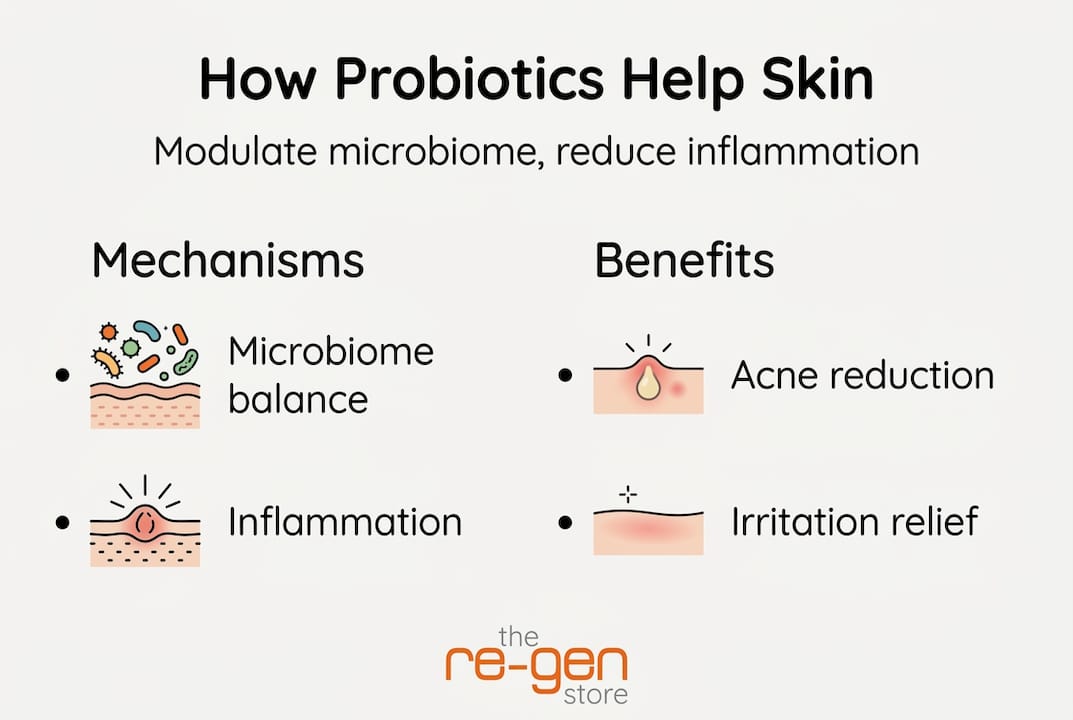
Research confirms this distinction clearly. Oral probiotics primarily act through gut-skin immune modulation, while topical preparations directly target the cutaneous microbiota and local inflammation. That means matching the delivery method to your skin concern matters more than simply picking “a probiotic.”
Here are the key skin benefits researchers have identified:
Strengthened skin barrier: Probiotics stimulate the production of ceramides and other lipids that form your skin’s protective outer layer. A stronger barrier means less water loss, less sensitivity, and better defense against irritants.
Reduced inflammation: Certain probiotic strains lower levels of pro-inflammatory cytokines (immune signaling molecules) in the skin, which can calm redness, swelling, and irritation.
Balanced skin microbiome: By competing with harmful bacteria for nutrients and space, probiotics help maintain a healthy microbial community on the skin surface.
Improved immune tolerance: Through the gut-skin axis, probiotics can help train the immune system to respond less aggressively to harmless triggers, which is relevant for conditions like eczema.
“The cutaneous microbiome is not a passive bystander. It actively participates in skin immunity, barrier maintenance, and inflammatory signaling.”
Pro Tip: If you’re dealing with a surface-level concern like mild acne or redness, a topical probiotic formulation may act faster. For systemic concerns like chronic inflammation or stress-related breakouts, oral supplementation may provide longer-lasting support by working through the gut-skin axis.
For those interested in soothing skin irritation naturally, understanding how probiotics reduce cutaneous inflammation is a useful starting point before choosing any product.
Clinical evidence: What the research says about probiotics for skin concerns
Having covered how probiotics work, let’s look at what the science reveals about their real-world effectiveness for common skin concerns.
The research base for probiotics in skin care has grown substantially in recent years. Most clinical data focuses on two conditions: acne and atopic dermatitis (eczema). The results are encouraging for some strains and less clear for others.
Acne
Acne data is the most compelling. A 2026 systematic review reported a favorable safety profile and roughly 45% reduction in total acne lesions for participants using probiotics. That’s a clinically meaningful outcome. Separately, a 2025 meta-analysis examining oral probiotic use found improved acne severity scores and better skin hydration after 12 weeks of use, with no major adverse effects recorded across the included trials.
These numbers are notable because acne treatment usually involves antibiotics, which carry their own risks including antibiotic resistance and disruption of the gut microbiome. Probiotics offer a different mechanism without those downsides.
Atopic dermatitis (eczema)
Results here are more mixed. A 2026 pilot study found no significant efficacy for a Lactobacillus lactis lysate cream in atopic dermatitis patients. While this might seem discouraging, it points to something important: the strain used matters enormously. A strain effective for acne may have zero effect on eczema, and vice versa.
Skin condition | Probiotic route | Key finding | Evidence quality |
Acne | Oral | ~45% reduction in lesion count | Systematic review (2026) |
Acne | Topical | Reduced C. acnes colonization | Moderate |
Atopic dermatitis | Oral | Some strains improve SCORAD scores | Mixed |
Atopic dermatitis | Topical | No significant effect (one strain) | Pilot trial (2026) |
Skin hydration | Oral | Improved after 12 weeks | Meta-analysis (2025) |
Key limitations to understand:
Most trials are short. Twelve weeks is the typical study window, which may not capture long-term effects or optimal dosing timelines.
Strain heterogeneity is high. Comparing results across studies using different strains is like comparing outcomes of two completely different medications.
Formulation varies. Viability of live bacteria in topical products is a real challenge. Dead bacteria (postbiotics) and bacterial extracts (lysates) behave differently than live strains.
Dosing is inconsistent. Most studies use varying colony-forming unit (CFU) counts, making direct comparisons difficult.
Despite these limitations, the probiotic safety for skin profile remains favorable across most published studies. This is reassuring for health-conscious individuals who want a low-risk addition to their skin care approach.
When you compare probiotics to conventional options, it’s worth reviewing a wound healing comparison with traditional antibiotic ointments to see how natural approaches stack up. And for those already exploring natural alternatives for skin healing, probiotics represent one piece of a larger strategy.
Statistic callout: A 2026 systematic review found probiotics produced approximately 45% fewer total acne lesions compared to control groups, with a favorable safety profile in all included trials.
Strain, formulation, and condition: Why results vary
With research supporting some benefits but not others, it’s essential to understand why not all probiotics deliver the same results for every skin issue.
This is where most guides fall short. People read a headline about probiotics improving acne, buy a random probiotic supplement, and wonder why nothing changes after a month. The answer almost always comes down to three factors: strain, formulation, and skin condition.
Why strain selection is critical
Different probiotic strains do different things. Lactobacillus rhamnosus has shown benefits for immune modulation and eczema prevention in some infant studies. Lactobacillus acidophilus may help reduce acne-causing bacteria. Bifidobacterium longum has anti-inflammatory properties relevant to sensitive or reactive skin. These are not interchangeable. Efficacy depends strongly on the specific strain and formulation used, as well as the skin condition being targeted.
Think of it like antibiotics. You wouldn’t use a penicillin-based antibiotic for a fungal infection. Similarly, reaching for the cheapest multi-strain supplement and expecting it to solve your skin concerns is rarely going to work.
The formulation problem
Even when the right strain is selected, how it’s delivered matters. A topical probiotic needs to maintain live bacteria long enough to interact with the skin’s surface. Many commercial products fail this test because bacteria die during manufacturing, storage, or exposure to preservatives. Postbiotics (metabolites produced by bacteria) and lysates (broken bacterial cells) may actually be more stable and still biologically active, which is why some researchers are shifting focus toward these alternatives.
Factor | What to look for | Why it matters |
Strain specificity | Named strain (e.g., L. rhamnosus GG) | Different strains produce different outcomes |
Live vs. lysate | Product type disclosed | Live strains require careful storage; lysates may be more stable |
CFU count | At least 1 billion CFU for oral use | Determines colonization potential |
Preservatives | Minimal or probiotic-compatible | Some preservatives kill live bacteria |
Product format | Serum, cream, capsule | Affects absorption and contact time |
Matching probiotic to skin concern
Acne: Look for L. acidophilus or L. rhamnosus in oral formats, or topical formulations targeting C. acnes specifically.
Eczema: Evidence supports certain oral strains for inflammatory modulation, but topical use remains investigational.
Dry or sensitive skin: Barrier-supporting strains that increase ceramide production may help; look for products that combine probiotics with skin-barrier ingredients.
Rosacea: Emerging research, limited evidence; anti-inflammatory strains show early promise.
Pro Tip: Before buying a probiotic skin product, look for the full strain name on the label, not just the genus (e.g., “Lactobacillus”). The strain name, like L. rhamnosus GG, is what the research is actually based on.
Comparing approaches like petroleum jelly vs probiotics for skin healing can also help you understand where probiotics fit relative to other topical strategies. For those exploring probiotics after surgery), strain-specific selection becomes even more important in recovery contexts.
Best practices: How to use probiotics for skin care effectively
Understanding when and how probiotics work best, let’s focus on practical strategies you can start using to support skin health.
Probiotics are not a magic switch. They work best when used thoughtfully, consistently, and alongside other evidence-based skin care habits. Here’s how to approach them effectively.
Step-by-step guide for adding probiotics to your routine:
Define your skin concern clearly. Are you dealing with acne, eczema, dryness, or general inflammation? This determines whether oral, topical, or a combination approach makes more sense.
Choose a product with a named strain. Avoid vague labels. Look for the full bacterial species and strain designation on the packaging.
Start with one variable. Introduce one probiotic product at a time so you can track what’s working. Adding three new products at once makes it impossible to know what’s responsible for any change.
Commit to at least 12 weeks. Clinical improvements for acne were observed after 12 weeks of consistent use. Shorter trials often show no effect, even for products that do work over time.
Monitor your skin’s response. Keep a simple log. Note changes in texture, breakouts, redness, or moisture levels weekly. This helps you spot both improvements and reactions early.
Pair with foundational skin care. Probiotics work best alongside good hydration, sun protection, a gentle cleanser, and a diet low in inflammatory triggers.
“Probiotics in skincare are best viewed as adjunctive or targeted-microbiome strategies rather than replacements for established dermatologic therapies.”
Common misconceptions to avoid:
“More strains means better results.” Multi-strain products sound impressive, but there’s no evidence that combining ten strains outperforms a single well-studied one. Precision beats quantity.
“If it’s natural, I can use as much as I want.” Even beneficial bacteria can irritate compromised or highly sensitive skin. Start with lower concentrations and assess your skin’s tolerance.
“I’ll feel results in a week.” Realistic expectations matter. The gut-skin axis takes time to respond. Surface-level topical effects may come sooner, but systemic benefits build gradually.
“All fermented foods equal all probiotic supplements.” Yogurt and kimchi contain live cultures, but not necessarily the strains studied in clinical trials. Food sources are beneficial for general gut health, but targeted skin concerns often need supplemental doses.
For additional tips for soothing skin alongside your probiotic routine, exploring plant-based topical options can be a smart complement to the strategies above.
Why probiotic skin care works and where most guides get it wrong
Having learned best practices, here’s a perspective most resources overlook about making probiotics work for your skin.
The probiotic skin care conversation has a clarity problem. Brands use the word “probiotic” as a marketing label, attaching it to products that contain dead bacteria, vague ingredient blends, or concentrations too low to have any effect. Meanwhile, readers come away thinking probiotics don’t work, when the reality is that the wrong probiotic was used for the wrong purpose.
The evidence base is genuinely promising but remains heterogeneous in strains, doses, and durations, and researchers are calling for larger, standardized trials before broad clinical recommendations can be made. That’s not a dismissal of the category. It’s an honest acknowledgment that precision matters.
The most common mistake we see health-conscious people make is treating “probiotic” as a single thing. It’s not. It’s a category of thousands of organisms with vastly different behaviors. Selecting a product based on a specific, studied strain for your specific skin concern is the approach that actually produces results. Think of probiotics as targeted tools within a broader skin recovery strategy, not as standalone solutions. Reviewing case studies of probiotic ointments against conventional treatments can help ground expectations in real-world outcomes.
Explore natural skin solutions with The Re-gen Store
Ready to apply what you’ve learned? Here are some natural solutions designed to support healthy skin and microbiome balance.
At The Re-gen Store, we believe in supporting your skin’s natural recovery processes using plant-based, chemical-free formulations. Our plant-based regenerative ointment is designed to work with your skin rather than against it, making it a natural complement to a probiotic-informed skin care approach.
If you’re moving away from petroleum-based products, our petroleum-free wound treatment offers a clean, effective alternative. For a broader look at our full range of natural skin recovery products, explore our catalog and find what fits your skin health goals. Supporting your skin starts with the right ingredients.
Frequently asked questions
Are probiotics safe for all skin types?
Clinical studies report favorable safety in acne trials and topical applications, but tolerability can vary depending on your specific strain and formulation choice.
Can probiotics replace traditional skin treatments?
Probiotics are best used as adjuncts. Probiotics should be adjunctive to established dermatologic therapies, not direct replacements, given the variability in results across strains and conditions.
How long does it take to see skin benefits from probiotics?
Most clinical improvements are observed after consistent use over 12 weeks. Oral probiotics for acne showed meaningful improvements in severity scores at the 12-week mark in recent meta-analyses.
Do all probiotic skin care products work the same?
No. Efficacy depends strongly on the strain, formulation, and the specific skin condition being targeted, which is why reading labels and selecting strain-specific products matters.
Recommended
How to Soothe Skin Irritation and Support Healing Naturally | The Re-gen Store
Supporting Faster Healing After Surgery (Naturally) | The Re-gen Store
How to Treat Diaper Rash Naturally (And Help Skin Heal Faster) | The Re-gen Store
Re-gen vs Petroleum Jelly: Which Helps Skin Heal Faster? | The Re-gen Store
Comments