
48–72 Hour Rule for Capsaicin Cream Burning
- Sunny

- 1 day ago
- 9 min read
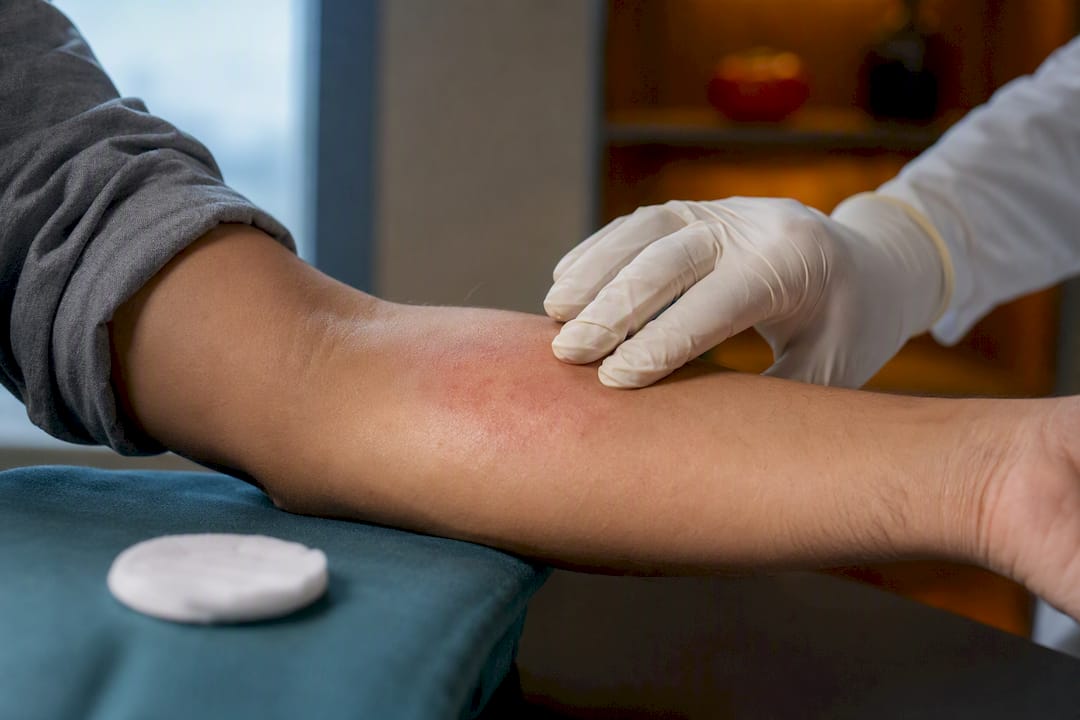
Mild-to-moderate burning happens to many people who use topical capsaicin, and it’s usually temporary. If the sensation feels intense, stop applying the product, wipe off any excess, and wash the area with lukewarm water and mild soap. Seek medical attention right away for blistering, spreading redness, or any contact with your eyes or mouth.
TL;DR:
Burning from capsaicin usually peaks within minutes and can last up to two to four weeks, depending on concentration and skin sensitivity.
Higher-strength products and damaged or inflamed skin tend to produce longer, more intense burning sensations than standard over-the-counter creams.
Stopping and restarting capsaicin re-sensitizes nerves, causing the burning sensation to return near its original intensity after a break.
Applying cool compresses, washing with lukewarm water, avoiding heat, and using dairy-based rinses can help alleviate immediate burning.
Serious signs like blistering, spreading redness, or pain out of proportion require medical evaluation to rule out tissue damage or allergic reactions.
Table of Contents
Why Capsaicin Cream Causes a Burning Sensation
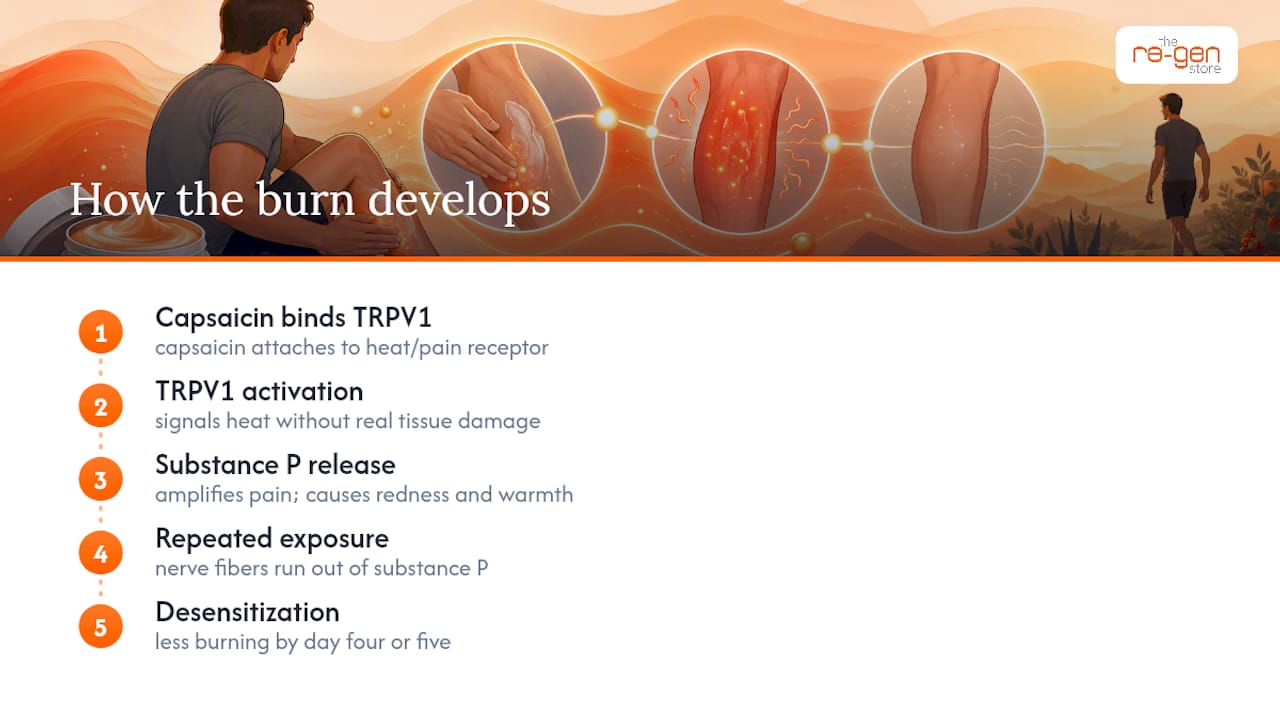
The burn you feel is real, but it isn’t tissue damage. Capsaicin binds to a receptor called TRPV1, a heat and pain sensor sitting on nerve endings in your skin. TRPV1 normally fires when your skin actually gets hot. Capsaicin tricks it into firing anyway, so your brain registers heat and burning even though nothing is scorching your skin.
That receptor activation triggers a cascade. Nerve fibers release a chemical messenger called substance P, which amplifies the pain signal and can cause the redness and warmth you see at the application site. It’s an odd irony: the same chemical that makes you flinch is also the reason capsaicin eventually works. With repeated exposure, those nerve fibers run out of substance P faster than they can restock it. Clinicians describe this as desensitization, and it’s the entire premise behind using capsaicin for chronic pain relief in the first place. The burning that greets you on day one is often quieter by day four or five, precisely because those nerves are running low on ammunition.
Here’s the distinction that matters most: TRPV1 activation is a sensory event, not an injury. Genuine skin damage, whether from a chemical burn or an allergic reaction, involves actual tissue breakdown. That looks different from ordinary capsaicin burn. Blistering, oozing, or skin that looks raw signals something beyond the expected pharmacological response, and it points toward irritant or allergic contact dermatitis rather than the burn you’d expect from the drug doing its job. One produces discomfort. The other produces damage. Confusing the two leads people to either panic over normal side effects or ignore signs of real harm.
How Long the Burning Typically Lasts
Most people feel stinging within minutes of application, and that sensation usually peaks early before starting to fade. According to Mayo Clinic, burning at the application site diminishes for most users after the first several days, with full resolution sometimes taking up to two to four weeks depending on the formulation.
Several variables stretch or shrink that window. Higher-concentration products burn longer and harder than standard over-the-counter creams, which usually have low concentrations. Prescription-strength patches behave differently than creams too, often producing more intense application-site pain because of how much capsaicin they deliver and how long they stay in contact with skin. Sensitive skin, broken skin, or skin that’s already inflamed from another condition will also burn more and longer than intact, tolerant skin.
One counterintuitive detail: stopping and restarting capsaicin resets the clock. Nerve endings that had been desensitized regenerate their substance P supply during a break, so the burning often returns at close to its original intensity when you pick the product back up.
Step-by-Step Actions to Reduce Burning Right Now
If capsaicin cream is burning more than you expected, work through these steps in order.
Stop applying and remove excess product. Use a mild, grease-cutting soap and lukewarm water, not hot water, to wash the treated area.
Apply a cool compress. A clean cloth soaked in cool (not ice-cold) water calms the skin and can take the edge off the sting within minutes.
Try milk or a dairy-based rinse if you have it on hand. Some clinical guides note that the fat in milk can help lift capsaicin’s oils from skin better than water alone, though this is a home remedy rather than a clinically proven treatment.
Stay away from heat. Skip hot showers, saunas, heating pads, and vigorous exercise until the burning settles, since sweat and warmth intensify the sensation.
Consider an oral pain reliever. Acetaminophen or ibuprofen, taken as directed on the label, can dull the discomfort while your skin settles down.
Use over-the-counter 1% hydrocortisone sparingly if irritation looks like dermatitis. This applies to localized redness and itching, not open or broken skin, and isn’t a substitute for calling a doctor if things worsen.
Wash your hands thoroughly after every step. Capsaicin residue under your fingernails is how it ends up in your eyes hours later.
Flush immediately with water if any product reaches your eyes, mouth, or nose. Seek emergency care if pain or vision changes don’t ease up quickly, since mucous membrane exposure is a different, more urgent situation than skin-level burning.
Pro Tip: Keep a small container of whole milk or a fatty lotion near your application spot for the first week of a new capsaicin routine. If the burning spikes unexpectedly, you’ll have relief within arm’s reach instead of scrambling to the sink.
Common Mistakes That Make the Burning Worse
A surprising number of people accidentally intensify their own discomfort trying to fix it. Avoid these:
Taking a hot bath or applying a heating pad to the treated area, which ramps up blood flow and the burning sensation together.
Wrapping the area in a tight bandage or occlusive dressing, which traps capsaicin against the skin instead of letting it dissipate.
Reaching for rubbing alcohol, essential oils, or greasy ointments like petroleum jelly, all of which can spread capsaicin’s oils further or trap them against skin rather than removing them.
Scrubbing or rubbing the skin raw in an attempt to wipe the burning away, which damages skin that’s already sensitized.
Applying capsaicin to broken, cut, or already-irritated skin, which invites deeper absorption and a harsher reaction.
Trying homemade “neutralizers” you found online. Baking soda pastes and vinegar rinses aren’t backed by clinical evidence and can trigger their own irritation on top of the capsaicin.
When Burning Signals a Real Problem
Ordinary capsaicin burn is uncomfortable but self-limited. A handful of signs mean you’ve crossed from expected side effect into something that needs medical attention.
Watch for blistering, skin that looks raw or weeping, swelling that spreads beyond the application site, or pain that feels disproportionate to a topical cream. Fever, chills, or difficulty breathing after applying a topical product are not typical capsaicin reactions and warrant prompt evaluation. Eye pain or vision changes that don’t resolve quickly after flushing also belong in this category.
Timing matters too. Mild burning that hasn’t budged, or has actually worsened, after 48 to 72 hours is a signal to stop self-treating and get it looked at. MedlinePlus is direct on this point: stop use and call your doctor if severe burning or other serious irritation develops.
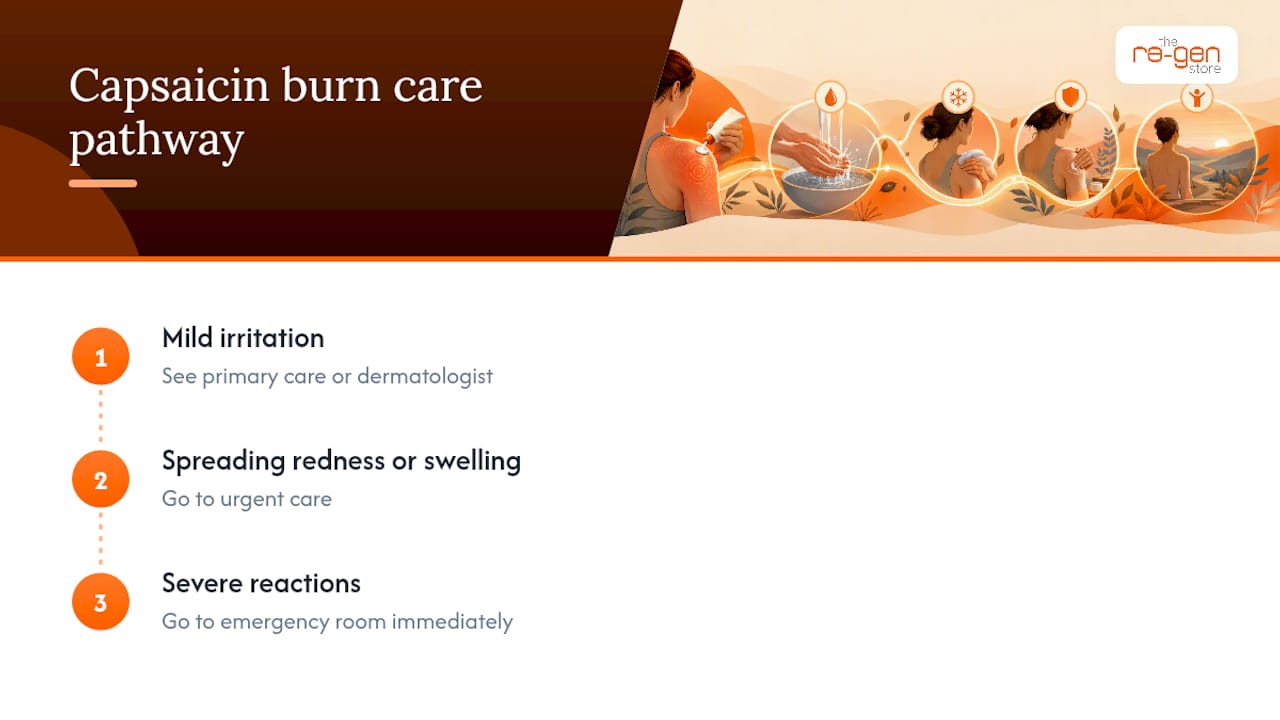
For matching care to severity: skin that’s simply slow to calm down is a conversation for your primary care provider or a dermatologist. Spreading redness, significant swelling, or signs of infection call for urgent care. Difficulty breathing, facial swelling, or a burn that looks deep and blistered belongs in the emergency room. Rare but documented case reports of second-degree chemical burns from high-concentration capsaicin exposure confirm that while uncommon, real tissue injury is possible, particularly with prescription-strength patches or product misuse.
How to Apply Capsaicin Safely and Cut Down on Future Burning
Most burning complaints trace back to how the product was used, not bad luck. A few adjustments up front go a long way.
Match the concentration to your tolerance and condition. Start with a lower-strength, over-the-counter formulation before considering a high-potency prescription patch, and never step up strength without medical guidance.
Use gloves or an applicator. Bare fingers spread capsaicin to your eyes, nose, and other sensitive areas far more often than people expect.
Rub the cream in fully, then wash your hands. If you’re treating your hands themselves, dermatology guidance suggests waiting at least 30 minutes before washing to let the product absorb, unless burning becomes severe enough that removal takes priority.
Apply on a consistent daily schedule rather than sporadically. Desensitization depends on steady substance P depletion. Skipping days and restarting resets the burning cycle each time.
Avoid heat and sweating in the hour or two after application. That includes hot showers, workouts, and heavy blankets.
Store the tube away from children and pets, and never apply near bandages, wounds, or areas of broken skin.
Pro Tip: If you’re starting capsaicin cream for arthritis pain, apply it in the evening rather than the morning. You’ll sleep through the peak burning window instead of trying to work or drive through it.
Our Approach to Skin Recovery After Irritation
The company offers plant-based, petroleum-free ointments designed to support skin recovery once the acute phase of an irritation has passed. That perspective shapes how we think about capsaicin burning too: the goal during an active flare is calming the skin down and following the medical steps above, and the goal afterward is helping skin that’s been through some stress recover its normal texture and resilience.
If you’ve dealt with capsaicin irritation before, you already know the aftermath sometimes leaves skin feeling dry, tender, or reactive for a day or two. That’s a similar recovery window to what we cover in our guides on treating chemical burns and supporting sunburned or heat-irritated skin, where the emphasis is on gentle, non-occlusive care rather than harsh chemical intervention. Nothing here replaces the medical steps for active capsaicin burning. It’s about what comes next, once the fire has actually gone out.
What the Research Actually Supports
The safest way to think about capsaicin cream is that burning is the mechanism, not the malfunction. Most people who quit a capsaicin regimen after three days do it because the sting scared them, not because anything went wrong. That’s a shame, because the sensation that made them stop is often the same process working toward the relief they wanted in the first place.
Where conventional advice falls short is nuance. A lot of product labeling treats “may cause burning” as a throwaway warning, when in reality the intensity, duration, and what counts as normal versus alarming deserves more than a single line of fine print. People deserve to know the difference between a receptor doing its job and skin that’s actually injured.
If you take one thing from this, prioritize consistency over intensity. Daily, correctly dosed use beats sporadic high-dose attempts at pushing through the burn faster. Confusing “more painful” with “more effective” is the most common and most avoidable mistake in how people use this ingredient.
— Kyle
A Gentler Next Step Once the Burning Settles
Capsaicin cream isn’t something Re-gen is designed to neutralize, and we won’t pretend otherwise. Once you’ve followed the safety steps above and the acute burning has calmed down, though, skin often benefits from something gentle to support its recovery.

This ointment is plant-based and petroleum-free, formulated to support skin recovery without synthetic fragrances or occlusive petroleum bases that can trap heat and irritation against the skin. It’s not a fix for active capsaicin burning. It’s a next step for skin that’s been through a rough patch and needs support getting back to normal, whether that’s after a capsaicin flare, a minor cut, or general skin irritation. If that sounds like where you are right now, take a look at the Re-gen plant-based ointment and its usage guidance to see whether it fits into your recovery routine.
This article is general information, not a substitute for advice from a qualified doctor. Consult a qualified healthcare professional about your own circumstances before acting on anything here.
Sources
FAQ
How do you stop capsaicin cream from burning?
Wash the area with lukewarm water and mild soap to remove excess product, then apply a cool compress. Avoid heat, hot water, and vigorous activity until the sensation eases.
How long does capsaicin skin burn last?
Burning typically peaks soon after application and eases over the following days, though Mayo Clinic notes full resolution can take up to two to four weeks depending on the formulation and concentration used.
Why does capsaicin ointment burn?
Capsaicin activates TRPV1 receptors on your skin’s nerve endings, tricking them into sending a heat and pain signal even though no actual thermal injury has occurred.
How do I make capsaicin burn go away faster?
Remove excess product with soap and cool water, apply a cool compress, avoid heat and sweating, and consider an oral pain reliever if discomfort persists; if burning is severe or doesn’t improve within 48 to 72 hours, contact a doctor.
Is capsaicin cream burning a sign of an allergic reaction?
Not usually. Mild-to-moderate burning is an expected pharmacological effect, but blistering, spreading redness, or intense pain out of proportion to the product can indicate irritant or allergic contact dermatitis rather than a normal response.
Recommended
Comments