
When X-rays Miss: Bone Bruise vs Fracture, MRI Tips and Plant Care

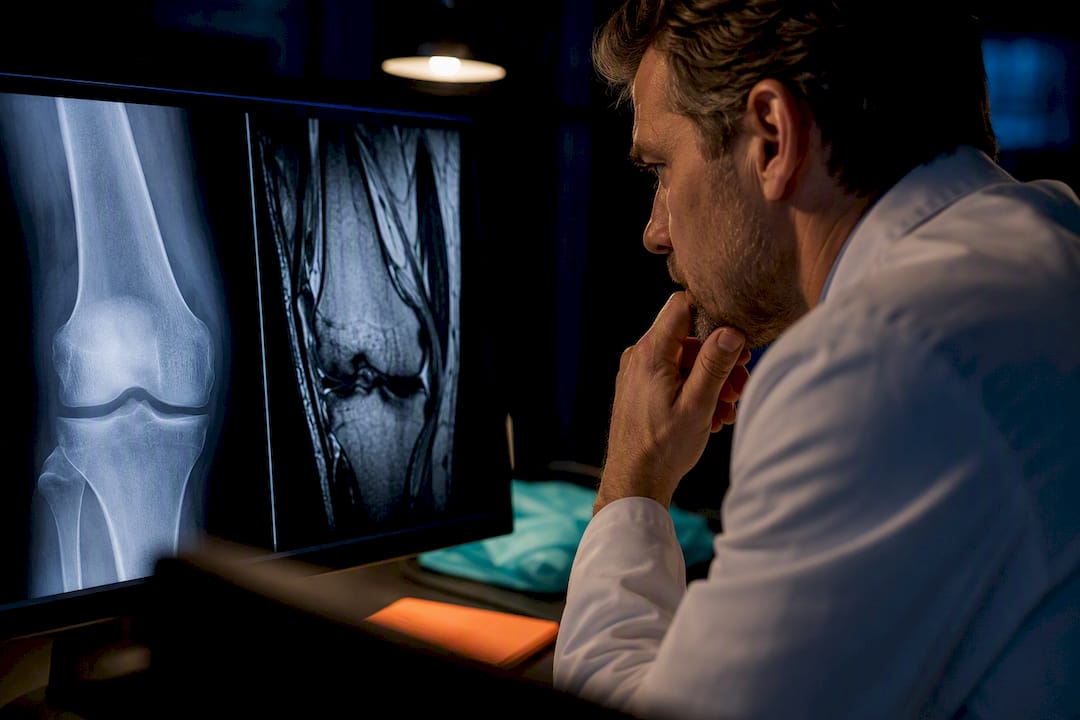
You cannot reliably tell a bone bruise from a fracture by symptoms alone, and treating it as a coin flip is risky. Deformity, inability to bear weight, or numbness point toward fracture and mean you need urgent evaluation. Without those red flags, an X-ray still may not settle the question, since bone bruises typically show up only on MRI. Start with rest, ice, compression, and elevation, then let a clinician decide what imaging you actually need.
TL;DR:
Most bone bruises heal naturally within three to six months, but accurate diagnosis often requires MRI imaging since X-rays usually miss them.
Fractures tend to cause sharp, immediate pain with visible deformity and swelling, while bone bruises produce deeper ache and develop gradually.
A high-energy trauma or broken limb, deformity, or numbness require urgent medical evaluation, and imaging is essential for proper diagnosis.
Rest, ice, compression, and elevation support recovery, but fractures often need immobilization or surgery, with healing times ranging from weeks to several months.
Supporting soft tissue with topical, plant-based ointments can aid comfort during recovery but should never replace proper medical treatment or stabilization.
Table of Contents
Bone Bruise vs Fracture: What’s Actually Happening Inside the Bone
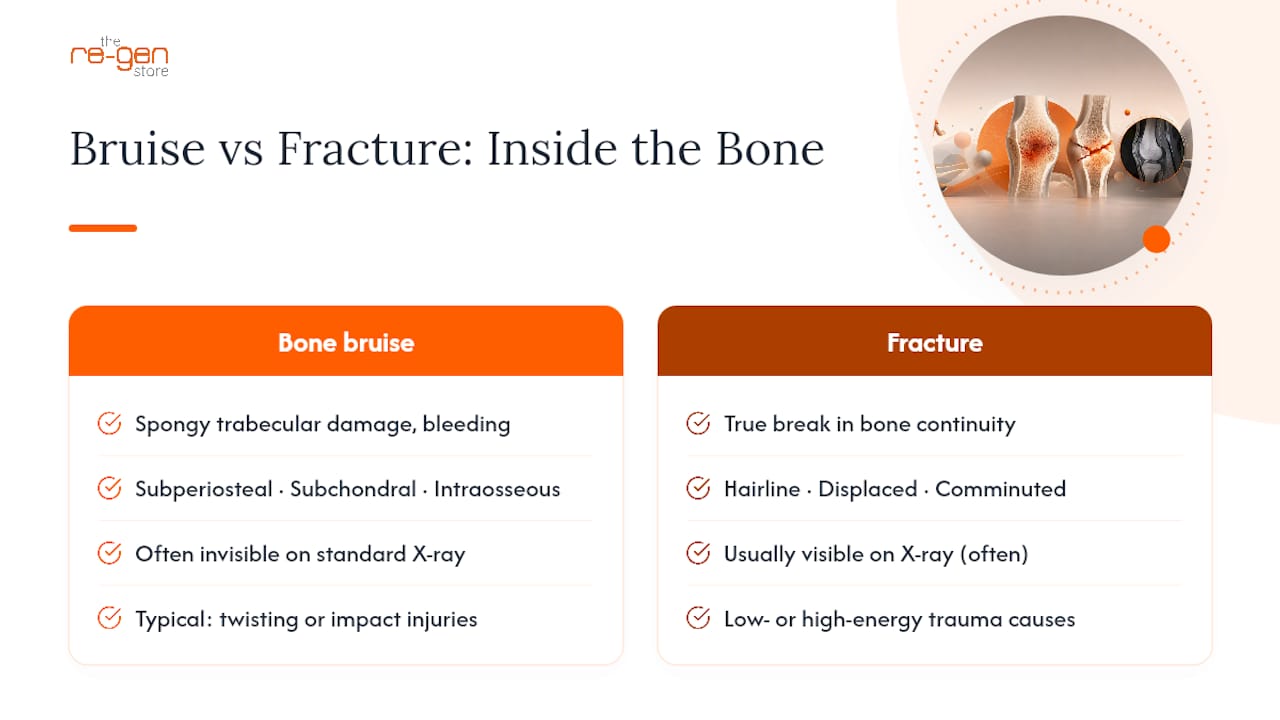
A bone bruise, medically called a bone contusion, is damage to the spongy trabecular network inside the bone along with bleeding and swelling trapped under the surface. It doesn’t break the bone’s outer shell, which is exactly why it often stays invisible on a standard X-ray. Clinicians classify bone bruises by location: subperiosteal (just under the bone’s outer lining), subchondral (beneath cartilage near a joint), and intraosseous (deeper inside the bone marrow). Each type behaves a little differently, but all three involve microscopic trauma rather than a clean break.
A fracture is a true break in the bone’s continuity, and it comes in patterns that matter for treatment. A hairline fracture is a thin crack that might not displace at all. A displaced fracture separates the bone into misaligned pieces. A comminuted fracture shatters the bone into three or more fragments, usually from serious force.
Mechanism of injury often predicts which one you’re dealing with. Most fractures come from low-energy events like a simple fall, but high-energy trauma, car accidents, falls from height, direct blows in contact sports, tends to produce messier, more complex fracture patterns. Bone bruises frequently show up in twisting or impact injuries where the bone absorbs force without snapping, like a knee slamming into a dashboard or an ankle rolling hard on uneven ground. Age and bone density matter too. Older adults with osteoporosis face a much lower threshold for fracture from the same fall that would leave a younger person with just a bruise.
Symptom Differences: Pain, Swelling, and What Your Body Won’t Let You Do
Pain quality is your first clue, though it’s an imperfect one. Fractures tend to produce sharp, immediate, unrelenting pain that intensifies with any movement or pressure on the site. Bone bruises usually cause a deeper, aching pain that can actually build over the following day or two as swelling and internal bleeding accumulate, and it worsens noticeably when you press directly on the bone.
Swelling and visible bruising follow different timelines too. A fracture often swells fast, sometimes within minutes, and surface bruising can look dramatic if blood vessels near the break are damaged. A bone bruise’s swelling develops more gradually since the bleeding is happening inside the bone rather than in the surrounding soft tissue, so what you see on the skin may understate what’s happening underneath.
A few functional signs deserve your full attention:
Inability to bear weight or use the limb normally strongly favors a fracture, especially when it’s immediate and severe.
Visible deformity, an oddly angled limb or a bump that shouldn’t be there, is a fracture until proven otherwise.
Numbness, tingling, or a cold, pale extremity suggests nerve or blood vessel involvement and needs urgent care regardless of what caused it.
Pain that’s manageable enough to walk on, with no visible deformity, is more consistent with a bone bruise, though this is a pattern, not a guarantee.
Here’s the trap: a hairline fracture can look and feel almost exactly like a bad bone bruise. No deformity, tolerable pain, some swelling. That overlap is precisely why imaging exists, and why self-diagnosis has real limits.
How Doctors Actually Diagnose a Bone Bruise or Fracture
The diagnostic path usually starts simple and escalates only when needed. A clinician takes your history (how the injury happened, what force was involved), performs a physical exam checking for deformity, tenderness, swelling, and range of motion, then typically orders an X-ray as the first imaging step.
X-rays are excellent at catching most fractures, since they show breaks in bone density clearly. What they routinely miss is a bone bruise, because the trabecular damage and internal bleeding don’t register the same way on a standard film. This is where MRI becomes the tool of choice: it can detect the fluid and swelling inside bone that X-rays simply cannot see.
A few scenarios reliably push a clinician toward ordering an MRI:
Persistent pain and swelling despite a negative X-ray
Joint instability or a sense that something inside the joint is “off”
Suspected ligament or cartilage damage alongside the bone injury
High-energy trauma where an occult (hidden) fracture is a real possibility
Many bone bruises are never formally diagnosed at all, simply because the patient improves with rest and never gets an MRI. The diagnosis tends to surface specifically in cases where symptoms linger longer than a soft-tissue injury should, prompting the deeper look. Hospital resources including Cedars-Sinai note that bone bruises generally don’t compromise the bone’s structural integrity the way a fracture does, which is a key reason management differs so much between the two.
Treatment and Healing: What to Expect Week by Week
Both injuries start with the same first move: rest, ice, compression, and elevation. RICE reduces swelling and pain in the first 48 to 72 hours regardless of which injury you have, and it’s a genuinely useful buy-you-time strategy while you arrange a medical evaluation, though it should never replace one if red flags are present.
From there, the paths diverge. A stable bone bruise usually calls for protected weight-bearing, activity modification, and time, sometimes with crutches if it’s in a weight-bearing bone like the tibia or heel. A fracture often needs a boot, splint, or cast to immobilize the bone while it knits back together, and displaced or comminuted fractures frequently require surgical fixation with pins, plates, or rods.
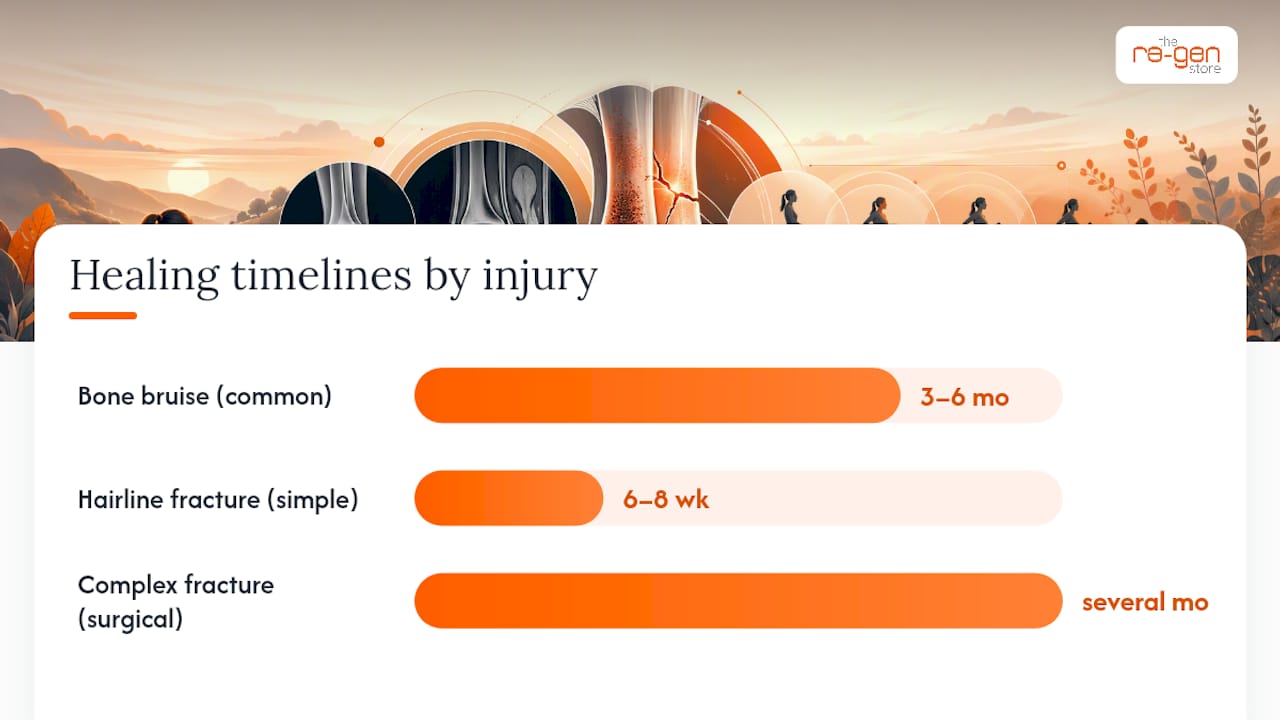
Timelines differ substantially. A bone bruise commonly improves over a few weeks but can take three to six months to fully resolve depending on severity and location, weight-bearing bones tend to heal slower than others. Fractures vary even more widely: a simple hairline crack might heal in six to eight weeks, while a complex fracture requiring surgery can take several months, plus additional time for hardware removal or rehabilitation in some cases.
Physical therapy plays a role in both, but the emphasis shifts. Bone bruise rehab often focuses on gradually restoring load tolerance and range of motion. Fracture rehab, especially post-surgical, tends to be more structured, moving through defined phases from protected motion to strengthening to a staged return to full activity. Programs built around bone-strengthening exercise, like those used in osteoporosis rehabilitation, illustrate how progressive loading supports bone recovery over time.
Red Flags: When to Stop Waiting and Get Evaluated Now
Certain signs mean you skip the wait-and-see approach entirely:
Visible deformity or a limb that looks angled wrong
An open wound with bone visible or protruding
Complete inability to move or bear weight on the injured area
Numbness, cold skin, or a pale/bluish color below the injury
Severe pain that isn’t responding to rest or over-the-counter relief
Any high-energy trauma: car accident, fall from height, high-speed sports collision
Open fractures or obvious deformity mean the emergency room, not a wait-and-see approach. Stable suspected fractures without those features can often go to urgent care or your primary care team instead. If symptoms worsen or plateau instead of improving over several days, get reevaluated. Bone injuries don’t reward guesswork.
Supporting the Soft Tissue Around the Injury
Whether you’re managing a bone bruise or recovering from a fracture, the soft tissue around the injury site, skin, muscle, and connective tissue, still needs attention. Ice, elevation, and protected rest remain the backbone of soft-tissue care, and topical products can play a supporting role in soothing skin and superficial tissue discomfort during recovery.
Topical care has real limits worth stating plainly: nothing applied to the skin stabilizes a fractured bone, replaces imaging, or substitutes for orthopedic treatment when a break is displaced or unstable. It’s a comfort measure for the tissue around the injury, not a fix for the bone itself. For readers looking for plant-based options to support the skin and soft tissue during this window, Theregenstore’s guidance on supporting tissue recovery and its approach to sprains and soft-tissue injuries outline how that adjunct role fits alongside clinician-directed care.
A Realistic Take on Recovery Expectations
Most bone bruises heal completely, even the ones that take months and feel alarmingly slow. Fractures heal too, but the stakes for getting the diagnosis right are higher. When in doubt, get imaged, follow the immobilization plan you’re given, and let topical comfort measures support, not substitute for, that process.
— Kyle
A Plant-Based Option for Supporting Skin and Soft Tissue During Recovery
Whether you’re nursing a bone bruise or working through the weeks after a fracture comes out of its cast, the skin and soft tissue around the injury often need their own attention separate from the bone itself. A plant-based, petroleum-free topical ointment is formulated to support skin and soft-tissue recovery without synthetic chemicals or antibiotics.

Be clear about what this is and isn’t. Re-gen is not a substitute for immobilization, a cast, or orthopedic care when a fracture needs stabilizing, and it will not change what your imaging shows. What it can do is support the surrounding skin and soft tissue while you follow your clinician’s actual treatment plan, the same category of comfort care recommended for bruises, minor cuts, and post-splint skin irritation. If you’re looking for a natural option to keep in your recovery kit alongside RICE and your doctor’s instructions, check out the Re-gen ointment product page or read more about its use as a petroleum-free wound treatment before you order.
Sources
FAQ
How can you tell if a bone is bruised or broken?
You often can’t tell with certainty from symptoms alone. Deformity, inability to bear weight, or numbness point toward a fracture, while manageable pain without deformity leans toward a bruise, but imaging is usually needed to confirm which one it is.
Can a bone bruise turn into a fracture?
A bone bruise itself doesn’t progress into a fracture, since they’re different types of injury, but continuing to stress an already-injured bone before it heals raises the risk of a separate fracture at the same weakened site.
Does a bone bruise ever fully heal?
Yes, the large majority of bone bruises heal completely, though it can take three to six months in weight-bearing bones or more severe cases rather than the few weeks people often expect.
Do you need a boot for a bone bruise?
Not always. Many bone bruises are managed with protected weight-bearing, activity modification, and sometimes crutches, but a clinician may recommend a boot if the injury is in a weight-bearing bone like the foot or ankle and pain limits normal walking.
Recommended
Comments