
Top Healing Herbs for Skin: Natural Remedies That Work


You want real results from your skincare routine, not just a long list of chemical names you can’t pronounce. The problem is that the natural remedy space is crowded with bold claims and very little proof. Choosing the right healing herb for a cut, burn, scar, or skin condition can feel overwhelming, especially when you also want something safe for your pet. This article cuts through the noise by focusing on herbs with actual clinical evidence, clear safety profiles, and proven benefits you can count on for both people and animals.
Table of Contents
Key Takeaways
Point | Details |
Evidence-backed herbal options | Aloe vera and Centella asiatica have strong scientific support for wound healing and scar care. |
Know your risks | Even natural products can cause irritation or allergies; always patch test before use. |
Choose quality, not trend | Use standardized, high-quality herbal products for the best results and safety. |
Herbal can rival synthetics | Herbal ointments can be as effective or better than synthetics, especially for everyday wounds and sensitive skin. |
Choosing the right healing herbs: What actually matters?
Before looking at specific herbs, let’s clarify how to judge what is truly effective and safe. Not every plant labeled “natural” earns that trust. The word natural is used loosely, and some herbal products carry real risks alongside their benefits.
Here is what to evaluate before choosing any herbal skin remedy:
Clinical evidence: Is there published research, including clinical trials or meta-analyses, that shows the herb actually works for your specific concern?
Safety for sensitive skin and pets: Some botanicals are gentle for people but toxic to animals. Always verify the target user.
Preparation quality: Is the product standardized? Concentration matters. A weak or contaminated extract may do nothing, or worse, cause harm.
Patch test results: Your skin is unique. Even well-researched herbs can cause a reaction in some individuals.
According to NCCIH guidelines, risks of herbal skin products include allergic reactions, irritation, contamination, and drug interactions. Evidence for many herbs is inconsistent, which is why patch testing is always recommended before full application.
Learning more about the safe use of herbal skin products helps you set realistic expectations and protect yourself from unnecessary reactions.
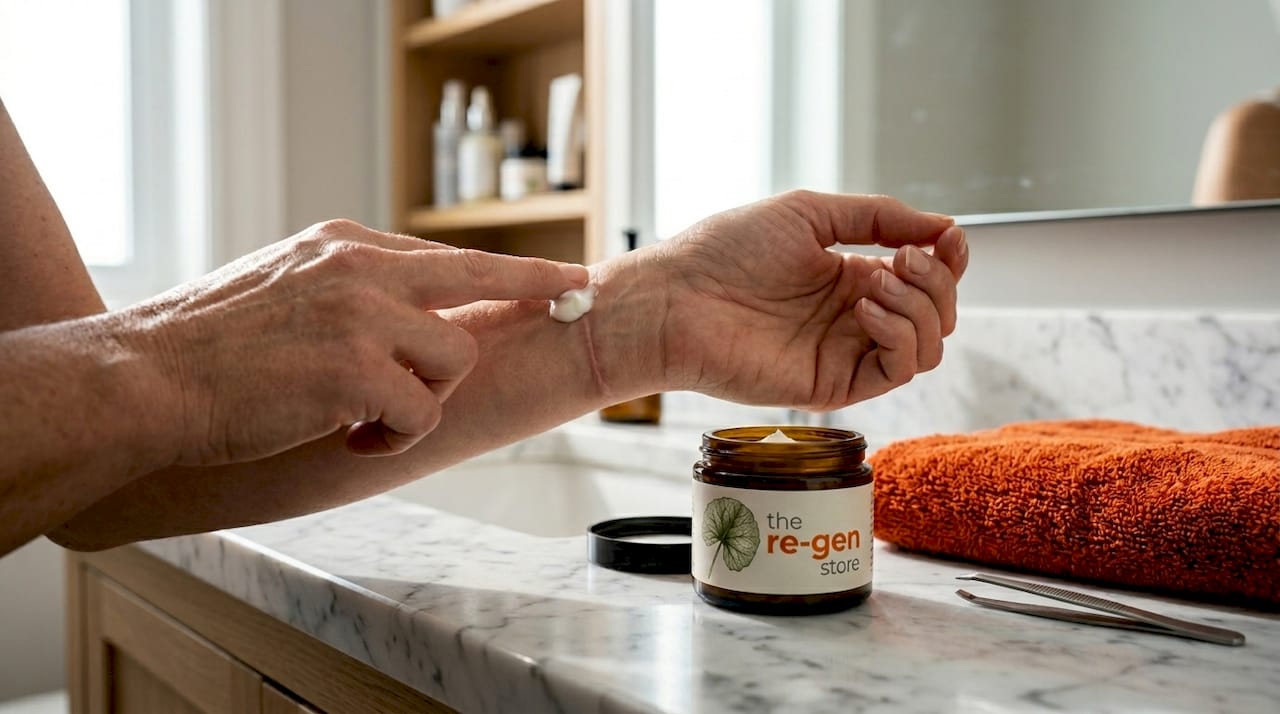
Pro Tip: Always apply a small amount of any new herbal product to the inner wrist or behind the ear. Wait 24 hours before using it on a wound or larger area of skin.
Aloe vera: The classic healer for wounds and burns
Armed with clear criteria, let’s look at the best-known herbal classic. Aloe vera has been used for thousands of years across cultures, and modern science has finally caught up with what traditional healers already knew.
The healing power of Aloe vera comes from specific compounds inside its gel:
Acemannan and mannose-6-phosphate: These polysaccharides actively promote fibroblast (skin-rebuilding cell) growth, collagen production, and new skin layer formation.
Bradykinase: An enzyme that reduces inflammation by breaking down inflammatory compounds on contact.
Anti-inflammatory cytokines: These signaling proteins help calm the immune response and reduce redness and swelling.
Research confirms that Aloe vera accelerates healing through polysaccharides like acemannan and mannose-6-phosphate, which promote fibroblast proliferation, collagen deposition, and epithelialization (new skin growth), while reducing inflammation.
“Clinical trials show Aloe vera gel heals second-degree burns in 15.9 days versus 18.73 days with silver sulfadiazine, and a meta-analysis confirmed healing time reduced by 4.44 days on average.”
Those numbers are significant. Aloe vera is not just matching synthetic treatments. In many cases, it is outperforming them with fewer side effects. For minor household burns, everyday cuts, and post-procedure skin recovery, Aloe vera is one of the most dependable plant-based tools available.
It is also widely used in pet care, particularly for minor skin irritations and hot spots, though you should always confirm the product is free of added ingredients that may be toxic to animals.
Pro Tip: Explore Aloe vera’s role in burn healing to understand how it compares to modern plant-based formulations and when a more advanced option may serve you better.
Centella asiatica: Scar reduction and skin rejuvenation
Beyond Aloe vera, another leading botanical in modern skin care is Centella asiatica, often listed on labels as “Gotu kola” or by its abbreviated extract names.
Centella asiatica works through a set of active molecules called triterpenoids, specifically asiaticoside and madecassoside. These compounds work at the cellular level to:
Stimulate collagen synthesis via the TGF-beta/Smad signaling pathway (the body’s main collagen production trigger)
Encourage fibroblast proliferation (growth of skin-rebuilding cells)
Promote angiogenesis (new blood vessel formation that feeds healing tissue)
Reduce inflammation and improve moisture retention in the skin barrier
Research shows that Centella’s triterpenoids stimulate collagen synthesis through the TGF-beta/Smad pathway, improve scar outcomes, and strengthen the skin barrier. In practical terms, studies found that Centella asiatica reduces Vancouver Scar Scale scores by 2.1 points post-surgery, and 5% extracts measurably reduce transepidermal water loss (TEWL), which is the rate at which your skin loses moisture.
“Centella asiatica accelerates healing in excision wounds and diabetic ulcers, making it a standout choice for people dealing with chronic or slow-healing skin injuries.”
This herb is particularly valuable when scarring is a concern. Whether you have had surgery, a deep cut, or a skin condition that leaves marks, Centella asiatica targets the very process that controls how visible a scar becomes. You can find a deeper look at evidence-based healing for skin that covers how these botanicals perform across a range of real-world conditions.
Comparing top herbal remedies: Which is best for you?
With multiple herbal options available, let’s see how they stack up side by side. Choosing the right herb depends on your specific skin concern, sensitivity level, and whether you need a solution for people, pets, or both.
Research confirms that herbal ointments provide anti-inflammatory, antimicrobial, and antioxidant benefits through flavonoids and tannins, and are often superior or comparable to synthetics with fewer side effects like tissue atrophy or antibiotic resistance.
Herb | Best for | Key benefit | Pet safe? | Limitation |
Aloe vera | Burns, minor wounds | Fast epithelialization | Generally yes | Avoid in deep wounds |
Centella asiatica | Scars, post-surgical skin | Collagen synthesis | With caution | Concentration must be adequate |
Calendula | Irritation, dry skin | Soothing, anti-inflammatory | Mostly yes | Ragweed allergy crossover |
Chamomile | Inflammation, eczema | Calming, gentle | Use carefully | Possible allergic reaction |
Tea tree oil | Infection prevention | Antimicrobial | No | Toxic to cats and dogs |
Key considerations when choosing:
For burns and fast healing: Aloe vera leads the field.
For scar reduction: Centella asiatica is your strongest option.
For everyday irritation: Calendula or chamomile works well.
For pets: Avoid tea tree oil entirely. Stick to formulations specifically designed for animal use.
Explore holistic healing approaches and consider plant-based wound treatment options that combine multiple botanicals for broader coverage.
Safety first: Patch testing and smart use of herbal skin care
Even the best herbs require careful use. Let’s talk about practical, safe steps before you apply anything new to your skin or your pet’s coat.
Follow this simple process for any new herbal product:
Choose a small test area. The inner wrist or the skin behind your ear works well. For pets, try the inner flap of their ear or the belly.
Apply a small amount. Use a pea-sized drop of the product directly on the skin.
Wait 24 to 48 hours. Check for redness, swelling, itching, or any change in skin texture.
Assess the results. No reaction means you can proceed with normal use. Any irritation means stop and consider an alternative.
Consult a professional when needed. Pregnant individuals, those on blood thinners, and anyone with known plant allergies should get guidance before starting any new herbal regimen.
Guidelines confirm that herbal products carry risks including irritation, contamination, and drug interactions, and that patch testing is a recommended baseline step for everyone.
For more guidance on avoiding adverse reactions when starting a new herbal skin product, you will find practical steps that protect both you and your animals.
Pro Tip: If you experience any reaction during a patch test, do not try to push through it. A reaction on healthy skin will be far worse on an open wound.
Our take: Science, tradition, and what actually works
Now that you know the options, here is a candid perspective based on science and real-world practice. The most important thing we want you to understand is this: “natural” is not automatically safe or effective. The word natural describes origin, not quality.
The empirical data is strongest for Aloe and Centella in burns and wounds, with mechanisms rooted in antioxidant and anti-inflammatory modulation of cytokines and collagen pathways like TGF-beta. That is meaningful. It means these herbs have moved beyond folklore into documented, repeatable clinical outcomes.
But even those herbs require standardized, quality preparations. A poorly formulated Aloe gel with minimal acemannan content will not deliver the results seen in trials. This is where product quality becomes the deciding factor, not the herb alone.
We also want to be transparent: large randomized controlled trials (RCTs) are still limited for many herbs, and herbal care is not a replacement for medical treatment in serious cases. Use these remedies as a powerful first line of support, not as a substitute for professional care when it is genuinely needed.
The sweet spot is here: choose herbs with clinical backing, sourced from quality-controlled products, and listen closely to how your body responds. Browse real-life natural healing examples to see how this balanced approach works in practice.
Find your best healing solution with plant-based care
You now have a clear, evidence-informed picture of which healing herbs work, why they work, and how to use them safely. The next step is finding a product that puts those principles into action.
At TheRegenStore.com, Re-gen is a petroleum-free, plant-based regenerative ointment formulated for people and pets alike. It is designed to support recovery from cuts, burns, sprains, and post-surgical wounds without synthetic chemicals or harsh additives. Whether you want to learn how to speed up wound healing naturally or you are ready to try a plant-based regenerative ointment backed by real botanical science, we have you covered. Pet owners will also find a dedicated healing ointment for pets designed with animal safety as the top priority.
Frequently asked questions
Can healing herbs be used safely on pets’ wounds or skin?
Many healing herbs like Aloe vera and Centella asiatica are used in pet care, but always choose pet-specific formulations and patch test first, since some botanicals like tea tree oil are toxic to animals.
How quickly do healing herbs work on cuts and burns?
Herbs like Aloe vera can significantly speed up recovery. Clinical data shows healing time reduced by 4.44 days on average, though results depend on wound depth, skin type, and application consistency.
Are there any side effects to using herbal skin products?
Yes. Risks include allergic reactions, irritation, and drug interactions. Patch testing and choosing high-quality, standardized products significantly lower those risks for most people.
Which healing herbs have the strongest scientific backing for skin benefits?
Aloe vera and Centella asiatica have the most robust evidence available. Empirical data is strongest for these two botanicals in wound healing, burn recovery, and scar improvement.
Can herbal ointments fully replace synthetic medications for skin issues?
Herbal ointments are superior or comparable to synthetics for many minor wounds, but severe infections, deep wounds, or non-healing conditions still warrant professional medical evaluation and care.
Recommended
Comments