
Why Chemical-Free Skincare Matters for Your Skin Health


“Chemical-free skincare” is a marketing term, not a scientific one. Every substance on earth, including water and aloe vera, is a chemical. What the phrase actually signals is a product formulated without certain synthetic ingredients, such as parabens, phthalates, and sulfates, to reduce irritation and increase ingredient transparency. No regulatory body, including the FDA or the EU’s European Chemicals Agency, has established a legal definition for the term. Understanding why chemical-free skincare resonates with so many people requires separating the marketing language from the real skin science underneath it.
Why do consumers seek chemical-free skincare products?
Consumer demand for gentler formulations has grown steadily, and the reasons are practical. People with reactive skin conditions like eczema and rosacea associate “chemical-free” labels with fewer irritants and greater ingredient transparency. That association drives purchasing decisions more than clinical evidence does.
Regulatory differences also fuel consumer caution. The EU bans or restricts over 1,400 cosmetic ingredients, compared to fewer than 20 in the United States. That gap tells consumers that what is legal in an American product may still be restricted elsewhere, which pushes many toward products marketed as cleaner or more natural.
Environmental and ethical concerns add another layer. Many consumers want to avoid petrochemical ingredients not just for skin reasons, but because of how those ingredients are sourced and processed. The benefits of plant-based ingredients extend beyond skin contact, covering sourcing, biodegradability, and long-term exposure reduction.
Key reasons consumers choose natural or chemical-free products include:
Sensitive skin support: Avoiding known synthetic irritants like artificial fragrance and sulfates reduces flare-ups in reactive skin.
Ingredient transparency: Shorter, recognizable ingredient lists feel more trustworthy to health-conscious shoppers.
Reduced long-term exposure: Plant-based formulations limit contact with controversial synthetics like phthalates and parabens over time.
Environmental values: Avoiding petrochemical derivatives aligns with sustainability goals.
Global regulatory awareness: Consumers increasingly research EU-restricted ingredients and apply that standard to their own purchases.
What does science say about natural skincare safety?
Safety depends on molecular properties, concentration, and individual skin tolerance, not on whether an ingredient comes from a plant or a lab. This is the core principle that dermatologists apply when evaluating any formulation. Effective skincare depends on stability and concentration, not natural versus synthetic origin.
The evidence on natural ingredients is more complicated than most marketing suggests. A Stanford study found that 94% of natural skincare products contained at least one recognized contact allergen. Essential oils and plant fragrances are among the most common triggers for allergic contact dermatitis. That statistic matters because many consumers switch to natural products specifically to avoid reactions, only to encounter different ones.
Synthetic ingredients are not automatically harmful. Retinoids, which are synthetic, remain the gold standard for collagen stimulation. Colloidal oatmeal, which is natural, is clinically proven to calm inflammation. The origin of an ingredient tells you very little about its safety profile.
Here is how dermatologists evaluate ingredient safety:
Molecular properties: How the ingredient interacts with skin cells at a chemical level.
Concentration: The dose determines the effect. A botanical extract at high concentration can irritate just as readily as a synthetic compound.
Formulation context: Stability, pH, and preservative systems all affect how an ingredient behaves on skin.
Individual tolerance: Skin biology varies. Patch testing remains the most reliable way to assess personal compatibility.
Exposure duration: Rinse-off products carry lower risk than leave-on formulations, regardless of ingredient origin.
Pro Tip: If you have reactive skin, look for products labeled “fragrance-free” rather than “natural fragrance.” Natural fragrances contain allergens like linalool and limonene that irritate a significant portion of people who use natural formulations.
How do natural and synthetic ingredients compare?
Synthetic ingredients generally offer greater stability, purity, and consistent shelf life than their natural counterparts. Synthetic ingredients provide better batch-to-batch consistency because controlled manufacturing eliminates the variability that comes with harvesting botanicals from different seasons, soils, and climates. That consistency matters for both safety and efficacy.
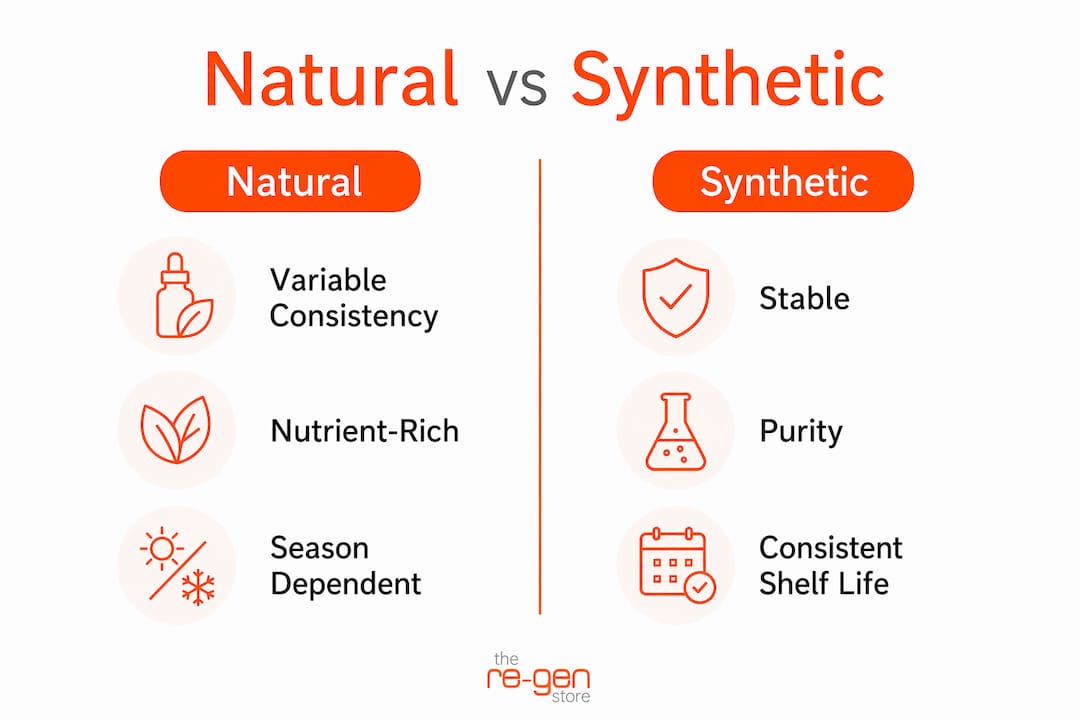
Natural ingredients carry their own strengths. Nutrient-dense botanicals deliver antioxidants, fatty acids, and anti-inflammatory compounds that support skin recovery. The role of botanicals in skincare is well-documented, particularly for wound support, inflammation reduction, and barrier repair. The limitation is preservation. Without adequate preservatives, botanical extracts oxidize faster and carry higher microbial contamination risk.
Parabens illustrate the complexity well. They are excluded from most clean beauty products due to hormonal disruption concerns, but FDA and EFSA found no health risk at cosmetic concentrations. Removing them sometimes reduces a product’s stability and shelf life, which can introduce different risks.
Feature | Natural ingredients | Synthetic ingredients |
Batch consistency | Variable, season-dependent | High, controlled manufacturing |
Allergen risk | Higher (essential oils, plant fragrances) | Lower in most cases |
Stability and shelf life | Shorter without strong preservatives | Longer, more stable |
Sustainability profile | Generally better sourcing story | Depends on petrochemical origin |
Clinical evidence base | Growing but uneven | Extensive for many actives |
Pro Tip: Check the full ingredient list for “natural fragrance” as a single entry. That label can legally cover dozens of undisclosed compounds, some of which are known contact allergens in clinical literature.
What should you look for in natural skincare products?
Reading past the front label is the single most useful habit you can build. “Chemical-free,” “clean,” and “natural” are marketing terms with no legal definition. The ingredient list, printed in descending order of concentration, tells you what is actually in the product.
Practical guidance for evaluating natural or low-synthetic skincare:
Prioritize fragrance-free formulations if you have sensitive or reactive skin. Both synthetic and natural fragrances carry irritation risk.
Check for certifications like USDA Organic or NSF/ANSI 305 for personal care products. These have defined standards, unlike “natural” or “chemical-free.”
Assess preservation systems. A product without any preservative is not safer. It may harbor bacteria or mold, especially in water-based formulations.
Research key actives. Understand what each active ingredient does and at what concentration it is effective. A botanical extract listed last in an ingredient list is present in trace amounts.
Consult a dermatologist for persistent skin conditions before switching product lines. Skin type, barrier function, and existing conditions all affect compatibility.
For people interested in natural ingredients for healing, the evidence supports plant-based formulations when they are properly preserved, clearly labeled, and matched to your skin’s actual needs. Aging reversal research also points to evidence-based botanical actives as a credible complement to synthetic treatments, not a replacement.
Key Takeaways
Natural skincare products work best when you evaluate formulation quality and ingredient function rather than relying on “chemical-free” as a safety signal.
Point | Details |
“Chemical-free” is a marketing term | No legal or scientific definition exists; all skincare contains chemicals by definition. |
Natural does not mean non-allergenic | 94% of natural products in a Stanford study contained at least one recognized contact allergen. |
Synthetic ingredients can be safer | Retinoids and certain preservatives are clinically proven safe and more stable than many botanicals. |
Formulation quality determines safety | Concentration, preservation, and pH matter more than whether an ingredient is natural or synthetic. |
Read the full ingredient list | Certifications like USDA Organic have defined standards; “natural” and “chemical-free” labels do not. |
The real problem with how we talk about natural skincare
I have watched the “chemical-free” conversation evolve for years, and the most persistent mistake I see is treating ingredient origin as a proxy for safety. Consumers who switch from a synthetic product to a natural one because of a reaction often end up with a new reaction, this time from essential oils or plant fragrances they did not expect to be a problem.
The harder truth is that fear-driven skincare choices rarely produce better outcomes. Removing parabens from a product because of online concern, when both the FDA and EFSA have found no risk at cosmetic concentrations, can actually reduce a product’s stability. You end up with a shorter shelf life and a higher chance of microbial contamination, which is a real risk, not a theoretical one.
What I advocate for is ingredient literacy over ingredient fear. Learn what retinol does. Understand why colloidal oatmeal calms inflammation. Know that “natural fragrance” is not a single ingredient. When you read a label with that kind of knowledge, you make better decisions for your actual skin, not for the marketing story on the front of the bottle.
— Kyle
Plant-based skin treatment from Theregenstore
Theregenstore’s Re-gen ointment is formulated without petroleum, parabens, or synthetic preservatives, making it a practical option for people who want plant-based wound and skin support backed by clear ingredient transparency.
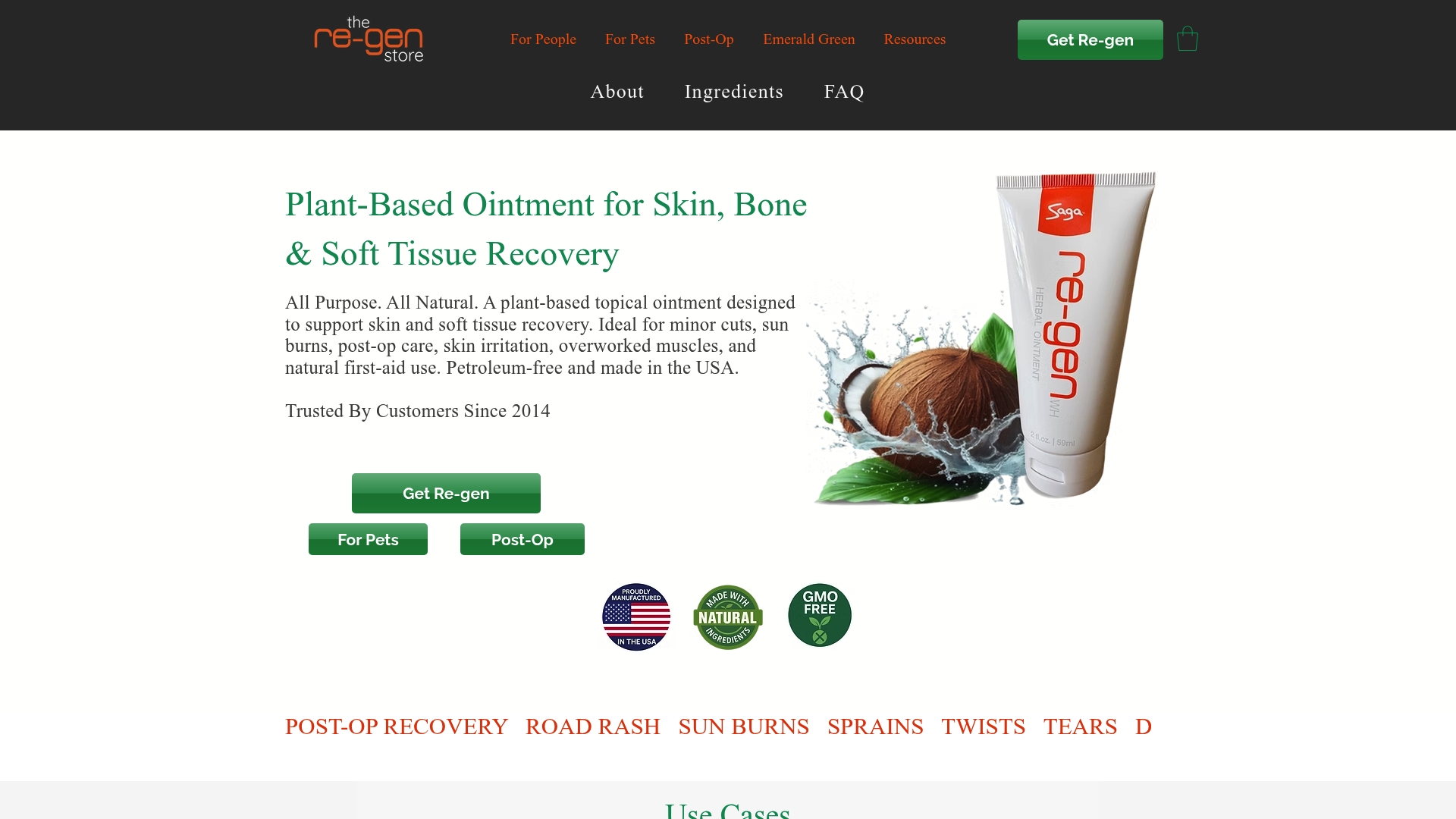
Re-gen is designed for cuts, burns, post-operative wounds, and general skin recovery. Every ingredient serves a function, and the formulation avoids the petrochemical base that conventional wound treatments rely on. If you are looking for a petroleum-free, plant-based treatment that aligns with what you have read here, Re-gen is worth a close look. You can also explore the full Re-gen plant-based ointment to review the complete ingredient list and usage guidelines before purchasing.
FAQ
What does “chemical-free skincare” actually mean?
“Chemical-free” is a marketing term with no scientific or legal definition. It typically signals that a product avoids certain synthetic ingredients like parabens, sulfates, or artificial fragrance.
Is natural skincare safer than synthetic skincare?
Not automatically. Safety depends on concentration and formulation, not ingredient origin. Some natural ingredients, including essential oils, are common allergens.
Can natural skincare products cause allergic reactions?
Yes. A Stanford study found that 94% of natural skincare products contained at least one recognized contact allergen, with essential oils and plant fragrances being the most frequent triggers.
Why do EU cosmetic regulations differ from US regulations?
The EU restricts over 1,400 cosmetic ingredients compared to fewer than 20 in the United States. That regulatory gap drives many consumers to seek cleaner formulations regardless of where they live.
How do I choose a genuinely safe natural skincare product?
Read the full ingredient list, look for certifications with defined standards like USDA Organic, and prioritize fragrance-free formulations if your skin is reactive. Consulting a dermatologist is the most reliable step for persistent skin concerns.
Recommended
Comments