
Does Ointment Expire? What the Date Means and When to Replace It


Yes, ointment expires. The date printed on the tube or carton is the point until which the maker has tested the product to keep its strength, quality, and purity when stored as labeled. After that date, the manufacturer can no longer vouch for it. For a product that goes on broken skin, a fresh tube is the simple, confident choice, and our Re-gen line is made for exactly that kind of everyday first-aid shelf.
TL;DR
Ointments carry an expiration date. It marks how long the maker has tested the product to stay stable, when stored as labeled.
The FDA advises against using medicines past that date, because safety and effectiveness are no longer guaranteed.
Heat and humidity can shorten a tube’s useful life, so keep it cool, dry, and out of the bathroom.
If a rash, itching, or swelling appears after use, stop and ask a doctor.
Take expired tubes to a drug take-back site, or follow the FDA’s household trash steps.
Table of Contents
What the expiration date actually means
The FDA explains that an expiration date is the period a drug is known to hold its strength, quality, and purity when stored as the label directs. Manufacturers set it through stability testing.
That makes the date a guarantee window, not a switch that flips overnight. But once it passes, nobody can promise the product still performs as tested.
If an over-the-counter product has no date on its label, the FDA says to treat it as expired three years after purchase. Write the purchase month on the carton when you buy it, so you always know.

Where to find the date
Look on the carton first. On many tubes the date is stamped on the crimped end. A current triple-antibiotic ointment label on DailyMed points to the carton or the tube crimp for the expiration date. If you throw the carton away, keep a note of the date somewhere, or mark the tube itself.
How long does ointment last?
There is no single number. The FDA notes that it is hard to set dates that apply after long storage under the varied conditions of a home, and that the right conditions depend on the drug. In practice, three things decide how long your tube stays good:
The printed date. This is your outer limit.
Storage. Heat, humidity, and sunlight work against any topical product.
Handling. Touching the tip to skin, leaving the cap off, or squeezing a damaged tube all invite contamination.
A sealed tube kept in a drawer will generally reach its date. A tube carried in a hot car or kept on a steamy bathroom shelf may not.
Is expired ointment safe on a cut or burn?
The FDA’s advice is not to use a medicine after its expiration date. Expired drugs may be weaker, chemically changed, or at risk of bacterial growth.
That matters most for wounds. Broken skin is an open door, and you want the product that touches it to be at its best. The FDA also warns that sub-potent antibiotics can fail to treat an infection, which may allow a more serious illness and contribute to antibiotic resistance.
This is why antibiotic ointment is the category people ask about most. It is meant for minor cuts, scrapes, and burns, and the label says to ask a doctor before using it on deep or puncture wounds, animal bites, or serious burns. Stop and ask a doctor if you need it for more than a week, or if the wound worsens.
Signs a tube has gone off
Check the tube each time you reach for it. Replace it if you notice:
A change in smell, color, or texture
Separation, graininess, or a watery layer
A cracked, leaking, or swollen tube, or a missing seal
Anything you cannot date
When in doubt, replace it. A new tube costs little next to a slow-healing wound.
How to store ointment so it lasts
The FDA says improper storage can undermine a medicine before its printed date. Heat and humidity matter, and a cool, dry place is generally best unless the label says otherwise.
For reference, current DailyMed labels for bacitracin zinc ointment direct storage at 20 to 25°C (68 to 77°F). That is product-specific, so always read your own label. MedlinePlus adds a useful habit: keep topical medicine in its original, tightly closed container, away from heat and moisture, and not in the bathroom.
A good first-aid routine:
Keep the tube in its original carton.
Store it in a bedroom closet or kitchen cabinet away from the stove.
Close the cap right after use.
Do not carry it in a car for long stretches.
Mark the date you bought it.
Reactions: when to stop
Some ointments cause allergic skin reactions. Poison Control notes that bacitracin and neomycin more commonly cause redness, swelling, itching, or rash, and that risk is higher with repeated use. If any of these appear, stop using the product. The bacitracin label says to stop and ask a doctor if a rash or other allergic reaction develops or the condition worsens.
If you want to understand these reactions better, see our guides on antibiotic ointment risks, bacitracin allergy, and neomycin allergy symptoms.
How to dispose of expired ointment
First read the label. The FDA prefers drug take-back locations or prepaid mail-back envelopes. Your pharmacist can tell you about local programs. Do not flush topical ointment.
If take-back is not available, the FDA says to check its flush list; if the product is not on it, follow its household trash steps. Cleveland Clinic describes them: mix the medicine with something unappealing such as dirt, cat litter, or coffee grounds, seal it in a bag or container, and put it in the trash.
Our perspective
A tube you can trust starts with a tube you can date. Most people keep first-aid products for years, and that is where problems start: a half-used tube in a hot drawer, with no date anyone remembers. That is why we make Re-gen a plant-based, petroleum-free ointment for skin, soft tissue, and muscle recovery, for people and for pets. We formulated it with a blend of 10 herbal ingredients, so you have a natural first-aid option without the chemical antibiotics many people are trying to move away from. Our advice is simple. Buy what you will use, store it cool and dry, write the date on it, and replace it when the date passes. Your skin, and your pet’s skin, deserve a fresh product. Kyle
Restock with Re-gen
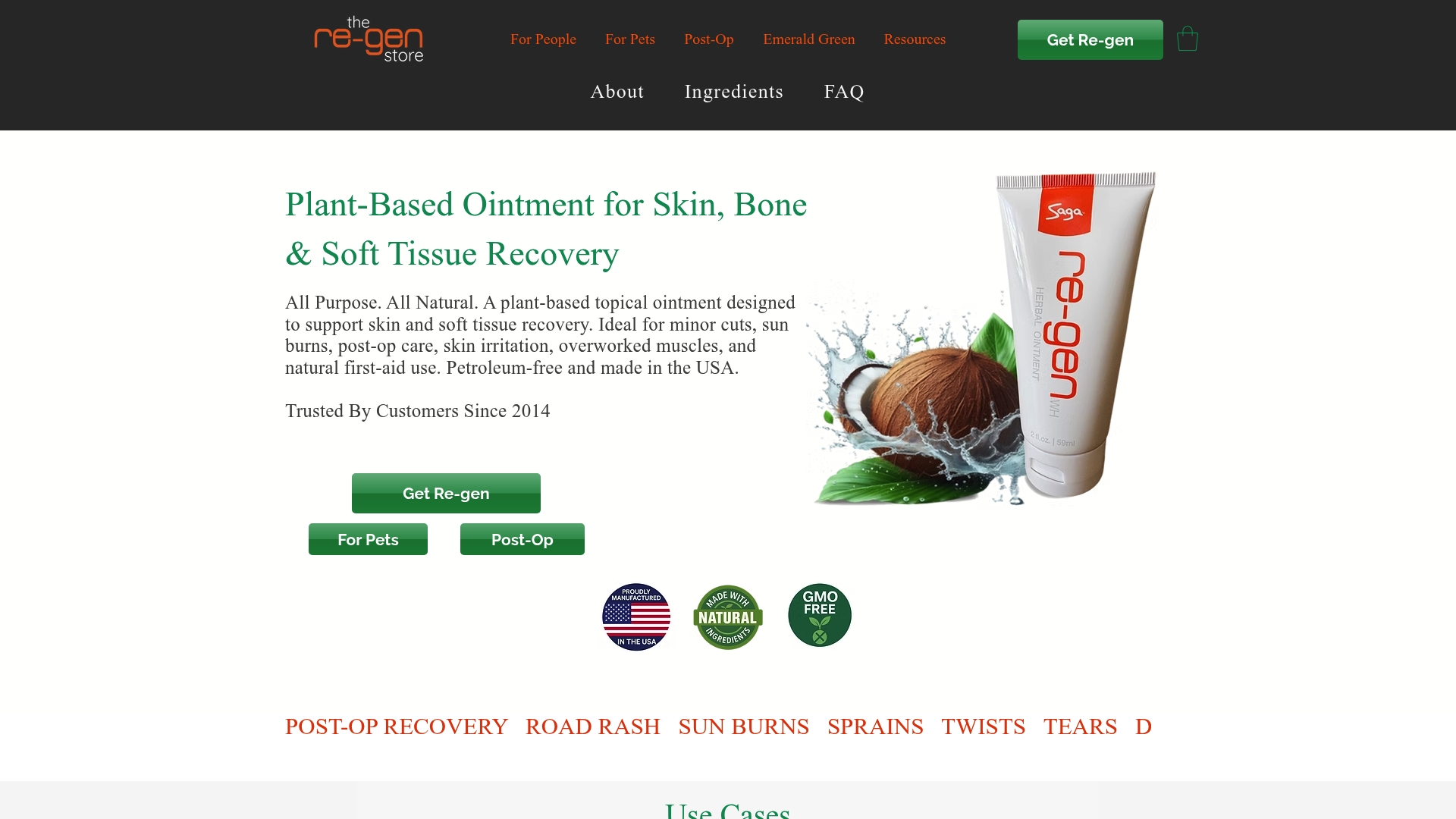
When an old tube goes into the take-back bin, replace it with Re-gen Plant-Based Regenerative Ointment. It is made to support skin, soft tissue, bone, and muscle recovery, and it comes in several sizes, including the Emerald Green spray and press cap formats. Shipping is a flat $3. You can also browse all Re-gen products.
If you are comparing options, our pages on ointment versus cream and antiseptic versus antibiotic explain the differences in plain terms.
FAQ
Does antibiotic ointment expire?
Yes. Antibiotic ointments carry an expiration date like other drugs. The FDA warns that weakened antibiotics may fail to treat an infection, so replace the tube once the date passes.
Is expired ointment safe to use?
The FDA advises against using any medicine after its expiration date, because safety and effectiveness are no longer guaranteed. Expired products may be weaker, chemically changed, or contaminated. Replace it, and ask a doctor about any wound that is deep, worsening, or not healing.
How long does ointment last once opened?
It depends on the product and how you store it. Use the printed date as your limit, keep the cap closed, and store the tube cool and dry. Discard it sooner if the texture, smell, or color changes.
What if my ointment has no expiration date?
For over-the-counter products, the FDA says to consider it expired three years after purchase. Note the purchase date on the carton going forward.
Sources
Recommended
Comments