
Vaseline vs Neosporin: Allergies, Resistance, Petroleum Free Options

For a clean, minor cut or scrape, petroleum jelly beats antibiotic ointment for most people, most of the time. Petroleum jelly keeps the wound moist so it can heal on its own, without the allergy risk that comes with topical antibiotics. Save Neosporin (or any antibiotic ointment) for wounds that show real signs of infection, or for dirty or deep injuries where a doctor recommends it.
TL;DR:
Petroleum jelly supports faster healing in clean, minor wounds by maintaining moisture, while antibiotic ointments like Neosporin offer no proven healing advantage.
Antibiotic ointments carry higher risks of allergic contact dermatitis and contribute to bacterial resistance, making petroleum jelly the safer first-line choice.
For contaminated or high-risk wounds, antibiotic ointments can reduce infection rates, but routine use on clean wounds remains unnecessary.
A petroleum-free plant-based ointment provides an alternative for those seeking natural, antibiotic-free wound care options.
Proper wound cleaning and dressing are more important than the choice of ointment, with antibiotics reserved for wounds showing signs of infection or contamination.
Table of Contents
Vaseline vs Neosporin: Which One Heals Minor Wounds Better?
The two products work in completely different ways. Vaseline is petroleum jelly. It does not kill bacteria or fight infection. It seals the skin’s surface, traps moisture underneath, and keeps the wound bed from drying out into a scab. That moist environment lets skin cells migrate across the wound faster, which is why doctors call this approach “moist wound healing.” Neosporin, by contrast, is a combination antibiotic ointment built to kill or suppress bacteria on the wound surface.
Here’s the part that surprises most people: for clean, uncomplicated cuts, the antibacterial action doesn’t translate into faster healing. A double-blind randomized trial comparing a petrolatum-based ointment against a combination antibiotic ointment found no difference in wound healing scores at days 7, 14, or 28. The antibiotic group, however, reported more burning during application and included one case of allergic contact dermatitis. Equivalent healing, extra irritation. That is the entire case against reaching for antibiotic ointment by default.
The American Academy of Dermatology Association and related clinical guidance point to the same pattern: clean, uncomplicated surgical wounds show no significant difference in infection rates whether treated with petroleum-based ointment or an antibiotic ointment.
Petroleum jelly: moist healing, occlusion, zero antibacterial action, minimal allergy risk
Neosporin/antibiotic ointments: active antibacterial ingredients, higher irritation risk, no proven healing advantage on clean wounds
Quick fact: In the randomized trial cited above, wound healing scores were statistically equivalent between petrolatum and antibiotic ointment groups, while the antibiotic group experienced more burning and one confirmed allergic reaction.
There’s a real exception, though. Some research on contaminated or higher-risk wounds found topical antibiotics did reduce minor infection rates compared with petrolatum in certain settings, with one trial reporting a number needed to treat around 8. Clean kitchen cut on your finger? Petroleum jelly does the job. Wound with visible dirt, gravel, or an animal bite? That’s a different conversation, one worth having with the how to apply antibiotics guidance further down.
Allergy Risk, Antibiotic Resistance, and What Can Go Wrong
Antibiotic ointments carry a real allergy burden that most people never hear about until it happens to them. Reported rates of allergic contact dermatitis are notably higher for bacitracin and neomycin compared with petroleum jelly, according to various studies, according to wound care research compiled by Ohio State Health. Petroleum jelly’s allergy profile is nowhere close to that.
By the numbers: Allergic contact dermatitis has been reported at substantial rates among neomycin and bacitracin users in clinical studies, compared with a markedly lower rate for plain petrolatum.
There’s a second, quieter issue: resistance and microbiome disruption. Using antibiotic ointment on every scrape, splinter, and paper cut trains local bacteria to tolerate the active ingredients over time. Dermatologic surgeons increasingly advise against routine antibiotic ointment use on clean wounds precisely because the benefit is marginal while the resistance and sensitization costs are real and cumulative.
A few practical safety habits reduce risk on both sides:
Buy petroleum jelly in a tube, not a jar. Dipping fingers into a jar repeatedly introduces bacteria into the product itself.
Apply a thin layer. A thick glob doesn’t heal wounds faster, it just wastes product.
Watch for burning, spreading redness, or itching after antibiotic ointment. That’s often an allergic reaction, not a sign the infection is winning, and it means stop immediately.
Never apply antibiotic ointment to a wound that’s already showing an allergic rash from a previous application.
If you develop worsening redness or a burning sensation after applying an antibiotic ointment, the reflex to apply more is usually wrong. That pattern more often signals sensitization to neomycin or bacitracin than a worsening infection, and piling on more product only makes it worse.
How to Clean and Dress a Minor Wound Correctly
Getting the basics right matters more than which ointment sits in your medicine cabinet. Follow these steps for a routine cut or scrape:
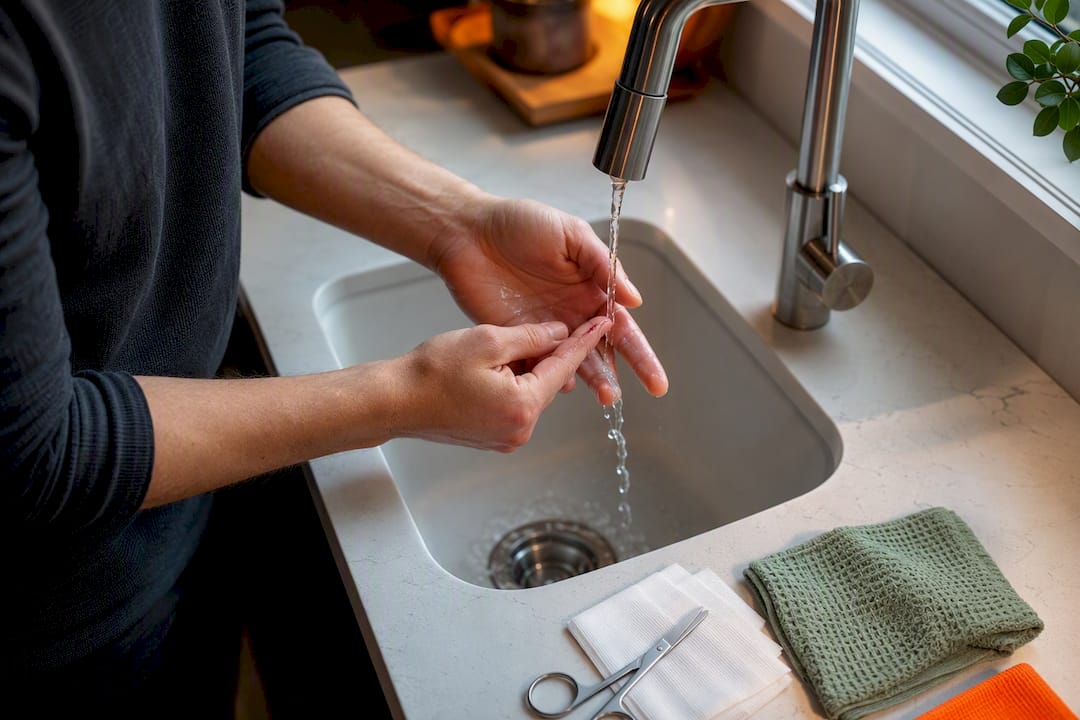
Rinse the wound under cool running water and clean gently with mild soap, removing any visible debris.
Pat the area dry with a clean cloth or gauze.
Apply a thin layer of petroleum jelly directly to the wound, straight from a tube if possible.
Cover with a bandage if the wound is on a spot prone to friction or dirt; leave it uncovered if it’s in a low-friction area and staying clean easily.
Reapply petroleum jelly and change the dressing once or twice daily, or whenever it gets wet or dirty.
Reserve antibiotic ointment for wounds showing actual signs of infection: increasing pain, spreading redness, pus or cloudy drainage, or fever. Deep punctures, animal bites, and heavily contaminated wounds also warrant antibiotic use, ideally guided by a healthcare provider who can tell you how long to continue treatment.
Pro Tip: If a wound starts burning or itching within a day of applying antibiotic ointment, stop using it and switch to plain petroleum jelly. That reaction is almost always the ointment, not the injury getting worse.
What the Research Actually Shows
The evidence behind this recommendation isn’t thin. The core trial, a double-blind randomized comparison between Aquaphor Healing Ointment and a combination antibiotic ointment, found equivalent clinical healing scores at three separate time points, alongside more burning and an allergic reaction in the antibiotic arm.
Broader reviews compiled in open-access PubMed Central literature back the same conclusion across multiple postprocedural wound studies. Limitations exist. Many of these trials involve modest sample sizes and focus on clean, elective, or minor traumatic wounds rather than contaminated or high-risk injuries, so the equivalence finding doesn’t automatically extend to every wound type you’ll encounter.
Where a Plant-Based Ointment Like Re-gen Fits In
Not everyone wants petroleum on their skin, and that preference is valid. Some people find petroleum jelly cosmetically greasy, some have petrolatum sensitivity, and pet owners often want something safer if their dog or cat licks the area. Theregenstore’s Re-gen Plant-Based Regenerative Ointment is built around that gap: a petroleum-free formula using a blend of botanical ingredients, positioned by the brand as support for skin, muscle, and tissue recovery without antibiotics or petroleum derivatives.
Petroleum jelly’s biggest limitation is that it’s purely protective. It seals and moisturizes but adds nothing regenerative to the wound bed. A plant-based alternative can be formulated to include botanicals alongside that protective barrier. If you’re weighing options beyond the petroleum jelly versus antibiotic ointment debate, the Re-gen versus Neosporin comparison walks through how a plant-based formula stacks up against a conventional antibiotic ointment in more detail.
Vaseline vs Neosporin: Ingredients and Formulation Compared
Vaseline is, chemically, a single ingredient: 100% white petrolatum, refined from petroleum. Nothing else goes in. That simplicity is exactly why its allergy profile is so low. There is essentially one substance for skin to react to, and reactions to pure petrolatum are rare.
Neosporin’s original formula combines three active ingredients, each targeting different bacteria: neomycin, polymyxin B, and bacitracin, suspended in a petrolatum-based carrier. Some versions on the market drop neomycin (the most allergenic of the three) and market themselves as gentler, but they still carry bacitracin and polymyxin B, either of which can trigger a reaction in sensitive skin.
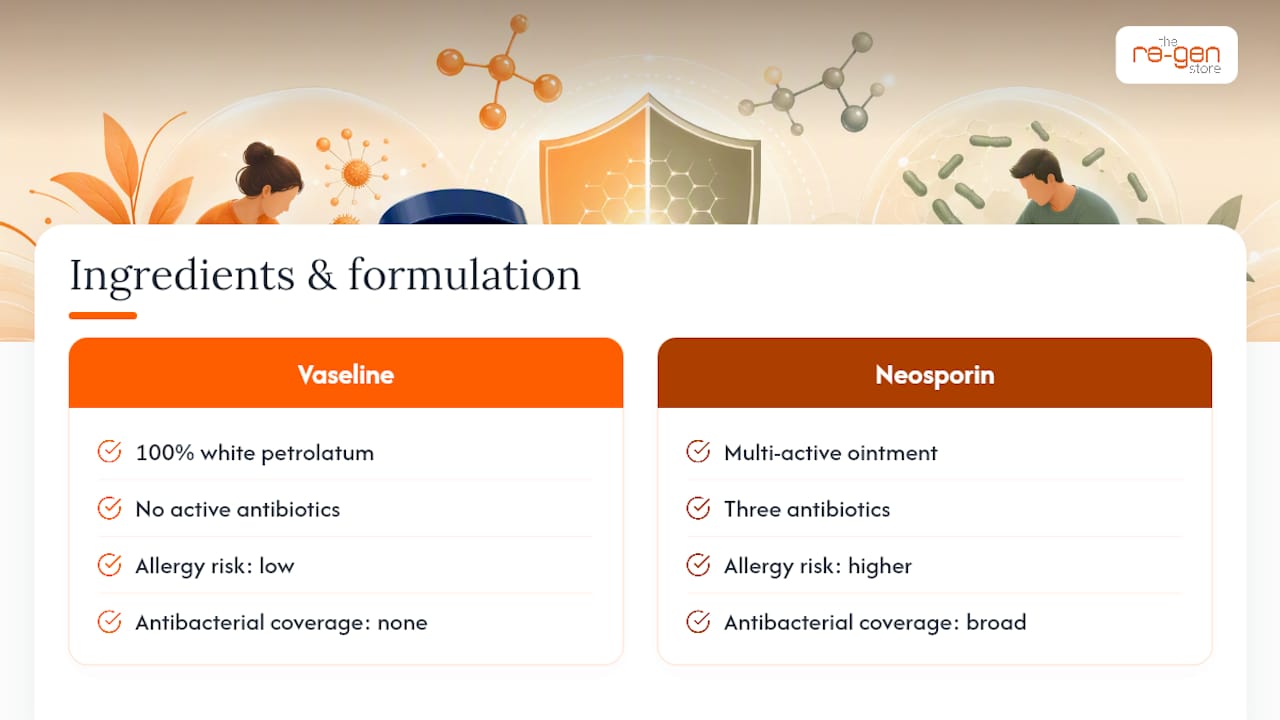
The practical takeaway: Vaseline’s ingredient list is a strength, not a limitation. Fewer active compounds means fewer chances for your skin to revolt. Neosporin’s multi-antibiotic approach was designed for broader bacterial coverage, but that same complexity is what drives its allergy numbers higher. If you’re comparing petroleum jelly versus antibiotic ointment purely on formulation risk, plain petrolatum wins on simplicity every time, while a multi-ingredient antibiotic blend wins only when you specifically need antibacterial coverage.
Side Effects and Contraindications Beyond Allergies
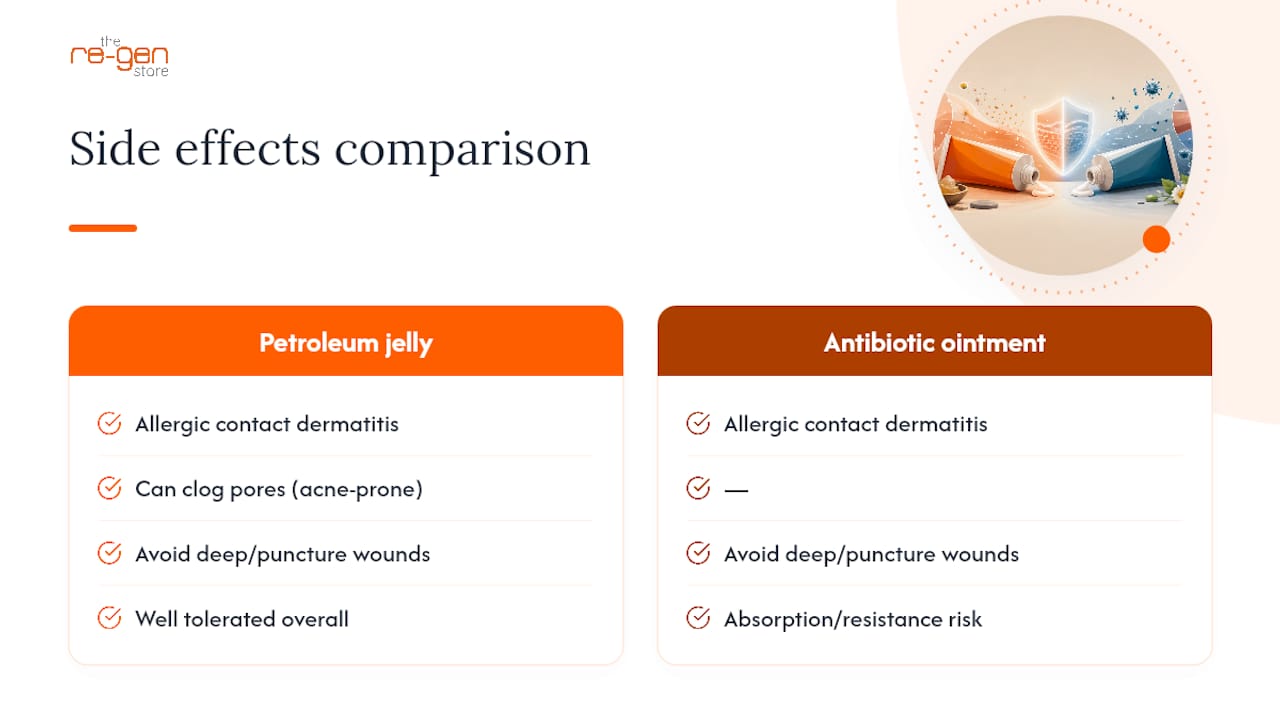
Allergic contact dermatitis gets most of the attention, but it isn’t the only downside worth knowing about. Petroleum jelly is very well tolerated overall, though it can clog pores if used heavily on acne-prone facial skin, and it shouldn’t be applied to deep puncture wounds or wounds actively draining pus, since sealing those in without medical evaluation can trap bacteria against the skin.
Neosporin and similar antibiotic ointments carry a few additional considerations beyond allergy risk. Applying antibiotic ointment over large areas of broken skin, or using it for extended periods without a break, raises the theoretical risk of absorption and resistance development. Some formulations aren’t recommended for children under certain ages without a doctor’s guidance, and product labeling on antibiotic ointments generally advises against use on deep or puncture wounds without medical supervision, the same caution that applies to leaving any wound of that severity untreated by a professional. Anyone with kidney concerns should also be cautious with neomycin specifically, since it belongs to a drug class with known effects on the kidneys and inner ear at high systemic exposure, even though topical absorption is typically minimal on intact skin.
Cost and Availability: Vaseline vs Neosporin
Vaseline is cheaper and more widely stocked than Neosporin, full stop. A jar or tube shows up in nearly every drugstore, grocery store, and convenience store, often for a fraction of the price of a comparably sized antibiotic ointment tube. Store-brand petroleum jelly is typically the least expensive wound-care product on the shelf.
Neosporin costs more per ounce, largely because of the active pharmaceutical ingredients, and store-brand “triple antibiotic ointment” alternatives usually run cheaper than the name brand while delivering the same active ingredients. Both products sit on open shelves without a prescription, so availability isn’t the deciding factor for either one. Cost only becomes relevant if you’re treating wounds frequently, at which point plain petroleum jelly’s lower price adds up.
Which Wounds Suit Vaseline and Which Suit Neosporin
Petroleum jelly is the right call for the vast majority of everyday injuries: paper cuts, kitchen nicks, road-rash style scrapes, blisters, minor burns after the initial cooling stage, and post-shave or post-waxing irritation. Anything clean, shallow, and low-risk belongs in this category.
Neosporin and other topical antibiotics earn their place with a narrower set of wounds: those already showing infection signs, deeper cuts with visible dirt or debris that couldn’t be fully rinsed clean, animal bites, and wounds sustained in environments with higher contamination risk (gardening injuries, rusty metal, outdoor falls). For pet-related situations specifically, check guidance on whether antibiotic ointment is safe for dogs before applying anything, since licking behavior changes the safety calculus. Parents managing pediatric skin issues, including diaper rash, may also find value in clinician-backed pediatric skincare guidance that follows a similar gentle-first philosophy.
The Simple Rule Worth Remembering
Petroleum jelly for routine minor wounds, antibiotic ointment only when infection signs actually show up. That’s the whole decision tree for the overwhelming majority of everyday cuts and scrapes. If you notice a rash, burning, or an allergic reaction after applying either product, stop and switch, and if a wound looks deep, dirty, or is not improving within a few days, that’s a signal to call a doctor rather than keep experimenting at home. For readers curious about petroleum-free options, the product comparison pages are worth a look.
— Kyle
A Petroleum-Free Option Worth Knowing About
If plain petroleum jelly isn’t your preference, Theregenstore’s Re-gen Plant-Based Regenerative Ointment gives you a petroleum-free route to the same goal: a moist, protected wound environment without antibiotics.
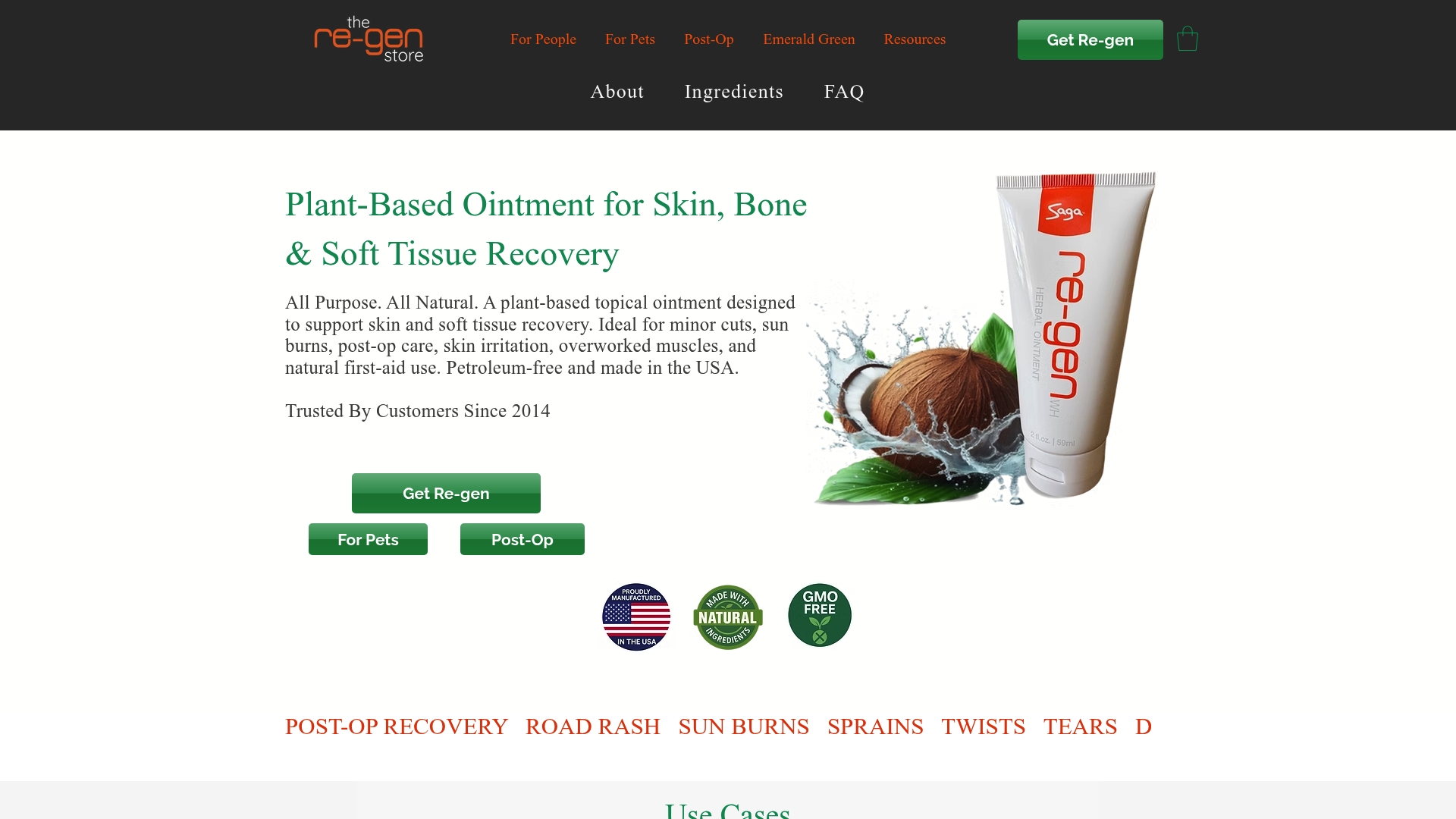
The ointment is formulated with a blend of botanical ingredients described as supporting skin, muscle, and bone recovery, designed for those who want to avoid both petroleum derivatives and antibiotic exposure on everyday cuts, scrapes, and post-procedure skin. It’s also relevant for pet owners managing licking behavior around a treated wound. You can browse the full product lineup or check out the Emerald Green formula directly for ingredient details and sizing. Every order ships with a flat $3 shipping fee, so trying it out doesn’t require guessing what checkout will cost. Head to Theregenstore to compare sizes and place an order.
This article is general information, not a substitute for advice from a qualified doctor. Consult a qualified healthcare professional about your own circumstances before acting on anything here.
Sources
FAQ
Do Wounds Heal Better with Vaseline?
For clean, minor wounds, yes. Vaseline supports moist wound healing and clinical trials show it performs as well as antibiotic ointment on healing scores, with fewer side effects.
Why Do Dermatologists Say Not to Use Neosporin?
Many dermatologists caution against routine Neosporin use because topical antibiotics carry allergic contact dermatitis rates as high as roughly 30% for neomycin, and offer no proven healing advantage on clean wounds compared with plain petroleum jelly.
Why Do Dermatologists Use Vaseline Instead of Neosporin?
Vaseline keeps wounds moist and protected without the antibacterial ingredients that trigger allergic reactions or contribute to antibiotic resistance, which is why it’s often the preferred first choice for routine minor cuts and scrapes.
Can I Use Vaseline as an Antibiotic Ointment?
Vaseline isn’t an antibiotic and doesn’t kill bacteria, but for clean minor wounds it doesn’t need to. Its job is to keep the wound moist and sealed so your skin can heal itself, which research shows works about as well as antibiotic ointment for uncomplicated cuts.
Is There a Natural Alternative to Vaseline and Neosporin?
Yes. Plant-based ointments like Theregenstore’s Re-gen formula offer a petroleum-free, antibiotic-free option for people who want botanical ingredients instead of either standard choice.
Recommended
Comments