
How to Speed Up Wound Healing Naturally

Slow wound healing is genuinely frustrating. Whether you are dealing with a cut that refuses to close, a burn that lingers, or a post-operative incision that feels stuck, the wait can feel defeating. Knowing how to speed up wound healing gives you real control over your recovery. This guide covers evidence-based wound healing tips you can start using today, from home care practices and nutrition strategies to advanced natural therapies that support faster, cleaner tissue repair.
Table of Contents
Key takeaways
Point | Details |
Moist environment matters | Keeping a wound covered and moist can accelerate skin cell regrowth by up to 50% compared to dry healing. |
Clean gently, not aggressively | Avoid hydrogen peroxide and alcohol. Use mild soap, water, or saline to protect healthy tissue. |
Nutrition drives repair | Protein, vitamin C, and zinc directly fuel the tissue rebuilding process at the cellular level. |
Sleep and stress affect outcomes | At least 7 hours of sleep and active stress management support immune response and growth hormone release. |
Natural therapies add real value | Medical-grade honey, aloe vera, and hyperbaric oxygen therapy each have research-backed mechanisms for accelerating recovery. |
How to speed up wound healing: understanding the basics
Your body heals wounds in four distinct phases: clotting, inflammation, proliferation, and remodeling. Each phase has a specific job, and disrupting any one of them slows the whole process. Typical minor cuts usually complete primary wound healing within 7 days when conditions are right. When conditions are wrong, that timeline stretches significantly.
The four healing phases
Clotting: Blood vessels constrict and a clot forms to stop bleeding. This phase takes minutes to hours.
Inflammation: White blood cells arrive to fight bacteria and clean damaged tissue. Redness and swelling are normal signals here, not problems.
Proliferation: New tissue forms. Collagen is deposited, blood vessels regrow, and skin cells migrate across the wound surface.
Remodeling: The new tissue strengthens and reorganizes. This phase can last months for deeper wounds.
One of the biggest factors affecting speed across all four phases is the wound environment itself. Dry healing slows epithelialization by up to 50%. Skin cells cannot migrate across a dry, crusty surface nearly as efficiently as they can across a moist one. Beyond that, internal factors like blood flow, nutrition, hydration, and stress levels all influence how quickly your body moves through each phase.
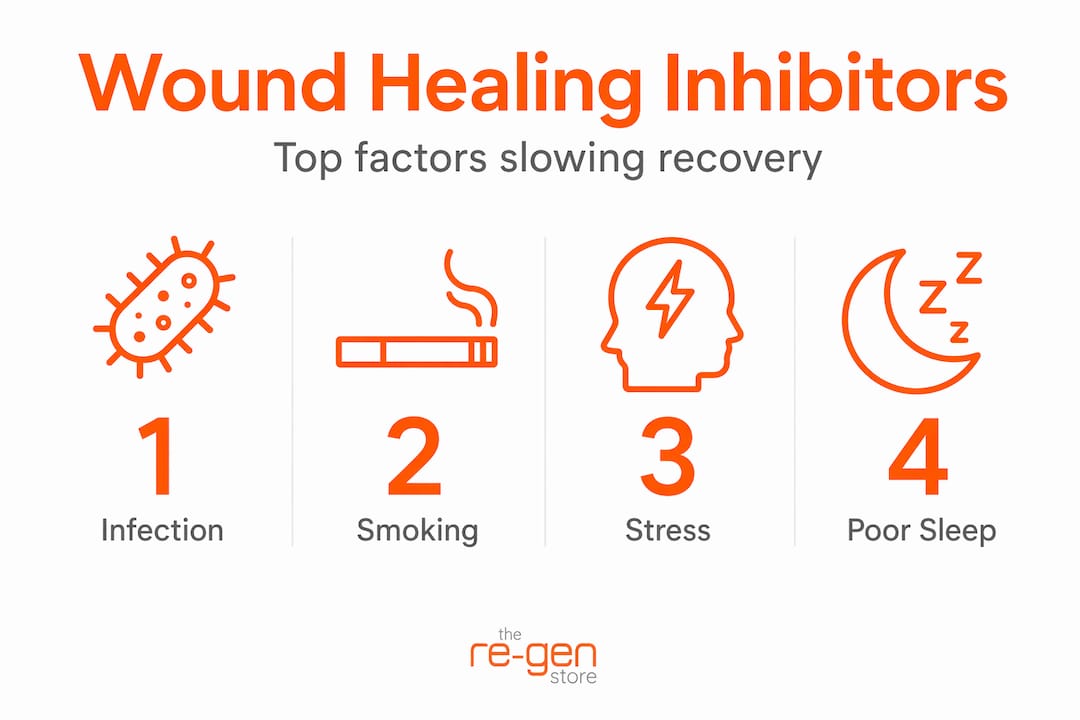
Common inhibitors that stall recovery include infection, smoking, uncontrolled blood sugar, chronic stress, and poor sleep. Identifying which of these applies to your situation is the first step toward optimizing wound healing effectively.
Essential wound care practices at home
What you do in the first 24 to 48 hours sets the tone for the entire healing process. These steps are not optional extras. They are the foundation of healing a wound quickly at home.
Clean the wound gently. Rinse with cool running water and mild soap or saline. Avoid harsh antiseptics like hydrogen peroxide and rubbing alcohol. They are cytotoxic and destroy the healthy cells your body is trying to build.
Apply a protective covering. Use a moist, breathable dressing. This keeps the environment stable and prevents the surface from drying out.
Change dressings carefully. When you change a dressing, work quickly and minimize the time the wound is exposed to open air. Repeated exposure to cool air impairs cellular activity for several hours after each dressing change.
Leave scabs alone. Premature scab removal disrupts the proliferation phase, raises infection risk, and prolongs healing. A scab is not a failure. It is a natural protective barrier.
Watch for infection signs. Increasing redness, warmth, swelling, pus, or fever are red flags. Infected wounds do not heal faster on their own. They need medical attention.
Pro Tip: Warm the area around your wound slightly before a dressing change by placing your hands near it for a minute or two. This supports local circulation and helps offset the cellular slowdown caused by temperature exposure.
Keeping dressing changes consistent, not just frequent, also matters. More is not always better. Disrupting a wound too often interferes with the tissue regeneration process. Follow the 24 to 48 hour guideline for most minor wounds unless you see signs of infection or saturation.
Nutrition, hydration, and lifestyle habits for faster recovery
You cannot out-dress a bad diet. The raw materials for tissue repair come from what you eat and drink, and nutrition deficiencies in protein, vitamin C, and zinc significantly impair tissue healing. Think of these nutrients as the building crew your wound site calls in.
Nutrients that directly support repair
Protein: Collagen and new tissue are made from amino acids. Without adequate protein, your body cannot rebuild effectively. Prioritize lean meats, eggs, legumes, and dairy.
Vitamin C: Directly required for collagen synthesis. It also supports immune function during the inflammation phase. Citrus fruits, bell peppers, and broccoli are reliable sources.
Zinc: Supports cell division, protein synthesis, and immune response. Deficiency slows wound closure visibly. Find it in pumpkin seeds, shellfish, beef, and lentils.
Antioxidants: Found in colorful fruits and vegetables, antioxidants reduce oxidative stress at the wound site and support tissue recovery.
Hydration is just as important as food. Drinking 0.5 fluid ounces of water per pound of body weight daily promotes skin elasticity and efficient nutrient delivery to the wound. A 160-pound person should aim for about 80 fluid ounces per day.
Sleep is non-negotiable in any speed up recovery plan. At least 7 hours of sleep supports growth hormone release, which is critical for tissue repair. Stress does the opposite. Elevated cortisol suppresses immune function and directly slows the healing response. Managing stress through breathing exercises, light movement, or social support is not soft advice. It is wound care.
Pro Tip: If your appetite is low during recovery, focus on high-protein, nutrient-dense snacks like Greek yogurt with berries or a small handful of mixed nuts rather than forcing large meals. Consistent smaller doses of nutrition keep repair materials available around the clock.
Light movement like gentle walking improves circulation and blood flow to the wound without stressing the injury. Sedentary recovery is not automatically safer. Getting blood moving supports oxygen and nutrient delivery to exactly where your body needs it most. Learn more about post-surgery recovery and how lifestyle choices affect tissue repair timelines.

Advanced and natural therapies for stubborn wounds
Some wounds need more than good home care. When healing stalls, these therapies offer research-backed ways to heal wounds faster at a biological level.
Therapy | Mechanism | Best for |
Medical-grade honey (Manuka) | Maintains moisture, inhibits bacteria, promotes tissue regeneration | Infected or slow-healing wounds |
Aloe vera (topical) | Reduces inflammation, supports skin cell migration | Burns, minor abrasions |
Hyperbaric Oxygen Therapy (HBOT) | Increases oxygen delivery, stimulates collagen and new blood vessels | Chronic wounds, diabetic ulcers |
Low-level laser therapy | Stimulates cellular energy production and circulation | Post-operative and slow-closing wounds |
Senolytic treatments | Activates collagen production and angiogenesis in aging tissue | Older adults with impaired healing |
Medical-grade Manuka honey works by maintaining a moist wound environment while simultaneously suppressing bacterial growth. It is one of the few natural remedies for wounds that has genuine clinical support. Aloe vera is similarly effective for surface-level burns and abrasions, with compounds that reduce inflammation and encourage skin cell movement.
HBOT, which involves breathing pure oxygen in a pressurized chamber at 2 to 3 times atmospheric pressure, is a clinical option worth discussing with your doctor if you have a chronic wound or compromised circulation. Emerging research also shows that targeted senolytic therapies can speed healing in older skin by activating collagen production and angiogenesis in aged tissue. These are not home treatments, but knowing they exist can open a useful conversation with your healthcare provider.
My take on healing wounds the right way
I have spent years observing how people approach wound care, and the most common mistake I see is impatience. People want to do more, add more, and intervene more. Often, the best thing you can do is set up the right conditions and then get out of your body’s way.
The body is remarkably capable when it has what it needs: moisture, nutrients, circulation, rest, and protection from infection. Where I have seen recovery go sideways is not from lack of effort but from the wrong efforts, such as using antiseptics that damage tissue, picking at scabs, or sleeping poorly while wondering why healing is slow.
My honest advice is to treat wound care like you would treat training for something. You create conditions, you stay consistent, and you trust the process. Pair that mindset with the right natural support and clinical guidance when needed, and recovery usually follows. The people who heal well are rarely doing anything dramatic. They are just doing the fundamentals, without skipping steps.
— Kyle
Support your recovery with plant-based wound care
If you are looking for a natural, petroleum-free way to support wound healing at home, Theregenstore offers Re-gen, a plant-based regenerative ointment designed for cuts, burns, sprains, and post-operative recovery. It is formulated without harsh chemicals and works as a natural Neosporin alternative for people who prefer herbal, clean-ingredient wound care.
Theregenstore also carries petroleum-free wound treatments and supporting products designed to promote tissue regeneration naturally. Whether you are managing a fresh cut or supporting longer-term tissue recovery, the product line is built around the same principles covered in this guide.
FAQ
What is the fastest way to heal a wound naturally?
Keep the wound clean and covered with a moist dressing, eat adequate protein and vitamin C, stay hydrated, and get quality sleep. These steps together support every phase of the healing process simultaneously.
Does keeping a wound moist really speed up healing?
Yes. A moist wound environment can accelerate skin cell regrowth by up to 50% compared to letting a wound dry out. Use a breathable, moisture-retaining dressing rather than leaving wounds uncovered.
Should I use hydrogen peroxide to clean a wound?
No. Hydrogen peroxide is cytotoxic and damages the healthy tissue your body is rebuilding. Clean wounds gently with mild soap and water or saline instead.
How does nutrition affect wound healing speed?
Deficiencies in protein, vitamin C, and zinc directly impair tissue repair and slow wound closure. Eating a nutrient-rich diet gives your body the raw materials it needs to rebuild at a cellular level.
When should I see a doctor about a wound?
Seek medical attention if you notice increasing redness, warmth, swelling, pus, red streaks, or fever. These are signs of infection that will not resolve with home care alone and require professional treatment.
Recommended
Comments