
Homeopathic vs Herbal: What Sets Them Apart


Herbal products are made from plants and can contain active compounds. Homeopathic remedies are prepared by repeated dilution, and many contain no measurable amount of the original substance. Harvard Health draws the same line. The two get lumped together as “natural,” but they work on different ideas and the FDA treats them differently. This guide shows how to tell them apart on a label, and what that means when you choose something for a cut, a burn or a scrape.
TL;DR
Herbal products use plant material that may contain biologically active ingredients. Homeopathic remedies are highly diluted preparations, often with no active ingredient left.
A homeopathic product does not have to come from a plant. It can start from minerals, chemicals or animal sources.
“Natural” on a label tells you little. Look for the word “Homeopathic,” dilution marks such as 6X or 30C, and a plain list of plant ingredients.
Some herbs have clinical research behind them for skin and wound care, including aloe vera and calendula.
Deep, dirty, bleeding or infected wounds, and any wound on a pet, need a clinician or vet.
Table of Contents
The core difference: plant compounds vs. dilution
Herbal medicine uses the plant itself, or an extract of it: leaves, flowers, roots, oils, gels. The plant’s compounds are the point. According to Harvard Health, herbal supplements are made from plants and may contain biologically active ingredients that affect the body.
Homeopathy rests on a different theory. The National Center for Complementary and Integrative Health (NCCIH) describes it as built on “like cures like” and a “law of minimum dose.” Many homeopathic products are so diluted that no molecules of the original substance remain.
In short:
Herbal | Homeopathic | |
Starting material | Plants | Plants, minerals, chemicals, animal sources |
How it is made | Extracts, infusions, oils, gels, ointments | Repeated dilution |
Active compounds | Usually present | Often none left |
Label clues | Plant names, extract type, amounts | “Homeopathic,” 1X, 6X, 30C |
Are homeopathic medicines herbal?
Sometimes the starting point is a plant, but the finished product is not herbal in the usual sense. NCCIH lists plant sources such as arnica and stinging nettle, alongside minerals such as white arsenic and animal sources such as crushed whole bees.
The FDA adds that homeopathic products can include ingredients from diseased animal or human sources, minerals and chemicals. They can also include known poisons or toxins, always in highly diluted form.
So the same name can mean two things. “Arnica” in a plant-extract cream is an herbal product. “Arnica 30C” is a homeopathic dilution.
How the FDA treats each one
Regulation is another way to separate them. Homeopathic products are regulated as drugs. Herbal products sold as supplements fall under the Dietary Supplement Health and Education Act of 1994. Under that law, herbal products may be sold without efficacy testing. Companies cannot claim to cure disease, but they may make structure and function claims.
Neither category gets the review a pharmaceutical gets. Harvard Health says neither herbal nor homeopathic remedies are regulated as carefully as pharmaceuticals. The FDA also notes that homeopathic products marketed in the U.S. have not been reviewed for safety or effectiveness.
The FDA points out another practical issue. Homeopathic products often sit on shelves next to nonprescription drugs the agency has reviewed, which can make them hard to spot.

What the evidence shows for wounds and skin
This is where herbal and homeopathic products part ways most clearly. NCCIH says there is little evidence that homeopathy works for any specific health condition.
Plant-based skin care has a more developed research record. A few examples:
Aloe vera. In a 2021 randomized trial in Iran, aloe vera gel reduced itching and pain and sped healing compared with silver sulfadiazine cream in first- and second-degree burns.
Calendula. In a 2016 Brazilian trial of chronic venous leg ulcers, 73.7% of patients treated with calendula extract reached complete epithelialization, against 31.6% in the control group.
Calendula, regulatory view. The European Medicines Agency has approved calendula extracts as traditional medicinal products for minor wounds and minor skin inflammations.
These are specific studies on specific preparations, not a promise about every product. If you want to go deeper on one herb, see our look at what the clinical evidence shows for calendula, or our broader guide to natural remedies and what the evidence shows.
What “chemical-free” wound care should mean on a label
Every substance is a chemical, so the phrase is better read as a question: what is actually in this? A few checks make the answer clear.
Find the category. The FDA says to look for the word “Homeopathic,” Latin ingredient names and dilution marks such as 1X, 6X or 2C. If you see them, it is a homeopathic product.
Read the ingredient list. A product that names each plant and its form (extract, oil, gel) tells you what you are putting on your skin.
Look at the base. Many conventional ointments use a petroleum base. Plant-based formulas use other carriers.
Think about consistency. Researchers reviewing botanical wound care note that plant formulations can vary, so batch-to-batch standardization matters. A maker who controls its process is worth more than a long ingredient story.
Know your allergies. Calendula is generally regarded as safe on skin, but people allergic to the daisy family (Asteraceae) should avoid it.
Gentle wound care is mostly about simple habits: clean the area, keep it covered and moist, and use a short ingredient list. Our guide to herbal skin support walks through this step by step.
When a wound needs a professional
No ointment, herbal or otherwise, replaces medical care for a serious wound. Natural does not mean a wound can wait. MedlinePlus advises contacting a health care provider right away if the wound:
is large or deep, more than a quarter inch deep, on the face, or reaches the bone;
came from a human or animal bite, a rusty object or a nail;
has debris stuck in it;
shows signs of infection, such as warmth, redness, throbbing pain, fever, swelling, a red streak or pus;
happened when your last tetanus shot was more than 10 years ago.
Call 911 if bleeding is severe or does not stop after 10 minutes of pressure. The American College of Surgeons also names diabetes, vascular disease, and medicines such as steroids or anticoagulants as reasons to call a doctor early.
Harvard Health makes the wider point: herbals used instead of conventional therapy for serious disease can cost precious time. Herbs can also interact with medications, so tell your clinician what you use.
Pets: keep a vet in the loop
Animal skin and physiology differ from ours. VCA Animal Hospitals says herbal treatment should follow an accurate diagnosis and be prescribed by a trained veterinarian. For a fresh wound, their guidance is to clean with saline or water only unless your vet directs otherwise. Call your vet before applying any new product to an animal’s wound.
Perspective
We make a plant-based ointment, so we care about this line. Herbal and homeopathic are not interchangeable, and a reader deserves to know which one is in the jar. Re-gen is an herbal product. Our formula is designed around a blend of 10 herbal ingredients and is petroleum-free. It is meant to support skin, soft tissue, bone and muscle recovery, for people and, with the right guidelines, for pets. That is a plant-compound approach, not a dilution approach. Our advice is simple. Read the whole label, favor products that tell you what is in them, and treat deep or infected wounds as a medical matter. Then give your skin a clean, protected place to recover. Kyle
Where Re-gen fits
If you want a plant-based option for everyday cuts, scrapes and minor burns, Re-gen is our petroleum-free herbal ointment, with versions and usage guidelines for people and pets. You can compare it with a conventional antibiotic ointment in our page on Re-gen vs Neosporin, or see how we approach plant-based wound treatment without petroleum.
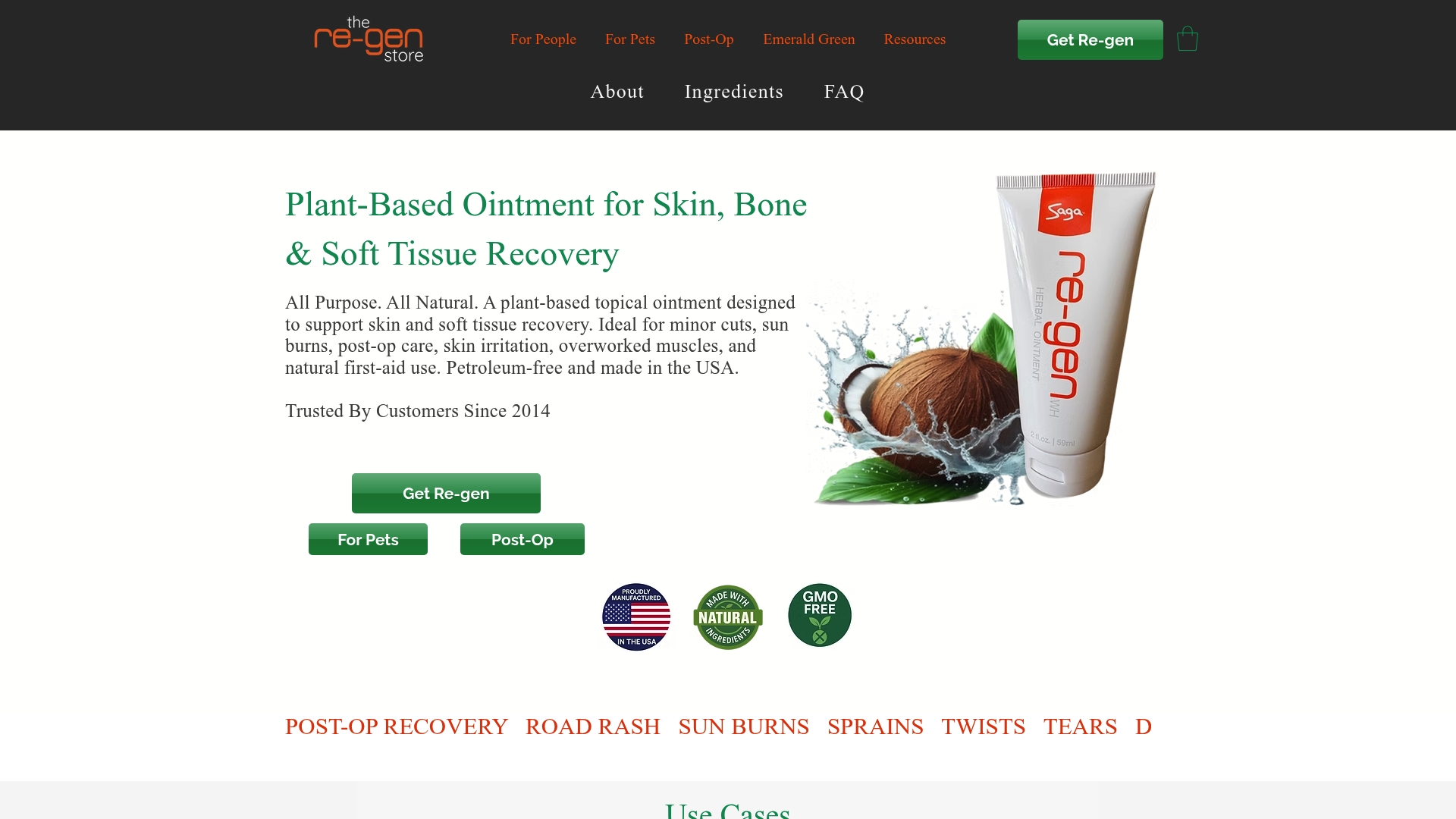
Browse the Re-gen range or the Emerald Green spray. Shipping is a flat $3. Start at theregenstore.com.
FAQ
Is homeopathy the same as herbal medicine?
No. Herbal medicine uses plant material that may contain active compounds. Homeopathy uses highly diluted preparations, often with no active ingredient left. A homeopathic product can also start from minerals or animal sources, not only plants.
Are homeopathic medicines made from herbs?
Some start from plants, such as arnica or stinging nettle, but others start from minerals or animal material. After dilution, the finished product is regulated and labeled as homeopathic, not herbal. Check the label for the word “Homeopathic” and dilution marks like 6X or 30C.
Is a natural wound ointment automatically safe?
Not automatically. Some herbs can cause allergic reactions or interact with medicines. Calendula, for example, can trigger reactions in people allergic to the daisy family. Check the ingredient list against your allergies, and ask a pharmacist or doctor if you take regular medication.
Can I use herbal products on my dog or cat?
Ask your vet first. Veterinary sources advise that herbal treatments follow a diagnosis and come from a trained veterinarian. For a fresh wound, clean it with saline or water and call your vet for the next step.
Sources
Recommended
Comments