
Essential oils for healing: Evidence, uses, and safety
- Sunny

- May 8
- 7 min read
Essential oils have earned a devoted following among health-conscious people seeking natural alternatives to conventional products. But the widespread belief that “natural” automatically means safe or effective can lead to real harm. Research confirms that essential oils exhibit genuine antimicrobial, anti-inflammatory, antioxidant, and anxiolytic properties. The catch? Those same properties come with risks that most guides quietly ignore. This article walks you through what the science actually says, which oils work best for skin and wound recovery, how to protect yourself and your pets, and where caution is just as important as confidence.
Table of Contents
Key Takeaways
Point | Details |
Backed by biology | Essential oils work through anti-inflammatory, antimicrobial, and neurological pathways supporting healing. |
Best oils for healing | Lavender, Nigella sativa, tea tree, and oregano oils show the strongest evidence for skin and wound recovery. |
Safety is essential | Dilute oils, patch test, and be especially careful with children, sensitive skin, and pets. |
Pets need extra caution | Essential oils can be toxic to animals, especially cats and birds, and require strict veterinary supervision. |
Complementary, not primary | Use essential oils as supportive care alongside, not instead of, standard medical treatments. |
How essential oils act in the body
Essential oils reach your body through two primary routes: inhalation and skin absorption. When you inhale an oil, aromatic compounds travel through your olfactory (smell) system directly to the brain, influencing mood, stress hormones, and nervous system activity. When you apply an oil to your skin, its small molecular size allows it to pass through the outer skin barrier and enter the bloodstream.

Once inside, these compounds get to work at a cellular level. They do not simply smell pleasant. Essential oils modulate cytokines, which are chemical messengers that control inflammation, and they interact with neurotransmitters like GABA, the calming chemical your brain uses to reduce anxiety. They also influence the Nrf2/Keap1 pathway, a cellular system that regulates your body’s response to oxidative stress, which is the kind of cellular damage that slows tissue repair.
Here is a quick summary of the key biological actions:
Anti-inflammatory: Reduces swelling and redness around wounds and irritated skin
Antimicrobial: Inhibits bacterial and fungal growth on the skin surface
Antioxidative: Protects cells from free radical damage during recovery
Anxiolytic: Calms the nervous system, supporting rest and stress reduction
Pro Tip: Inhalation and topical use are not interchangeable. An oil that relaxes you when diffused may irritate your skin if applied directly. Choose your application method based on the outcome you want.
For a deeper look at how plant-based compounds support tissue repair, explore natural healing for skin and the pathways involved. The science is nuanced, but the takeaway is practical: essential oils are biologically active substances, not passive fragrances.
Top essential oils for skin, wounds, and recovery
Understanding the science is key, but which oils actually deliver on their promise for your skin, wounds, and recovery? Research has focused most heavily on four oils, and the results are encouraging, though still largely based on preclinical (laboratory and animal) studies.
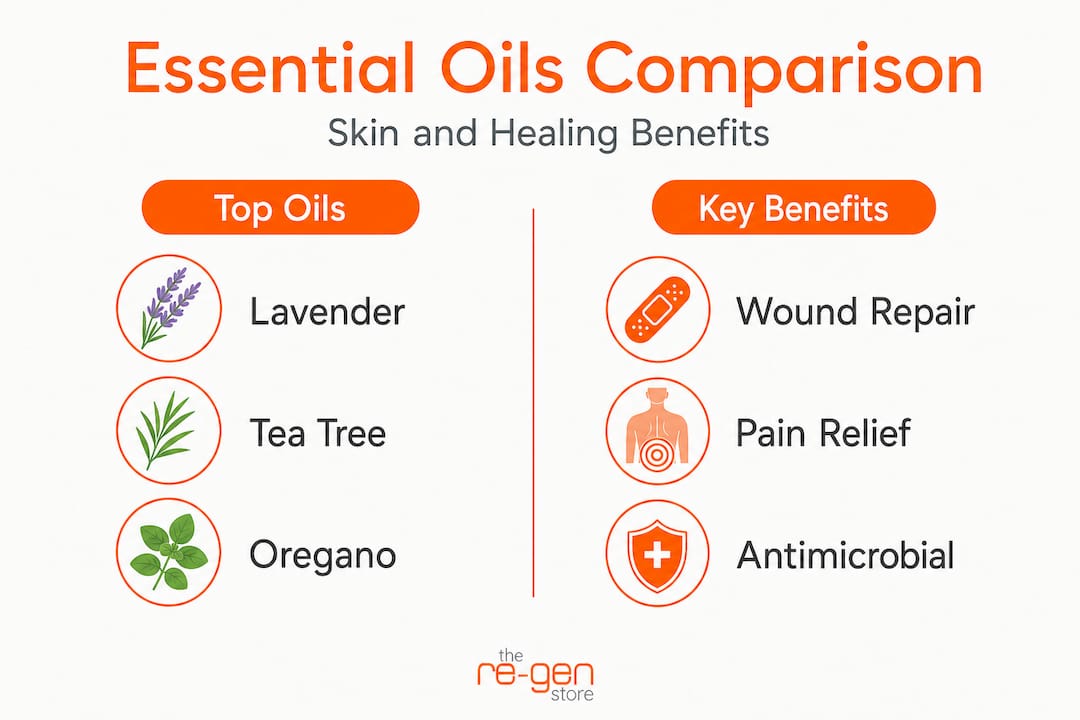
Oregano, Nigella sativa, tea tree, and lavender oils accelerate healing and reduce inflammation in preclinical models. Here is how they compare:
Oil | Key benefit | Evidence level | Best use |
Lavender | Wound closure, pain relief | Preclinical + some human | Minor cuts, burns, stress |
Tea tree | Antimicrobial, antifungal | Preclinical + some human | Infections, acne, wounds |
Oregano | Potent antimicrobial | Preclinical | Contaminated wounds |
Nigella sativa | Anti-inflammatory, wound repair | Preclinical | Skin inflammation, healing |
A few things stand out from this comparison. Lavender is probably the most studied oil for wound recovery. It supports faster closure of minor wounds and reduces the inflammatory response in surrounding tissue. Tea tree oil is one of the most reliable natural antimicrobials available, effective against a broad range of bacteria and fungi. Oregano is extremely potent, which also means it carries higher irritation risk. Nigella sativa (black seed oil) has emerged as one of the more promising options for both reducing inflammation and actively supporting tissue regeneration.
The phrase “preclinical models” matters here. It means the evidence comes from lab cultures and animal studies, not large-scale human clinical trials. Results are promising, but they do not guarantee identical outcomes in everyday use. If you want to learn more about speeding up wound healing through evidence-backed approaches, the methods go beyond oils alone. Combining plant-based options with good wound care practice produces better outcomes than oils in isolation.
For practical application, pairing the right oil with the right situation matters. Find science-backed skin healing tips that put these oils in context with other natural recovery strategies.
Safety first: What most guides miss about risks and adverse reactions
While plant oils can seem harmless, using them safely requires more than intuition. Here is what the science actually says about protecting yourself.
Undiluted and high-absorption use can cause dermatitis or systemic reactions, and phototoxicity in citrus oils affects around 4% of users. That number may sound small, but a phototoxic burn from applying lemon or bergamot oil before sun exposure can be severe and slow to heal.
Follow these steps before applying any essential oil to your skin:
Dilute every time. Use a carrier oil such as jojoba, coconut, or sweet almond. A safe dilution is 1 to 5% depending on the oil and the individual.
Patch test first. Apply a small diluted amount to the inner forearm. Wait 24 hours before wider use.
Avoid citrus oils before sun exposure. Bergamot, lemon, lime, and grapefruit can cause chemical burns when skin is exposed to UV light within 12 to 18 hours of application.
Keep oils away from broken skin until you understand the oil. Tissue that is already compromised absorbs compounds far more rapidly.
Note reaction timing. Minor reactions typically resolve in 48 hours. Sensitization reactions from repeated exposure can take up to a year to fully clear.
Risk type | Common oils | Timeline | Action |
Contact dermatitis | Cinnamon, clove, oregano | Hours to 48 hrs | Stop use, soothe area |
Phototoxicity | Bergamot, lemon, lime | 12 to 18 hrs post-application | Avoid sun exposure |
Sensitization | Tea tree (undiluted) | Repeated exposure | Dilute properly, rotate oils |
Pro Tip: “Natural” oils like cinnamon bark and clove are among the most irritating substances you can apply to skin. Potency is not always a benefit. If you experience any reaction, learn how to approach calming skin irritation naturally to support recovery without making things worse.
Children, pregnant people, and those with sensitive skin face elevated risks. Always consult a healthcare provider if you are managing a condition with essential oils.
Natural doesn’t mean safe: Essential oils and pets
Human safety is just one side of the story. For pet owners, knowing the risks is critical before considering essential oils for your furry or feathered friends.
Pets, particularly cats and birds, are highly sensitive to essential oils, with potential for serious toxicity via inhalation and ingestion. Cats lack the liver enzyme (glucuronyl transferase) needed to metabolize many of the compounds found in essential oils. This means that even small exposures can accumulate to toxic levels. Birds have extremely efficient respiratory systems, which makes inhalation risks even higher for them.
Key rules for pet owners:
Never apply undiluted essential oils directly to pets
Never diffuse oils in enclosed spaces where pets cannot leave the room
Tea tree oil is toxic to dogs and cats, even in small topical amounts
Eucalyptus, pennyroyal, and clove carry high toxicity risks for most animals
For dogs, use only highly diluted formulations and always under veterinary supervision
Pro Tip: Passive diffusion in a large, well-ventilated room with your pet present is far safer than direct application, but it is still not risk-free. Watch for signs like lethargy, drooling, tremors, or difficulty breathing.
If you are looking for genuinely pet-safe approaches to recovery, natural healing for pets covers evidence-based options that support your animal’s recovery without the toxicity risks. You can also explore plant-based pet recovery options formulated with animal safety in mind.
A nuanced view: The real potential (and limits) of essential oils in healing
We see a lot of enthusiasm for essential oils in natural health communities, and much of it is warranted. The biological activity is real. The anti-inflammatory, antimicrobial, and regenerative effects are not imaginary. But there is a gap between early-stage evidence and the bold claims you read on social media.
Most essential oil evidence remains preclinical, and standardized chemotypes plus randomized controlled trials are still largely missing from the research landscape. “Chemotype” refers to the specific chemical composition of an oil, which can vary significantly between batches and brands. An oregano oil with high carvacrol content behaves differently from one with lower concentrations. Without standardization, comparing studies or predicting outcomes is genuinely difficult.
Our honest view: essential oils work best as a complementary layer within a broader healing approach. They are not a replacement for wound cleaning, proper bandaging, medical assessment, or pharmaceutical care when those are needed. Explore plant-based wound care options that are formulated with this kind of integrated thinking.
The promise is real. So are the limits. Holding both of those truths at once is what responsible natural healing actually looks like.
Plant-based healing, powered by science: What to try next
If you are ready to put these science-backed insights into practice, the next step is choosing products formulated with both efficacy and safety as design priorities.

At TheRegenStore.com, Re-gen regenerative ointment is built around plant-based, petroleum-free ingredients designed to support skin, soft tissue, and wound recovery. It is formulated to complement your body’s natural healing processes rather than override them. Whether you are dealing with a minor cut, a slow-healing wound, or post-activity skin recovery, explore natural wound healing solutions that align with what the evidence actually supports. For a practical starting point in your first-aid routine, plant-based first aid shows you what thoughtful, chemical-free wound care looks like in practice.
Frequently asked questions
What essential oils are proven best for wound healing?
Lavender, tea tree, oregano, and Nigella sativa show the strongest evidence for supporting wound healing, based primarily on preclinical studies showing accelerated closure and reduced inflammation.
Can essential oils replace standard medical treatments?
No, essential oils are best used as complementary support alongside conventional care. Experts recommend integrating essential oils with professional medical treatment rather than as standalone therapies.
How do I avoid skin irritation when using essential oils?
Always dilute to 1 to 5% in a carrier oil and patch-test on a small skin area first. Dilution and patch testing are the most reliable ways to prevent contact dermatitis and sensitization reactions.
Are essential oils safe for pets?
Most essential oils carry serious toxicity risks for pets, especially cats and birds. Always consult a veterinarian before using any essential oil around or on your animals.
Do essential oils help with stress management?
Lavender oil shows real promise for anxiety relief through its interaction with GABA receptors, though research is mostly preclinical and large-scale human trials are still needed to confirm consistent effects.
Recommended
Comments