
How to Clean a Dog Wound Safely at Home
- Sunny

- 4 days ago
- 12 min read
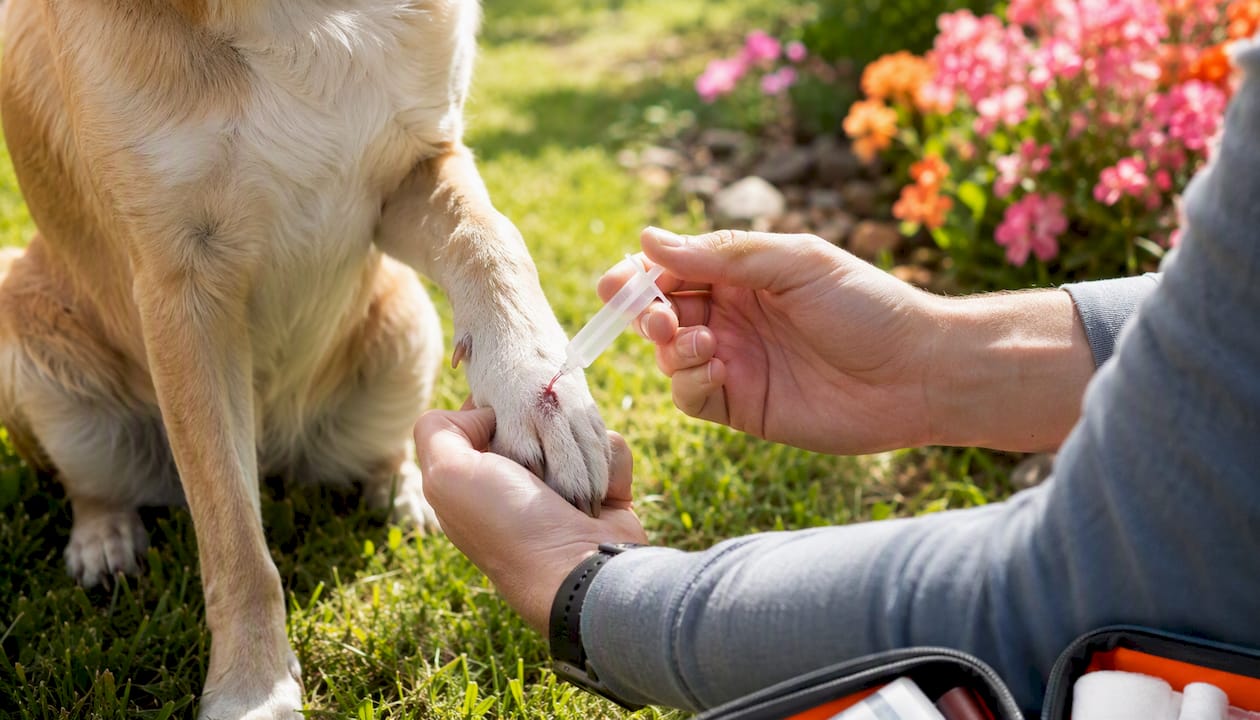
For a minor dog wound, act in this order: apply gentle pressure to stop bleeding, flush the wound with sterile saline or warm water, keep your dog from licking the site, and cover it with a clean nonstick dressing. That sequence handles most small cuts, scrapes, and superficial pad injuries without a vet visit.
Here’s what to do in the first few minutes:
Control bleeding: Press a clean cloth or gauze firmly over the wound for 3–5 minutes without lifting to peek.
Flush the wound: Use sterile saline or plain warm water to rinse away dirt and debris. Do not scrub.
Dry and protect: Pat the area dry with clean gauze, then cover loosely with a nonstick pad.
Call your vet immediately if bleeding won’t stop after 10 minutes, the wound is deep or gaping, or your dog shows weakness, pale gums, or collapse.
Pro Tip: Keep a 10 mL or 12 mL syringe in your first-aid kit. Filling it with saline and pressing the plunger creates enough pressure to flush debris from a wound without damaging tissue — far more effective than pouring from a bottle.
Key Takeaways
Proper home wound care starts with controlled bleeding, thorough irrigation with saline or warm water, and consistent protection — and escalates to veterinary care the moment infection signs or systemic symptoms appear.
Point | Details |
Flush first, always | Irrigate with sterile saline or warm water using a syringe; this is the most effective step for reducing infection risk. |
Avoid harmful agents | Never use hydrogen peroxide, rubbing alcohol, tea tree oil, or dish soap — all damage healing tissue. |
Watch paw injuries closely | Pad lacerations carry a 27% short-term complication rate; monitor daily and change bandages as needed. |
Call your vet promptly | Escalate if redness, swelling, or discharge worsens after 48–72 hours, or sooner with systemic signs. |
Re-gen requires vet approval | Re-gen is a plant-based topical option for minor, clean wounds only — use it only when your veterinarian agrees. |
Table of Contents
Which dog wounds need a vet right away?
Knowing when to handle things at home versus when to call your vet is the most important judgment call you’ll make. Some wounds look minor but carry serious risk.
Call your vet immediately for any of these:
Bleeding that does not slow after 10 minutes of firm pressure
A wound that is deep, gaping, or has edges that won’t stay together
Exposed tissue, fat, or bone
Puncture wounds, especially from another animal’s bite
A foreign object visibly embedded in the wound (do not pull it out)
Severe or rapidly spreading swelling
Signs of systemic illness: weakness, lethargy, fever, pale or white gums, or loss of appetite
Call within 24 hours if you notice:
A wound that is more than half an inch long or located near a joint
Redness or mild swelling that is not improving
Your dog is limping or guarding the area consistently
Paw-pad injuries deserve special attention. Pad tissue does not hold stitches well, and normal walking constantly reopens the wound. A study of military and pet dogs with paw lacerations found a short-term complication rate of about 27%, even in cases that initially appeared manageable. If your dog has a pad injury that is anything beyond a superficial scrape, a vet evaluation is worth the trip.
How to clean a dog wound step by step
Once bleeding is controlled, you can safely clean a minor wound at home. Work calmly and move through these steps in order.
Prepare your supplies and calm your dog. Gather sterile saline, gauze, nonstick pads, blunt-tipped scissors, and disposable gloves. Have a second person hold your dog if possible. Speak in a low, steady voice.
Control bleeding first. Press clean gauze firmly over the wound for 3–5 minutes. Do not remove the gauze to check — lifting it disrupts clot formation.
Trim fur around the wound (optional but helpful). Use blunt-tipped bandage scissors or dog-safe clippers to clear hair from the wound edges. Standard scissors can snag skin.
Irrigate the wound. Fill a 10–12 mL syringe with sterile saline or warm water. Hold it about an inch from the wound at a slight angle and press the plunger steadily. Flush for 30–60 seconds. This dilution approach, recommended by the AKC, removes contamination without damaging tissue the way scrubbing does.
Remove surface debris gently. Use damp gauze to wipe away any loose material at the wound edges. Do not probe or dig. If debris is embedded, stop and call your vet.
Pat dry. Use clean gauze to absorb moisture before dressing.
Apply a thin barrier if directed by your vet. A small amount of petrolatum-based ointment or a vet-approved topical can protect the surface temporarily.
Cover with a nonstick dressing. Secure it with self-adherent wrap. Keep it snug but not tight.
According to the Merck Veterinary Manual, thorough irrigation is the single most effective step for reducing infection risk in contaminated wounds. Vets sometimes delay wound closure for 24–72 hours after injury specifically to allow proper flushing before suturing.
Pro Tip: If you are outdoors and have no saline, mix 1 teaspoon of table salt into 1 quart of clean warm water as a temporary rinse, per American Red Cross guidance. Get proper saline as soon as you can.
What should you never put on a dog wound?
Several common household products cause more harm than the wound itself. Avoid all of these:
Hydrogen peroxide: Damages healthy cells and delays tissue repair. VCA Animal Hospitals lists it as one of the most common harmful mistakes owners make.
Rubbing alcohol: Causes intense pain, kills healing cells, and dries out tissue.
Tea tree oil: Toxic to dogs even in small amounts when absorbed through broken skin.
Dawn or other dish soaps: Formulated for grease, not tissue. They strip the skin’s protective barrier and irritate the wound bed.
Undiluted iodine: Full-strength iodine is caustic. If you use it at all, dilute to the color of weak tea (roughly 0.1–0.5% solution).
Undiluted chlorhexidine: Safe at 0.05%, damaging at higher concentrations. The AKC recommends this specific dilution to avoid tissue toxicity.
Essential oils (lavender, eucalyptus, peppermint): Many are toxic to dogs and should never contact open wounds.
Beyond the physical damage, painful agents create a behavioral problem: a dog that associates wound cleaning with pain will resist future care, making it harder to monitor and treat the injury. Keep the process as gentle as possible.
One more note: dog wounds do not require human tetanus protocols. Dogs are not susceptible to tetanus the same way humans are. If you have questions about your dog’s vaccination status after an injury, ask your vet directly.
How do you bandage a paw pad injury correctly?
Paw-pad wounds need a bandage that stays in place through movement, protects the pad from ground contact, and does not restrict circulation. The American Red Cross outlines a reliable method using tape stirrups anchored to fur.
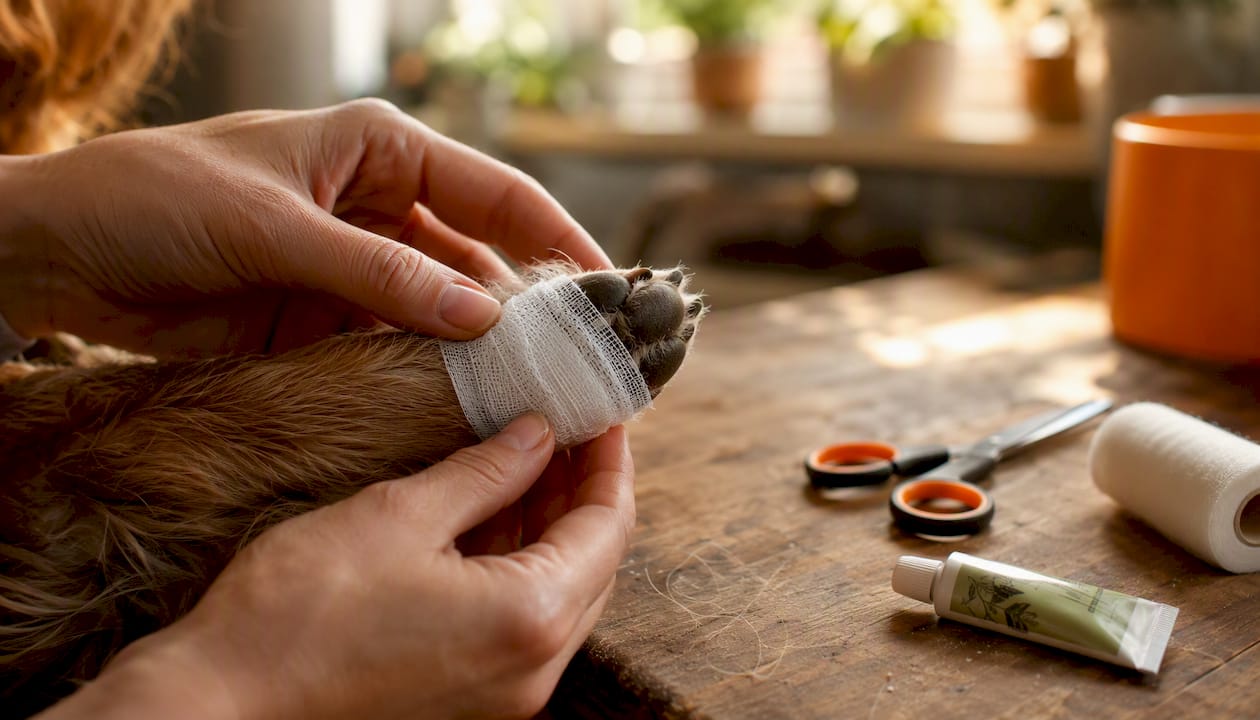
Place a nonstick pad directly over the wound. This prevents the dressing from sticking to the wound bed.
Add a layer of gauze padding. Wrap the foot, including all toes, to cushion the pad and absorb any seepage.
Create tape stirrups. Cut two strips of medical tape long enough to extend from below the wound site up past the ankle. Press them against the gauze on opposite sides of the foot, then fold the ends up onto the fur above the ankle. This anchors the bandage and prevents it from sliding down.
Apply self-adherent wrap. Start at the toes and spiral upward, past the wrist or ankle joint. Extending above the joint is what keeps the bandage from slipping off during walking.
Check the two-finger rule. Slide two fingers under the wrap at the top. If you can’t fit them, the bandage is too tight. Loosen it immediately.
After bandaging, check your dog’s toes every few hours for swelling, coldness, or color change. According to PetMD, remove and replace the bandage if it becomes wet, slips, smells bad, or your dog seems more painful. Daily bandage changes are standard for active paw injuries.
Veterinarians often prefer bandaging over suturing for pad wounds because pad tissue does not hold stitches reliably, and the mechanical stress of walking pulls sutures open. Protection and frequent rechecks are the core of conservative pad management.
How do you stop your dog from licking a wound?
Licking introduces bacteria, delays healing, and can reopen a wound that was closing well. You have several options, each with real trade-offs.
Rigid Elizabethan collar (E-collar): The most reliable option. Dogs dislike them, but they work. Use one whenever your dog is unsupervised.
Inflatable collar: More comfortable and less disorienting, but a determined dog can often reach leg or paw wounds around the sides.
Protective garments or booties: Useful for body wounds or paw injuries, especially during short outdoor walks. A bootie over a bandaged paw also keeps the dressing clean and dry.
Bitter-tasting sprays: Applied around (not on) the wound, these deter licking in some dogs. Effectiveness varies widely.
For behavioral management during cleaning, keep sessions short and reward your dog with calm praise or a high-value treat immediately after. Minimize activity during healing: short leash walks only, no running or jumping, and quiet confinement when you cannot supervise directly.
Pain management matters here too. If your dog is clearly uncomfortable, do not reach for human pain relievers. Ibuprofen, acetaminophen, and aspirin are all toxic to dogs. Contact your vet for appropriate analgesic options — prescription pain control makes wound care easier for both of you.
What topical treatments actually help a dog wound heal?
Not every wound needs a topical ointment, and applying the wrong one can slow healing or mask infection. Here is what the evidence supports.
Topicals vets commonly use or recommend for minor wounds include:
Medical-grade honey (Manuka honey): Has documented antimicrobial properties and supports moist wound healing. Use only veterinary-formulated products, not grocery store honey.
Veterinarian-directed antibiotic ointment: Triple antibiotic ointments are sometimes recommended for very superficial wounds, but only under vet guidance. Overuse can promote resistant bacteria.
Petrolatum-based barriers (Vaseline, Aquaphor): Useful short-term to keep a wound from drying out or collecting debris until you reach a vet, per AKC guidance.
Apply any topical only to a clean, non-deep wound, and only in a thin layer under a dressing. The dressing limits ingestion risk, which matters because dogs will lick anything accessible.
Do not apply topicals to: deep wounds, wounds with visible infection (discharge, odor, spreading redness), or any wound your vet has not evaluated.
For pet owners interested in plant-based wound care, Re-gen from Theregenstore is a petroleum-free, plant-based ointment positioned as a natural supportive option for minor soft-tissue recovery. It is formulated without harsh chemicals and is intended as an alternative to conventional antibiotic ointments. Use it only on minor, clean wounds, and only if your veterinarian agrees it is appropriate for your dog’s specific injury.
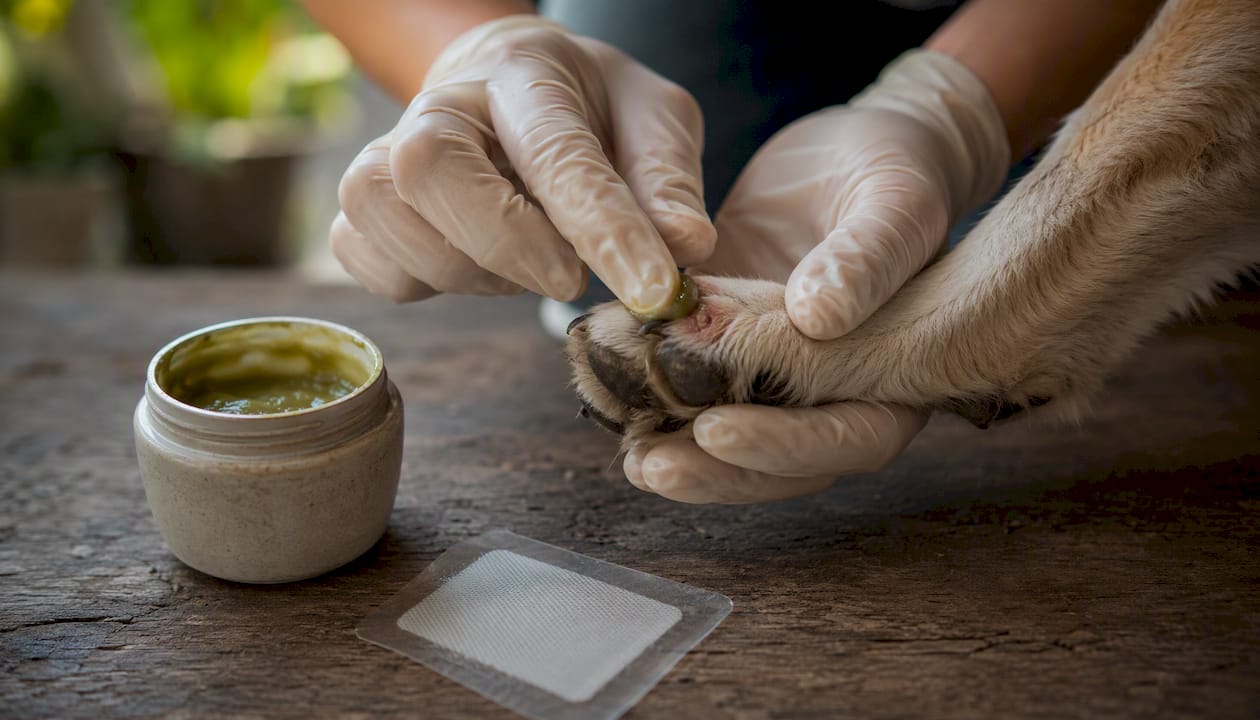
Pro Tip: Apply any ointment in a thin layer, then cover immediately with a nonstick dressing. This limits how much your dog can ingest if they manage to reach the site, and keeps the product where it can actually work.
What does normal healing look like, and when should you worry?
Healing timelines vary by wound depth, location, and your dog’s overall health.
Superficial scrapes: Typically close within a few days with proper cleaning and protection.
Mild pad burns or abrasions: Expect 7–10 days for surface healing, longer for full pad toughening.
Deeper lacerations or pad lacerations: Several weeks, with ongoing bandage changes and monitoring.
Watch for these signs of normal healing: the wound edges drawing together, reduced redness after the first 48 hours, and your dog showing less sensitivity to touch around the site.
Call your vet if you see any of these after 48–72 hours:
Redness or swelling that is increasing, not decreasing
Heat radiating from the wound or surrounding skin
Discharge that is yellow, green, or has a foul odor
Persistent or worsening limping
Your dog stops eating, develops a fever, or seems lethargic
These are signs of infection or deeper damage that home care cannot address. Early intervention prevents a manageable wound from becoming a serious one. The Merck Veterinary Manual notes that veterinary protocols sometimes include deliberate delayed closure of 24–72 hours for contaminated wounds — meaning even wounds that will eventually be sutured may need a window of open monitoring first.
For outdoor wounds, contamination risk is higher. Dirt, gravel, plant material, and standing water all introduce bacteria. Irrigate more thoroughly, monitor more closely, and have a lower threshold for calling your vet when the wound happened outside.
What should your dog’s home wound-care kit include?
A prepared kit means you spend the first minutes treating the wound, not searching the house for supplies. PetMD recommends keeping these items on hand:
Sterile saline solution or saline packets (your two-item emergency priority)
Nonstick wound dressings (your second emergency priority)
Rolled gauze and gauze pads
Self-adherent wrap (Vetrap or equivalent)
Medical tape
Blunt-tipped bandage scissors
10–12 mL syringe for irrigation
Disposable gloves
Styptic powder (stops minor bleeding quickly)
E-collar or spare cone
Clean towels or washcloths
Store everything in a labeled, waterproof container in a cool, dry spot you can reach in under a minute. If you have to build the kit in stages, start with sterile saline and nonstick pads. Those two items cover the most critical first steps for almost any minor wound.
Why cautious, evidence-based home care is worth getting right
There is a temptation to either panic over a minor wound or dismiss it too quickly. The middle path, careful home first aid paired with clear escalation criteria, is what actually protects your dog.
Small, correct actions at the start of wound care prevent the complications that turn a manageable injury into a veterinary emergency. Flushing a wound thoroughly, avoiding harmful agents, and keeping the site protected are not complicated steps, but they require the right information at the right moment. The veterinary sources referenced throughout this article, VCA, AKC, the Merck Veterinary Manual, and the American Red Cross, all converge on the same core message: clean gently, protect consistently, and know when to hand it off to a professional.
Plant-based topical supports, when used appropriately and with veterinary agreement, can be a reasonable part of that picture and support regenerative recovery. The key word is “appropriately.” A topical ointment applied to a wound that actually needs debridement or antibiotics does not help. Used on a genuinely minor, clean wound with vet approval, it can support the skin’s recovery process. That distinction matters more than the product itself.
Re-gen: a plant-based option for minor wound support
When your dog has a minor, clean wound and your veterinarian has confirmed that topical support is appropriate, Re-gen from Theregenstore offers a petroleum-free, plant-based alternative to conventional antibiotic ointments like Neosporin. It is formulated without harsh chemicals and designed to support natural soft-tissue recovery for both people and pets.

Re-gen is not a treatment for deep wounds, infected tissue, or injuries that require veterinary intervention. Use it only on minor, superficial wounds that are clean and dry, in a thin layer under a protective dressing, and always with your vet’s agreement. Keep the amount small to limit ingestion risk if your dog reaches the site.
To review ingredient details, usage instructions, and whether Re-gen is right for your dog’s situation, visit Theregenstore and consult your veterinarian before use.
Sources
These vetted resources provide deeper protocols and veterinary guidance for dog wound care:
For wound-specific questions about your dog, contact your local veterinarian directly. No online resource replaces an in-person evaluation.
This article is general information, not a substitute for advice from a qualified doctor. Consult a qualified healthcare professional about your own circumstances before acting on anything here.
FAQ
Can I put Neosporin on a dog wound?
Neosporin is not recommended for dogs without veterinary guidance. While a tiny amount on a superficial wound is unlikely to cause serious harm, dogs often lick it off, and ingestion of the antibiotic ingredients can cause digestive upset. A vet-approved alternative, such as a plant-based ointment used in a thin layer under a dressing, reduces ingestion risk.
What is the fastest way to heal an open wound on a dog?
Thorough irrigation immediately after injury, consistent protection with a clean dressing, and preventing licking are the three steps that most directly speed recovery. Keeping the wound moist (not wet) under a nonstick dressing supports tissue repair better than leaving it open to air.
Does a dog wound heal faster covered or uncovered?
Covered heals faster for most wounds. A nonstick dressing maintains a moist environment that supports cell migration and reduces scab formation, which can actually slow healing. It also physically blocks licking and environmental contamination.
Can I use Dawn dish soap to clean a wound on my dog?
No. Dawn is formulated to cut grease and strips the skin’s protective barrier when applied to tissue. It irritates the wound bed and delays healing. Use sterile saline or plain warm water instead, as recommended by VCA Animal Hospitals.
Recommended
Comments