
Best Natural Healing Ointments: Evidence-Based Guide 2026


Medical-grade Manuka honey and well-formulated plant-based salves are the most evidence-backed natural ointment classes for minor wound care. For a fresh minor cut, abrasion, or superficial burn, your best immediate move is to clean the wound gently, then apply a thin layer of a petroleum-free, botanical ointment or a medical-grade honey product. Both approaches have real clinical and lab support, not just tradition behind them.
Quick verdict by wound type:
Minor cuts and abrasions: Medical-grade honey (Manuka-class) or a calendula/comfrey plant-based salve. Antimicrobial and moisture-balancing properties support re-epithelialization.
Superficial burns: Aloe vera gel or a soothing calendula ointment. Aloe’s cooling, anti-inflammatory action is well-documented in burn studies.
Chronic dry wounds or cracked skin: A beeswax-based herbal salve with calendula and chamomile. The breathable barrier locks in moisture without fully occluding the wound.
Bruising and soft-tissue soreness: Arnica-based topical preparations. Arnica’s anti-inflammatory compounds have the most consistent human trial data of any topical herb for bruise resolution.
Post-operative or surgical incision support: A sterile, petroleum-free plant-based ointment or medical-grade honey product. Avoid DIY preparations on open surgical sites.
Table of Contents
What does the research say about natural wound-healing ingredients?
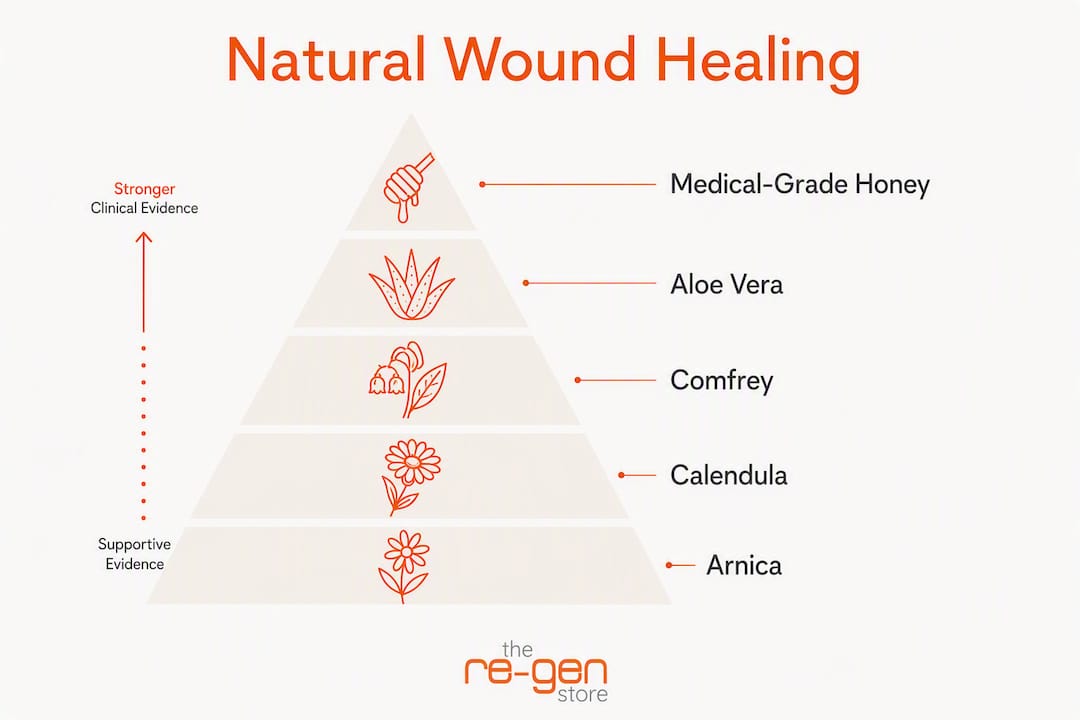
The short answer: the evidence is real but uneven. A few ingredients have solid clinical trial data; others have strong lab and animal-study support with limited human trials; and some rely primarily on traditional use. Knowing which is which helps you choose with confidence rather than guesswork.
Medical-grade honey (Manuka-type)
Manuka honey is the most clinically supported natural wound-care ingredient available. Its mechanism is multi-layered: osmotic action draws fluid out of bacteria, hydrogen peroxide provides broad antimicrobial activity, and methylglyoxal (MGO) is the compound unique to Manuka that delivers sustained antibacterial effects even in low-oxygen wound environments. Medical-grade honey products combining Manuka honey with antimicrobial silver show rapid bacterial reduction and support skin regeneration in topical use. The critical distinction is that medical-grade honey is sterilized and standardized for MGO concentration. Table honey from your pantry is not. For infected or high-risk wounds, that standardization matters considerably.
Evidence level: Clinical trials and systematic reviews.
Aloe vera
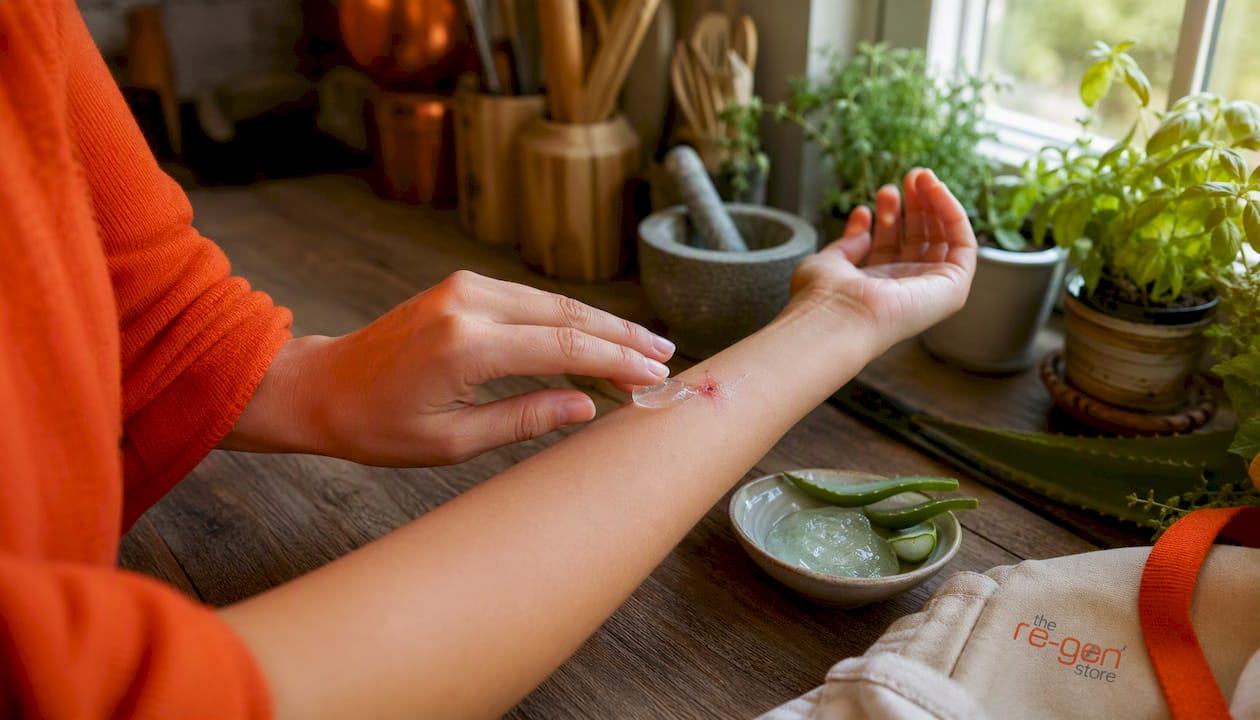
Aloe vera gel accelerates wound closure by stimulating fibroblast activity and collagen synthesis. It also reduces inflammation through compounds like acemannan, which modulates immune response at the wound site. Most evidence comes from controlled studies on superficial burns and post-procedure skin recovery, where aloe consistently outperforms petroleum-based controls on healing speed.
Evidence level: Clinical trials (burns, post-procedure); strong lab data.
Comfrey (topical only)
Comfrey contains allantoin and rosmarinic acid, both of which support cell proliferation and reduce inflammation. The concern with comfrey is pyrrolizidine alkaloids (PAs), compounds that are toxic to the liver when ingested. Topically, the risk is lower, but it is not zero, especially on broken skin where absorption increases. Tuberous comfrey (Symphytum tuberosum) is a lower-PA variety and the formulation choice in defensible artisan salves. Never use comfrey internally, and avoid it on deep open wounds, during pregnancy, or in children under 12.
Evidence level: Clinical trials for allantoin; traditional use with safety caveats for whole-plant topicals.
Calendula
Calendula’s flavonoids and triterpenoids drive its anti-inflammatory and antimicrobial activity. It supports re-epithelialization and is one of the gentlest options available, making it appropriate for sensitive skin, pediatric use, and post-radiation skin care. It pairs well with comfrey and chamomile in beeswax-based salves where the beeswax creates a breathable barrier that locks moisture without fully occluding the wound.
Evidence level: Clinical trials (post-radiation dermatitis, episiotomy healing); strong lab data.
Arnica
Arnica montana contains helenalin, a sesquiterpene lactone with anti-inflammatory and analgesic properties. It reduces bruising, swelling, and post-surgical ecchymosis in multiple randomized controlled trials. Use it topically only. Arnica is toxic when taken internally and should not be applied to broken skin or open wounds.

Evidence level: Clinical trials for bruising and post-surgical swelling; topical use only.
Curcumin/turmeric
Curcumin inhibits NF-κB, a key inflammatory signaling pathway, and promotes angiogenesis (new blood vessel formation) at the wound site. Polyherbal formulations combining curcumin with neem, aloe, and honey are in active commercial use for wound cleaning and infection prevention. Human clinical data for topical curcumin alone is still developing, but its mechanism is well-characterized.
Evidence level: Strong lab and animal data; emerging human trials.
Tea tree oil
Tea tree oil (Melaleuca alternifolia) is a broad-spectrum antimicrobial with activity against bacteria, fungi, and some viruses. It works by disrupting microbial cell membranes. Use it diluted (typically 5% or less in a carrier oil) on intact or minimally broken skin. Undiluted application causes irritation and can sensitize skin with repeated use.
Evidence level: Strong in vitro data; limited controlled human wound trials.
Neem
Neem leaf and seed extracts contain nimbidin and azadirachtin, compounds with antimicrobial and anti-inflammatory activity. Neem is commonly included in multi-active wound formulations alongside curcumin and aloe. Human wound-healing trials are limited; most evidence is from lab studies and traditional Ayurvedic use.
Evidence level: Lab studies and traditional use; limited human trials.
Gotu kola (Centella asiatica)
Gotu kola stimulates collagen synthesis and supports angiogenesis through its active compounds asiaticoside and madecassoside. It is one of the better-studied botanicals for scar reduction and chronic wound support. PMC reviews of wound-healing botanicals consistently list Centella asiatica among the most bioactive plants for tissue repair.
Evidence level: Clinical trials for scar management; strong lab data for collagen modulation.
Chamomile
Chamomile’s bisabolol and apigenin reduce inflammation and have mild antimicrobial activity. It is primarily a soothing and anti-irritant ingredient, well-suited for sensitive or reactive skin. Chamomile is a common supporting ingredient in artisan salves alongside calendula and comfrey.
Evidence level: Lab studies; traditional use; limited human wound trials.
Ingredient comparison at a glance
Ingredient | Best for (wound type) | Evidence level | Common formulation | Key safety notes |
Medical-grade honey | Infected, chronic, or high-risk wounds | Clinical trials | Ointment, gel, gauze | Use medical-grade only for open wounds; allergy risk (bee products) |
Aloe vera | Superficial burns, post-procedure skin | Clinical trials | Gel, cream | Avoid internal use of concentrated extracts |
Comfrey (topical) | Bruising, closed sprains, minor skin repair | Clinical trials (allantoin); traditional use | Salve, ointment | Avoid on deep wounds, pregnancy, children under 12; use tuberous variety |
Calendula | Minor cuts, sensitive skin, post-radiation | Clinical trials | Salve, cream, oil | Ragweed allergy cross-reaction possible |
Arnica | Bruising, swelling, post-surgical ecchymosis | Clinical trials | Gel, cream | Topical only; toxic internally; avoid on broken skin |
Curcumin | Inflammation, chronic wounds | Lab/animal; emerging human | Ointment, cream | Stains skin/fabric; may sensitize in high concentrations |
Tea tree oil | Antimicrobial support, minor infections | Strong in vitro | Diluted in carrier oil | Dilute to 5% or less; toxic internally |
Neem | Antimicrobial, anti-inflammatory support | Lab studies; traditional use | Ointment, cream | Avoid in pregnancy; strong odor |
Gotu kola | Scar reduction, chronic wound support | Clinical trials (scars) | Cream, ointment | Generally well-tolerated; rare allergy |
Chamomile | Soothing, sensitive skin | Lab studies; traditional use | Salve, cream | Ragweed allergy cross-reaction possible |
How do you choose a natural ointment that actually works?
The label is your first filter. Most products that call themselves “natural” are not equally effective or safe, and a few are poorly formulated. Here is what to look for and what to avoid.
Label checklist
Medical-grade honey vs. generic honey: If the product uses honey for wound care, confirm it states “medical-grade” or lists a standardized MGO rating. Generic raw honey is not sterile and is not appropriate for open wounds.
Active ingredient concentrations: Look for percentage disclosures on key actives (e.g., aloe vera 98%, calendula extract 5%). Vague “contains calendula” language without a percentage tells you nothing about potency.
Petroleum-free: Petrolatum creates an occlusive barrier that can trap bacteria in infected wounds. A petroleum-free plant-based formulation allows the wound to breathe while still maintaining moisture.
Preservative disclosure: All water-containing products need preservatives. Look for disclosed, low-irritant options (phenoxyethanol, rosemary extract). Undisclosed preservatives are a red flag.
Intended use language: Products labeled for “first aid” or “wound care” are held to higher standards than general “skin moisturizer” products. Check whether the label specifies wound use or only cosmetic skin support.
Sterile packaging: For open wounds, sterile or single-use packaging reduces contamination risk. Jar packaging with repeated finger-dipping is a hygiene concern.
Red flags to avoid
“Natural” on the label with no ingredient list
Internal-use herbs (like comfrey root tea) listed in a topical product without clarifying they are topical extracts only
Broad cure claims (“heals all wounds,” “eliminates infection”) without clinical support
No batch number, expiration date, or manufacturer contact information
Products that combine arnica and comfrey for use on open wounds (both are contraindicated on broken skin in their whole-plant forms)
Pro Tip: Ask one direct question before buying: “Is this formulated for open wounds or intact skin?” Many beautiful artisan salves are excellent for dry, cracked, or irritated skin but are not appropriate for fresh cuts or abrasions. Knowing the intended use prevents misapplication.
How should you apply a natural ointment for best results?
Correct application matters as much as ingredient quality. A well-formulated ointment applied to an uncleaned wound, or applied too thickly under an occlusive dressing, will underperform.
Clean the wound first. Rinse with clean running water for at least 30 seconds. Mild soap is appropriate for dirty wounds. Saline solution works well for sensitive tissue. Skip hydrogen peroxide and iodine on fresh wounds — both damage new tissue and slow healing.
Pat dry gently. Use a clean cloth or sterile gauze. Do not rub.
Apply a thin layer. A thin film is sufficient. Thicker application does not improve absorption and can macerate surrounding skin. For most ointments, a small amount covers a typical minor wound area.
Choose your dressing. For minor cuts and abrasions, a breathable non-stick dressing (like a silicone-coated pad) over the ointment keeps the wound moist without trapping bacteria. For dry or cracked skin, leaving the area open after application is often fine.
Reapply one or more times daily. Most natural ointments are applied once to three times per day. Medical-grade honey products typically follow the same schedule. Change the dressing each time you reapply.
Continue until the wound closes. For minor cuts and abrasions, expect visible closure within about one to two weeks. Superficial burns may take a similar period to heal. Chronic dry wounds vary. If you see no improvement after 7 days, reassess.
Healing timeline for minor wounds:
Days 1–3: Inflammation phase. Redness, swelling, and warmth are normal. The ointment supports antimicrobial protection and moisture balance.
Days 3–7: Proliferative phase. New tissue forms. Keep the wound moist and protected.
Days 7–14: Remodeling begins. Reduce dressing frequency as the wound closes. Scar-support ingredients like gotu kola become relevant here.
Pro Tip: Pair your topical ointment with good nutrition. Protein, vitamin C, and zinc are the three nutrients most directly tied to collagen synthesis and tissue repair. A well-nourished body heals faster regardless of what you apply topically.
When are natural ointments unsafe, and when should you see a doctor?
Natural ointments are appropriate for minor, superficial wounds. They are not appropriate for every wound, and using them on the wrong type can delay care that actually matters.
See a doctor immediately if you notice any of the following:
The wound is deep, gaping, or will not stop bleeding after 10 minutes of direct pressure
The wound was caused by an animal or human bite
You can see bone, tendon, or fat tissue
Redness is spreading beyond the wound edges, or red streaks are tracking away from the wound
You develop fever, chills, or swollen lymph nodes
The wound shows signs of infection: increasing pain, warmth, pus, or foul odor after 48 hours
The wound is on the face, hands, genitals, or over a joint
On comfrey and pyrrolizidine alkaloids: Comfrey contains pyrrolizidine alkaloids (PAs), compounds that are hepatotoxic when ingested. Topical absorption through intact skin is low, but absorption increases significantly through broken or damaged skin. Tuberous comfrey varieties have lower PA content than common comfrey (Symphytum officinale), making them a safer topical choice. Regardless of variety, never use comfrey on deep open wounds, never ingest it, and avoid it entirely during pregnancy and in children under 12. The European Medicines Agency recommends limiting topical comfrey use to no more than 4 to 6 weeks per year.
Patch test instructions: Before applying any new natural ointment to a wound, apply a small amount to the inner forearm. Wait 24 hours. If you see redness, swelling, or itching, do not use the product on a wound. Calendula and chamomile can cross-react with ragweed allergies. Tea tree oil is a known sensitizer at high concentrations.
This article is general information, not medical advice. Confirm wound-care decisions with a qualified healthcare provider for your specific situation.
DIY salves vs. commercial natural ointments: which is right for you?
Homemade herbal salves have real appeal: you control the ingredients, the cost is low, and you can customize the formula. But for wound care specifically, the tradeoffs are significant.
Where DIY works well
Dry, cracked skin, chapped lips, or minor skin irritation (intact skin only)
Moisturizing and barrier support for non-wounded skin
Situations where you have verified, food-grade or cosmetic-grade ingredients and clean preparation conditions
Beeswax-and-herb salves with calendula, comfrey-infused olive oil, and chamomile are a reasonable DIY option for dry skin care. The beeswax creates a breathable barrier that locks moisture without fully occluding the skin, which suits dry or irritated (but intact) skin well.
Where DIY falls short
Open wounds, cuts, abrasions, or burns: microbial contamination risk is real without sterile preparation
Inconsistent potency: herb-infused oils vary widely in active compound concentration depending on plant source, infusion time, and temperature
Comfrey sourcing: without verified botanical identification, you cannot confirm you are using a lower-PA tuberous variety
No preservative system: water-containing DIY preparations can grow mold and bacteria within days
If you want to try making your own, Theregenstore’s guide on how to make herbal ointment walks through safe preparation steps and appropriate ingredient choices.
Commercial natural ointments: the practical case
Tested commercial products offer standardized formulations, disclosed preservative systems, and in the case of medical-grade honey products, sterility guarantees. For open wounds, post-operative care, or any wound with infection risk, a tested commercial product is the safer choice.
Pro Tip: DIY is fine for a lip balm or a dry-skin salve. For anything involving broken skin, choose a commercial product with a disclosed ingredient list, a batch number, and a clear intended-use statement. The extra cost is worth the safety margin.
Why Re-gen from Theregenstore fits the evidence
Re-gen is a plant-based, petroleum-free regenerative ointment from Theregenstore, formulated to support skin, soft tissue, bone, and muscle recovery. It is positioned as a natural alternative to conventional antibiotic ointments like Neosporin, with a botanical ingredient profile that maps directly to the evidence-backed mechanisms covered in this article.
How Re-gen aligns with the selection checklist:
Petroleum-free: Re-gen uses plant-derived carrier ingredients rather than petrolatum, supporting breathable moisture balance at the wound site
Botanical actives: The formulation draws on herbs with documented anti-inflammatory, antimicrobial, and tissue-support activity
No synthetic antibiotics: Appropriate for health-conscious users who want to avoid antibiotic resistance concerns with routine wound care
Human and pet use: Re-gen is available with usage guidance for both people and animals, making it a practical household option for pet-safe wound care as well
Practical fit by wound context:
Minor cuts and abrasions: apply a thin layer after cleaning; cover with a breathable non-stick dressing
Superficial burns: apply gently to cooled skin; do not apply to blistered or broken burn tissue without medical guidance
Sprains and soft-tissue soreness: apply topically to the affected area to support recovery
Post-operative incision support: use only on closed incisions and with guidance from your surgical team; for post-Mohs or dermatologic surgery recovery, post-operative skin care guidance from a qualified provider should take precedence
Pro Tip: Re-gen is available in multiple sizes. If you are trying it for the first time, start with a smaller size to confirm it suits your skin before committing to a larger supply.
Key Takeaways
Medical-grade honey and petroleum-free plant-based salves are the most evidence-backed natural ointment classes for minor wound care in 2026.
Point | Details |
Top evidence-backed choices | Medical-grade Manuka honey and plant-based petroleum-free salves have the strongest clinical and lab support for minor wound healing. |
Medical-grade vs. table honey | Only medical-grade honey is sterilized and standardized for MGO; table honey is not appropriate for open wounds. |
Comfrey safety rule | Use tuberous comfrey topically only, avoid on deep wounds, and never use during pregnancy or in children under 12. |
When to see a doctor | Deep wounds, animal bites, spreading redness, red streaks, fever, or visible tendon or bone require immediate medical evaluation. |
Theregenstore Re-gen | Re-gen is a petroleum-free, plant-based ointment available for human and pet use, aligned with the evidence-backed selection criteria in this article. |
The case for being selective with natural ointments
Most articles on this topic treat “natural” as a single category. It is not. Aloe vera gel with clinical trial data for burns is a fundamentally different proposition from a jar of raw honey with a hand-drawn label. The gap between those two things is not a matter of preference; it is a matter of evidence, sterility, and formulation quality.
What I find genuinely encouraging is how much solid science now supports specific botanical ingredients. Gotu kola’s collagen-stimulating activity, Manuka honey’s multi-mechanism antimicrobial action, calendula’s documented role in post-radiation skin recovery — these are not folk claims anymore. They are published, peer-reviewed findings. The challenge is that the consumer market has not caught up with the science. Most products on store shelves blend a little of everything with no concentration disclosure and no clinical rationale.
The practical takeaway is simple: demand specificity. A good natural ointment names its active ingredients, states their concentrations, and tells you what the product is actually formulated for. If it does not, the “natural” label is doing all the work, and that is not enough.
Re-gen: a petroleum-free plant-based option worth considering
If you have read this far, you know what to look for in a natural wound ointment: petroleum-free, botanically active, with a disclosed ingredient list and clear intended-use guidance. Re-gen from Theregenstore checks those boxes.
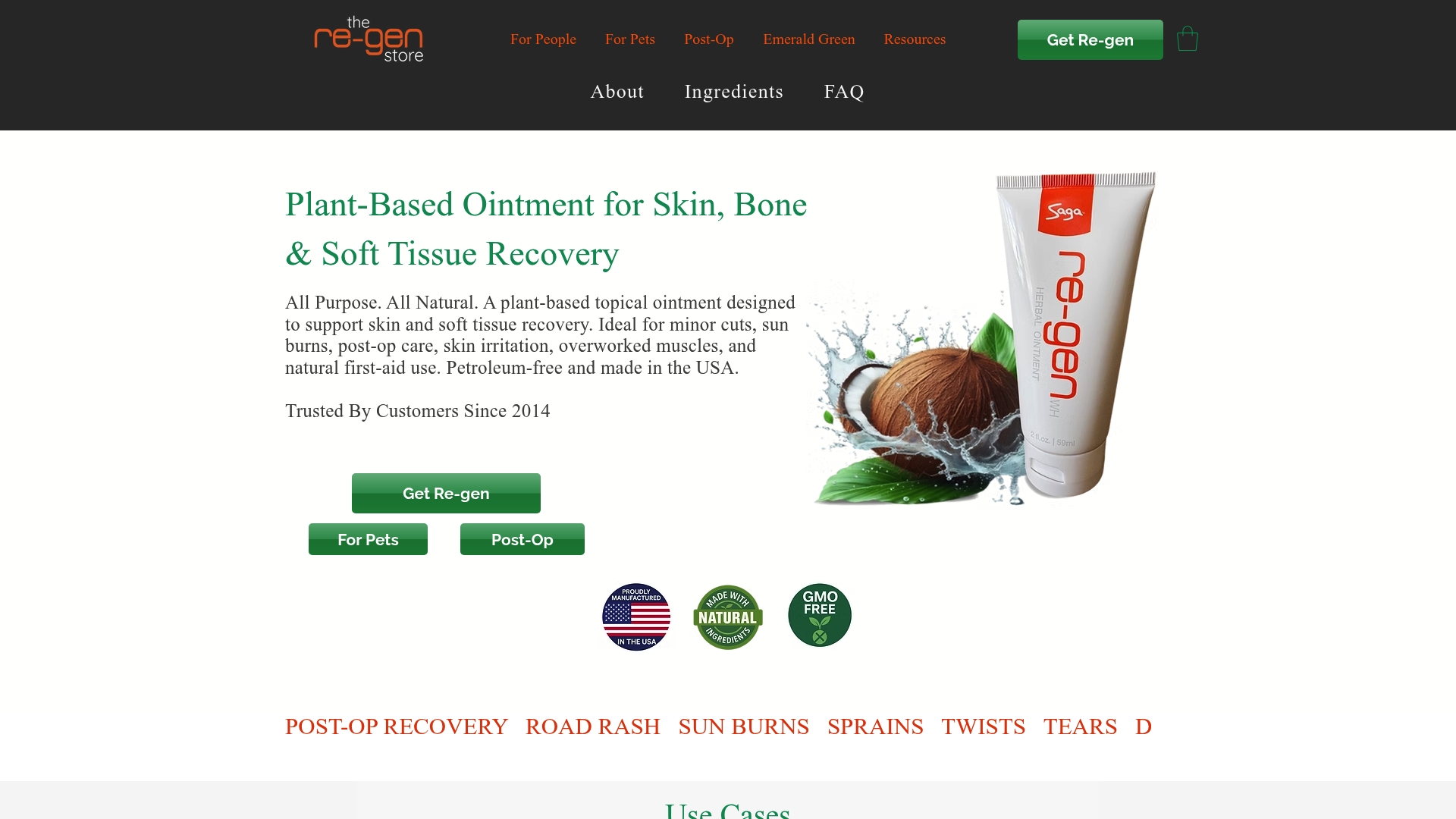
Re-gen is formulated for cuts, burns, sprains, soft-tissue soreness, and post-operative incision support. It is petroleum-free, uses plant-derived actives, contains no synthetic antibiotics, and is available in multiple sizes for both human and pet use. For health-conscious buyers comparing it to a standard drugstore petrolatum ointment, the difference is real: botanical actives that support the body’s own repair process rather than a passive occlusive barrier.
You can review the full ingredient list, usage guidelines, and available sizes on the Re-gen product page. If you are specifically looking for a natural alternative to conventional antibiotic ointments, Theregenstore’s plant-based wound treatment page explains the formulation rationale in detail.
Useful sources
These are the primary references and further reading used in this article.
Source | What it covers |
The Therapeutic Wound Healing Bioactivities of Various Medicinal Plants (PMC) | Systematic review of botanical wound-healing bioactivities including gotu kola, calendula, and curcumin |
Narrative review comparing natural product evidence levels across wound-healing phases | |
Aloe vera wound-healing review (NCBI) | Clinical and lab evidence for aloe vera in burn and wound healing |
Review of honey’s antimicrobial mechanisms and clinical wound-care applications | |
Silver Honey Rapid Wound Repair Ointment (Absorbine) | Medical-grade Manuka honey product with antimicrobial silver; formulation and use context |
Ouch Ointment — Comfrey Salve (MoonMaid Botanicals) | Artisan tuberous comfrey salve; formulation approach and PA safety rationale |
All Natural Healing Salve with Calendula and Comfrey (Cox Honey Farms) | Beeswax-based artisan salve; formulation notes on breathable barrier and herb-infused oils |
PBT Wound Shield Polyherbal Ointment (The Veterinary Medicine) | Polyherbal veterinary formulation combining curcumin, neem, aloe, and honey |
Top Wound Healing Foods (Glencoe Health) | Nutritional support for wound healing: protein, vitamin C, zinc, and healthy fats |
4 Natural Remedies for Wounds and Scrapes (Tom’s of Maine) | Consumer overview of common home remedies including raw honey, calendula, and chamomile |
FAQ
What is the best natural ointment for wound healing?
Medical-grade Manuka honey products and petroleum-free plant-based salves with calendula, aloe, or gotu kola have the strongest evidence for minor wound healing. For open wounds, always choose a sterile or medical-grade product over a homemade preparation.
What heals wounds faster naturally?
Keeping the wound moist, clean, and covered with a breathable dressing accelerates healing more than any single ingredient. Topical aloe vera and medical-grade honey both have clinical support for speeding re-epithelialization in minor burns and cuts.
Is table honey safe to use on wounds?
Table honey is not sterile and is not standardized for antibacterial potency. Medical-grade honey products are processed and tested specifically for wound use. Using raw table honey on an open wound carries a contamination risk that medical-grade products eliminate.
What makes Re-gen different from a standard drugstore ointment?
Re-gen from Theregenstore is petroleum-free and uses plant-derived botanical actives rather than a passive petrolatum base. Standard drugstore ointments like Neosporin rely on synthetic antibiotics; Re-gen is formulated as a natural alternative for health-conscious users who prefer botanical wound support.
Can natural ointments be used on pets?
Yes, with the right formulation. Several plant-based ingredients including calendula, aloe, and chamomile are generally well-tolerated by animals. Re-gen is available with specific usage guidance for pets. Avoid tea tree oil on cats and small animals, as it is toxic to them even in diluted topical form.
Recommended
Comments