
Transdermal Magnesium Absorption: Measurable but Not a Systemic Fix


Transdermal magnesium absorption does happen at a measurable level, but the evidence does not support it as a reliable way to correct a systemic magnesium deficiency. Small human trials show modest serum increases in some people, not all, and the effect size stays far below what oral supplementation delivers. If you’re using it on sore muscles or dry skin, it’s a reasonable addition to your routine. If you suspect a real deficiency, get your magnesium tested and treat it with your clinician’s guidance, not with a spray bottle alone.
TL;DR:
Transdermal magnesium can cause modest serum increases, but its ability to correct systemic deficiency remains unproven and inconsistent.
Skin absorption mainly occurs through hair follicles and sweat glands, with concentration and contact time influencing how much magnesium crosses the skin barrier.
Small human trials show magnesium absorption varies, with only a minority of participants experiencing measurable serum increases, and current studies are too limited to confirm effective systemic repletion.
Topical magnesium is safe for localized use, such as skin or muscle comfort, but potential skin irritation and interactions with kidney disease or medications require caution.
For systemic deficiency, testing and oral supplementation are more reliable options, while topical applications may best serve as supportive therapy for skin health or muscle relaxation.
Table of Contents
What the Research Says About Transdermal Magnesium Absorption
How Does Magnesium Absorb Transdermally? The Skin Barrier Explained
What Human Trials Show About Magnesium Patches, Sprays, and Creams
Is Topical Magnesium Effective for Everyday Use? Benefits and Safety
Where TheregenStore Fits Into the Topical Magnesium Conversation
What the Research Says About Transdermal Magnesium Absorption
The clearest verdict on this topic comes from a 2017 review in PMC, which concluded that marketing transdermal magnesium as a superior alternative to oral supplementation is not scientifically supported. The reviewers didn’t dismiss skin absorption outright. They found that existing research was too thin, too short, and too inconsistent to back the bold claims plastered across product labels, and they called for larger trials with higher doses and longer durations.
Two pilot studies since then have added real data, though neither settles the question.
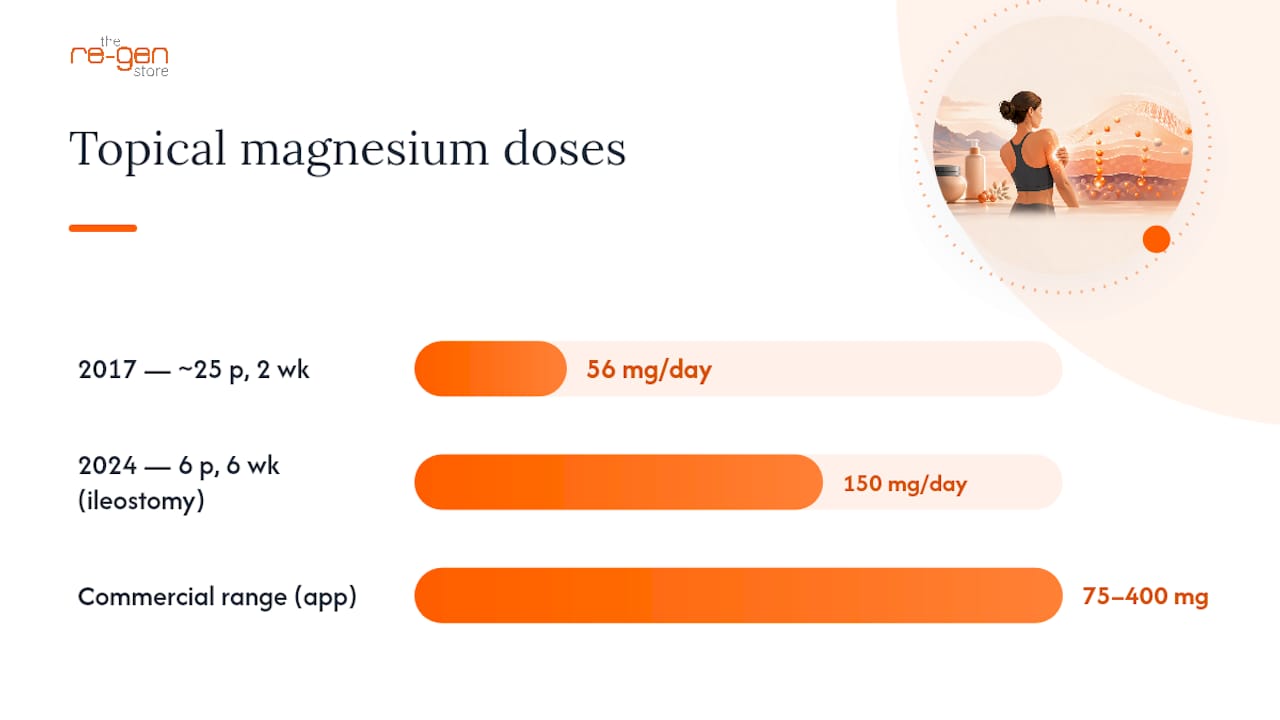
A 2017 trial using 56 mg of magnesium cream daily for two weeks found a serum rise from 0.82 to 0.89 mmol/L in the magnesium group, an increase not statistically significant overall, though it reached significance in a subgroup of non-athletes.
A 2024 pilot in patients with ileostomies used a 150 mg/day magnesium chloride hexahydrate spray for six weeks. Two of six participants showed serum increases, and one avoided a planned magnesium infusion as a result.
A small but real signal: Across both pilot trials, about a minority of participants showed a measurable serum response. That’s not nothing, but it’s also not a result you’d bet a deficiency correction on.
What links every study in this space is the same set of limitations: tiny sample sizes (often fewer than 30 people), short trial windows of two to six weeks, formulations that vary wildly in concentration, and outcome measures that don’t always agree with each other. Serum magnesium and 24-hour urinary magnesium can move in different directions in the same person, which makes “did it work” a harder question to answer than it sounds.
How Does Magnesium Absorb Transdermally? The Skin Barrier Explained
Your skin’s outermost layer, the stratum corneum, is built to keep things out, not let them in. It’s a dense, lipid-rich barrier, and magnesium ions in solution are hydrated and charged, which gives them a large effective size and low affinity for that fatty environment. That combination makes passive diffusion straight through the skin’s surface a slow and inefficient route for magnesium, a point the PMC review makes explicitly when explaining why transdermal metal-ion absorption tends to happen elsewhere.

That “elsewhere” is mostly hair follicles and sweat glands. These structures create small breaks in the otherwise continuous barrier, and research on magnesium permeation through human skin shows follicles measurably facilitate ion movement. You’re relying on a tiny fraction of your skin’s real estate to do most of the work.
Lab studies back up that this route is real, just limited. Ex vivo diffusion experiments on excised human skin have shown that formulated magnesium creams deliver measurably more magnesium across the skin barrier than control solutions, with penetration increasing alongside both concentration and exposure time.
Higher magnesium concentration in a product tends to drive greater penetration in lab models.
Longer contact time with the skin also increases how much crosses the barrier.
Follicle density varies by body region, so absorption is unlikely to be uniform across your skin.
Pro Tip: If you’re applying magnesium oil or cream for absorption rather than just moisturizing, target areas with more hair follicles, like the forearms or thighs, and give it several minutes before toweling off or dressing.
What Human Trials Show About Magnesium Patches, Sprays, and Creams
The two pilot trials mentioned above are the backbone of the human evidence base for topical magnesium absorption, and it’s worth walking through what each one actually measured.
The 2017 study put roughly 25 participants through a two-week regimen of 56 mg/day magnesium cream against a placebo. Serum magnesium in the treatment group rose from 0.82 to 0.89 mmol/L, a change that sounds meaningful on paper but didn’t clear statistical significance across the full group. When researchers split participants by athletic status, the non-athlete subgroup showed a significant effect, while athletes, who tend to have different baseline mineral turnover, did not. That’s a useful finding, but subgroup results in a small trial are a hypothesis generator, not proof.
The 2024 study took a very different population: six patients with ileostomies experiencing chronic hypomagnesemia, a group with genuinely elevated clinical need since their digestive anatomy impairs normal magnesium absorption from food. They used a magnesium chloride hexahydrate spray at 150 mg/day (ten sprays, twice daily) for six weeks. Two of the six showed serum increases, and one participant was able to skip a scheduled magnesium infusion they would otherwise have needed. That’s a meaningful outcome for one person, but a sample of six can’t tell you how often that result would repeat.
That’s the entire human clinical trial base this product category currently has to stand on.
A few other patterns show up across the smaller studies and commercial landscape:
Commercial product dosing is inconsistent, with reported ranges from 75 mg to 400 mg per application depending on the brand, and many labels don’t state concentration clearly at all.
Serum magnesium, the most common biomarker in these trials, reflects only about 1% of total body magnesium, so a stable serum reading doesn’t rule out deficiency in bone or soft tissue stores.
Twenty-four hour urinary magnesium, sometimes used as a secondary marker, is highly variable day to day and complicates interpretation further.
None of this means topical magnesium is fraudulent. It means the trials that exist are small, short, and measuring an imperfect proxy for whole-body magnesium status. Researchers who study this area have noted that future work needs longer durations, higher and standardized doses, and more consistent biomarkers before anyone can make a confident claim either way.
Is Topical Magnesium Effective for Everyday Use? Benefits and Safety
Here’s where the evidence-to-practice gap matters most. If you’re rubbing magnesium oil into a sore shoulder or using a magnesium cream as part of a bedtime routine, you’re probably getting real value, just not necessarily from magnesium crossing your skin barrier. Dermatologists interviewed for NPR’s 2025 coverage of magnesium lotion point out that the relaxation and sleep benefits people report often trace back to the massage itself and the moisturizing carrier base, not systemic magnesium uptake. That’s not a knock on the product. Massage genuinely reduces muscle tension, and a good moisturizer genuinely improves skin feel. It just means the mechanism people assume is happening may not be the one doing the work.
Safety-wise, topical magnesium is generally well tolerated, but it’s not risk-free:
Skin irritation or stinging is common, especially with magnesium chloride oils on freshly shaved or broken skin.
Renal impairment changes the calculus. People with kidney disease clear magnesium less efficiently, and even the limited systemic absorption documented in these trials could contribute to abnormal buildup over time.
Medication interactions are possible, particularly with drugs affecting blood pressure, since magnesium has mild vasodilatory effects and could compound hypotension risk in susceptible people.
Pro Tip: If you’re on diuretics, have chronic kidney disease, or take medications with a narrow therapeutic window, talk to your clinician before using topical magnesium regularly, even though it’s sold over the counter.
The conservative, evidence-aligned approach: if you suspect an actual magnesium deficiency, fatigue, muscle cramps, or heart palpitations that concern you, ask for a serum magnesium test first. If a real deficiency shows up, oral magnesium supplementation remains the better-studied route to systemic repletion. Save the topical route for what the data actually supports: localized comfort and skin support, covered in more detail in our guide to topical magnesium benefits, uses, and safety.
How to Use Magnesium Oil, Spray, and Cream Correctly
The best topical magnesium products fall into three main categories, and the carrier matters as much as the magnesium compound itself.
Magnesium chloride oils and sprays absorb quickly and are the most common form used in the human trials discussed above.
Magnesium sulfate (Epsom salt) baths work through full-body soak exposure rather than a targeted application, and offer a different exposure profile than a spray.
Creams and ointments use a fatty or emollient base, which slows evaporation and extends skin contact time, a factor that lab studies link to greater penetration.
If you want your usage to roughly mirror what’s been studied, here’s how the doses line up in practice:
Start with a patch test on a small area of skin and wait 24 hours to rule out irritation.
For a cream-based product, the 2017 pilot used roughly 56 mg/day, well below what many commercial labels suggest, so check your product’s actual concentration.
For a spray, the 2024 pilot used 150 mg/day split into multiple applications, applied to broad skin areas like the arms and legs.
Avoid applying to open wounds unless a product is specifically formulated and labeled for that use.
Massage the product in rather than letting it sit passively. Massage itself contributes to the relaxation benefit people report.
If your goal is a systemic effect, commit to several weeks of consistent use and get a baseline serum magnesium test before you start, with a follow-up test afterward to see if anything actually changed.
For guidance on choosing between an oil-based or cream-based formulation, our comparison of ointment versus cream walks through how each carrier behaves on skin.
Where TheregenStore Fits Into the Topical Magnesium Conversation
Theregenstore develops plant-based topical products, including the Re-gen ointment for skin and soft-tissue support, alongside a topical magnesium spray formulated for everyday use. Our position on this topic is straightforward: we sell topical products because they have real, specific value for skin health and localized comfort, not because we claim they replace oral magnesium for a diagnosed systemic deficiency. Readers looking for more detail on how topical magnesium supports skin specifically can check our guide on magnesium for skin health. We’d rather you know exactly what a product can and can’t do before you buy it than oversell a mechanism the current science doesn’t fully back.
The Bottom Line on Transdermal Magnesium Absorption
Transdermal magnesium absorption is real but limited. Small trials show it can nudge serum magnesium up in some people, not reliably, and not to the degree oral supplementation can. Use it for local comfort and skin support with confidence. If systemic deficiency is a concern, get tested, treat with your clinician’s guidance, and give any regimen several weeks before expecting to see it show up on a follow-up lab.
An Editorial Take on the Magnesium Oil Hype Cycle
The gap between what magnesium oil marketing promises and what the pilot trials actually show is the real story here, and it’s a pattern that shows up across the wellness aisle: a genuinely interesting lab finding gets stretched into a sweeping consumer claim long before the human data catches up. Hair follicles do facilitate ion movement. Ex vivo skin does show measurable penetration. None of that adds up to “skip your oral supplement.” What frustrates me about this category isn’t the products, it’s the confidence some brands project onto data that’s still this thin. Two small pilot trials with a combined sample under 40 people is not a mandate, it’s a starting point. If you want a deficiency fixed, test for it and treat it properly. If you want sore muscles to feel better after a long day, a topical product with a good carrier is a perfectly reasonable tool, and worth using for exactly that reason.
— Kyle
Topical Magnesium and Re-gen: What They’re Actually For
Theregenstore is the plant-based alternative for people who want topical support without synthetic fillers or petroleum bases, whether that’s soothing sore muscles after a workout or supporting skin recovery after an injury. Our Re-gen ointment and magnesium spray are formulated for exactly the use cases this article supports with evidence: localized comfort, skin health, and soft-tissue recovery, not a substitute for oral magnesium when a lab-confirmed deficiency is on the table.

If you’re dealing with a cut, sprain, post-surgical wound, or just want a natural option in your first-aid cabinet, take a look at the Re-gen plant-based ointment and see which size fits your household. For anyone comparing options to conventional antibiotic ointments, our page on the natural alternative to Neosporin breaks down how the formulation works. Order directly at Theregenstore and start with the product that matches what you actually need it to do.
Sources
FAQ
Can You Absorb Magnesium Transdermally?
Yes, in measurable amounts, but the effect is small and inconsistent across studies. Pilot trials show serum increases in roughly a third of participants, not the majority, and evidence for full systemic repletion remains limited.
Is Magnesium Better Absorbed Topically or Orally?
Oral magnesium has a far larger and more consistent evidence base for raising systemic magnesium levels. Topical application shows a measurable but smaller and less reliable effect, largely confined to skin appendages like hair follicles and sweat glands.
Can You Absorb Too Much Magnesium Topically?
Systemic magnesium toxicity from topical use is unlikely in people with normal kidney function, since absorption through skin is limited. The main concern is for people with kidney disease, where reduced clearance could allow even modest absorption to accumulate over time.
Can I Use Topical Magnesium If I Have Colitis?
There’s no direct research on topical magnesium in colitis specifically, but people with digestive conditions that impair mineral absorption, like the ileostomy patients in the 2024 pilot trial, may have a legitimate reason to explore topical options alongside medical supervision. Talk to your gastroenterologist before starting, especially if you’re on medications that affect electrolyte balance.
Recommended
Comments