
Start PRICE in 48–72 Hours: Sprained Ankle Care That Cuts Swelling

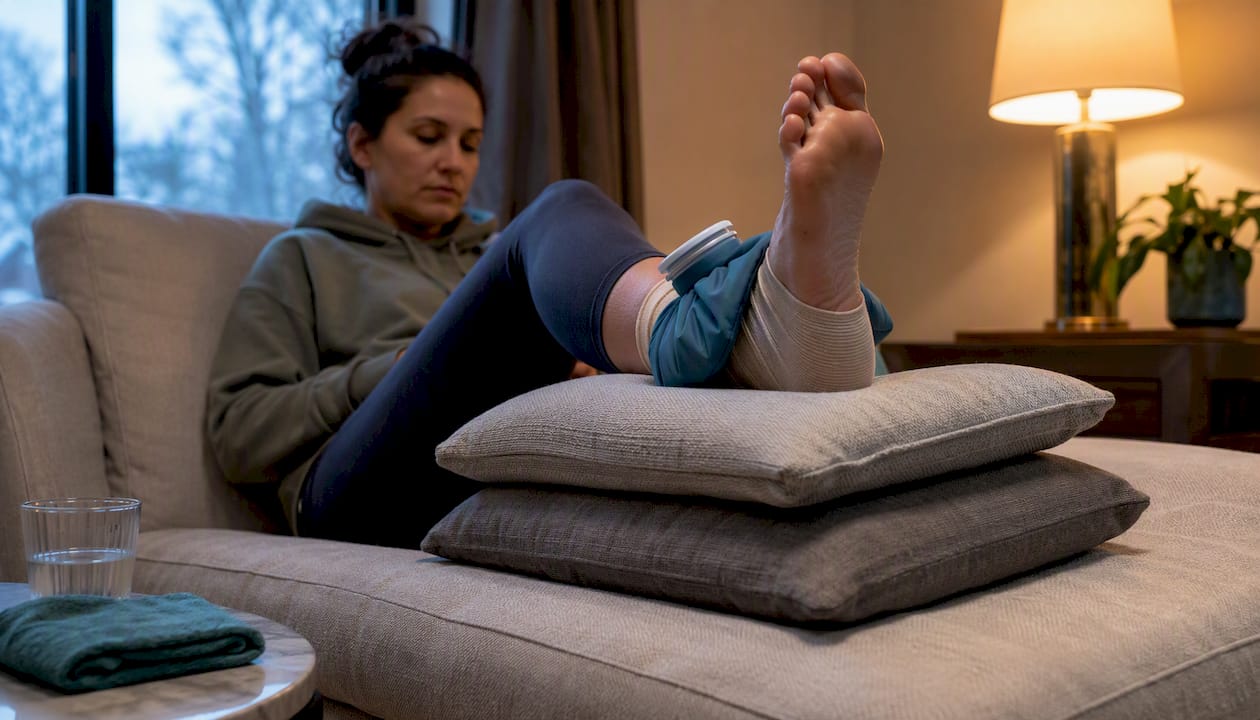
Protect the joint, stop putting weight on it, and start ice, compression, and elevation within the first hour. Combine that with short-term over-the-counter pain relief and you cover the four moves clinicians rely on most for a fresh sprain. Get to urgent care if you cannot bear any weight, see obvious deformity, or notice numbness. The first 48 to 72 hours decide how much swelling you’re dealing with a week from now.
TL;DR:
Protecting the joint within the first hour and sticking to ice, compression, and elevation for the first 72 hours reduces swelling and limits further injury.
Applying ice with a cloth, wrapping snugly but not too tight, and elevating the ankle above heart level optimizes early recovery and prevents complications.
NSAID pain relievers like ibuprofen are preferred during the acute phase to reduce pain and inflammation, but should not be used continuously beyond 10 days without medical advice.
Severity of the sprain dictates recovery time, with Grade I healing within a couple of weeks, while Grade II and III may take several weeks to months and require medical evaluation.
Using comfrey topicals alongside PRICE care can decrease pain and swelling if applied correctly after initial inflammation subsides, but they do not replace professional medical treatment for severe injuries.
Table of Contents
Sprained Ankle Home Treatment: The PRICE, RICE, and MEAT Approach
You’ve probably heard the acronym RICE. Clinicians now favor PRICE (protection, rest, ice, compression, elevation) because it adds a step people skip: protecting the joint from further damage before anything else. A newer variant, MEAT (movement, exercise, analgesia, treatment), enters later in recovery once acute swelling has settled and the goal shifts from limiting inflammation to rebuilding strength. You don’t choose one over the other. PRICE runs the first 72 hours; MEAT-style movement picks up once you can bear some weight without sharp pain.
Here’s the routine Mayo Clinic and similar clinical guidance recommend for the acute phase:
Protect the joint. Stop the activity that caused the injury and avoid putting weight on it. A brace, splint, or even a stiff-soled shoe helps until swelling drops.
Rest, but don’t go rigid. Limit weight-bearing for the first day or two. Total immobility for a week or more usually does more harm than good.
Ice on a schedule. Fifteen to twenty minutes at a time, several times a day, for the first 48 to 72 hours.
Compress. A snug elastic wrap limits swelling and gives the joint some support when you do need to move.
Elevate. Prop the ankle above heart level whenever you’re sitting or lying down.
Most people notice less throbbing and less visible swelling by day three if they’ve stuck to this. Bruising can actually look worse around day two or three as blood pools lower in the foot. That’s normal, not a setback.
Pro Tip: Set a phone timer for your ice sessions. People consistently underestimate how fast 20 minutes passes and end up leaving ice on too long, which risks skin damage on top of the sprain.
How Do You Ice, Compress, and Elevate an Ankle Correctly?
Technique matters here as much as timing. Get it wrong and you either waste the effort or create a second problem.
For ice, always put a thin towel or cloth between the ice pack and your skin. Fifteen to twenty minutes per session, then leave at least 40 minutes before icing again. Skip heat entirely during this acute window. Heat pulls more blood into the area and tends to worsen swelling rather than easing it. Save the heating pad for weeks later, once swelling is gone and stiffness is the main complaint.
Compression comes next. Wrap starting at the point farthest from your heart, typically the toes or foot, and work upward toward the calf. Each layer should overlap the one before it by about half its width.
Tension should feel snug, like a firm handshake, never like a tourniquet.
If your toes tingle, go numb, or change color, the wrap is too tight. Unwrap and start over.
Check your toes periodically throughout the day to confirm circulation is fine.
Elevation works purely on gravity. Stack pillows so your ankle sits above your heart, not just propped on a footrest. Do this especially at night, when hours of horizontal positioning without elevation can undo a full day of progress. In the randomized comfrey trial discussed later, swelling reduction was one of the two primary measures tracked alongside pain, underscoring how much clinical weight elevation and compression carry in recovery.
What Pain Relievers Are Safe for a Sprained Ankle?
Ibuprofen and naproxen are NSAIDs. They reduce both pain and the inflammation driving the swelling, which makes them the more targeted option for the first few days. Acetaminophen handles pain but doesn’t touch inflammation, so it’s a reasonable substitute if NSAIDs upset your stomach or you have a reason to avoid them.
A few safety rules matter more than people expect:
Don’t take over-the-counter pain relievers for more than 10 consecutive days without checking in with a healthcare provider.
If you have liver disease, keep acetaminophen doses conservative and check total daily intake across any combination products.
If you take blood thinners or have a bleeding disorder, talk to a doctor before starting NSAIDs. They increase bleeding risk and can worsen bruising at the injury site.
Pain that keeps climbing despite medication, rather than plateauing, is a signal to get evaluated rather than increase the dose.
How Severe Is Your Sprain, and When Should You See a Doctor?
Ankle sprains fall into three grades, and knowing which one you have changes almost everything about your timeline.
Grade I is a mild stretch of the ligament. You can usually still walk, though it’s uncomfortable, and swelling is minimal. Expect noticeable improvement within 48 hours and near-normal function within one to two weeks.
Grade II involves partial tearing. Walking is difficult, swelling and bruising are more obvious, and the joint may feel unstable. Recovery commonly runs four to six weeks before you’re back to full activity.
Grade III means a complete ligament tear. The ankle may feel loose or give way, swelling is significant, and weight-bearing is often impossible right after injury. These frequently need imaging and sometimes a formal brace or boot, with recovery stretching well beyond six weeks.
Get evaluated promptly if any of these show up:
You cannot bear any weight on the ankle, even briefly, right after the injury.
Pain is concentrated over a specific bone rather than spread across the joint.
Swelling or pain gets worse, not better, after the first two to three days.
You notice numbness, tingling, or a change in skin color in the foot.
Orthopedic guidance is consistent on this point: inability to bear weight or lack of improvement after a few days warrants a visit to rule out a fracture or a complete tear, both of which need a different treatment path than a standard sprain.
Rebuilding Strength: A Simple At-Home Rehab Progression
Once the sharpest pain has faded, usually a few days to a week after a mild sprain, movement becomes the priority instead of the enemy. Staying immobile too long is one of the more common reasons people end up with a chronically unstable ankle.
Start with range of motion. Trace the letters of the alphabet in the air with your big toe while seated. This “ankle alphabet” moves the joint through nearly every direction without loading it.
Add gentle stretching. A towel stretch, looping a towel around the foot and pulling it toward you while seated, helps restore flexibility in the calf and Achilles.
Introduce light resistance. Once alphabet tracing feels easy and pain-free, add resisted movements with a stretch band in each direction.
Work on balance. Single-leg stance, first with support nearby, then without, retrains the small stabilizing muscles that prevent re-injury.
Progress to heel raises and light impact. Two-legged heel raises come first, then single-leg raises, then light hopping once those feel stable.
A rough weekly guide: range of motion in week one, resistance and balance work in weeks two through four, and light impact training from week three or four onward, depending on how quickly pain resolves. MedlinePlus notes that delaying load-bearing exercise too long tends to increase stiffness and raises the risk of long-term instability, so cautious movement generally beats prolonged rest.
Pro Tip: If balance on the injured ankle still feels noticeably worse than the uninjured side after two to three weeks of consistent exercise, that’s a cue to see a physical therapist rather than push through on your own.
Does Comfrey Help a Sprained Ankle? What the Research Shows
Comfrey is the best-studied topical option for ankle sprains, and the data is more substantial than most home remedies people reach for. A randomized, placebo-controlled trial of 142 patients found that topical comfrey extract, applied four times daily for eight days, produced a statistically significant reduction in both pain and swelling compared with placebo, with a p-value below 0.0001 for pain specifically. A separate multicenter trial of 164 patients went further, comparing comfrey root extract directly against diclofenac gel, a standard topical NSAID, and found comfrey performed as well or better on several pain and swelling measures.
That’s a meaningfully stronger evidence base than most plant-based topicals can claim.
A few safety rules apply regardless of which topical you choose:
Apply only to intact skin. Never use on open wounds without checking the label.
Comfrey and other herbal topicals are for external use only. Ingesting comfrey carries known toxicity risks, so oral use should be avoided entirely.
Check labels for age limits and any listed contraindications before use.
Treat topical products as an addition to PRICE, not a replacement for ice, compression, and elevation, especially in the first 72 hours.
When Can You Start Putting Weight on a Sprained Ankle?
Timing this step wrong is one of the most common ways a simple sprain turns into a lingering problem. The general rule: let pain guide load, not the calendar.
For a Grade I sprain, gentle weight-bearing often starts within a day or two, as soon as you can put weight on the foot without sharp, localized pain. A limp is fine. Sharp pain is not. For Grade II sprains, partial weight-bearing with a brace or supportive wrap typically begins after several days, once swelling has started to recede. Grade III sprains usually need a period of protected weight-bearing in a boot or brace, sometimes with crutches, before any unsupported walking.
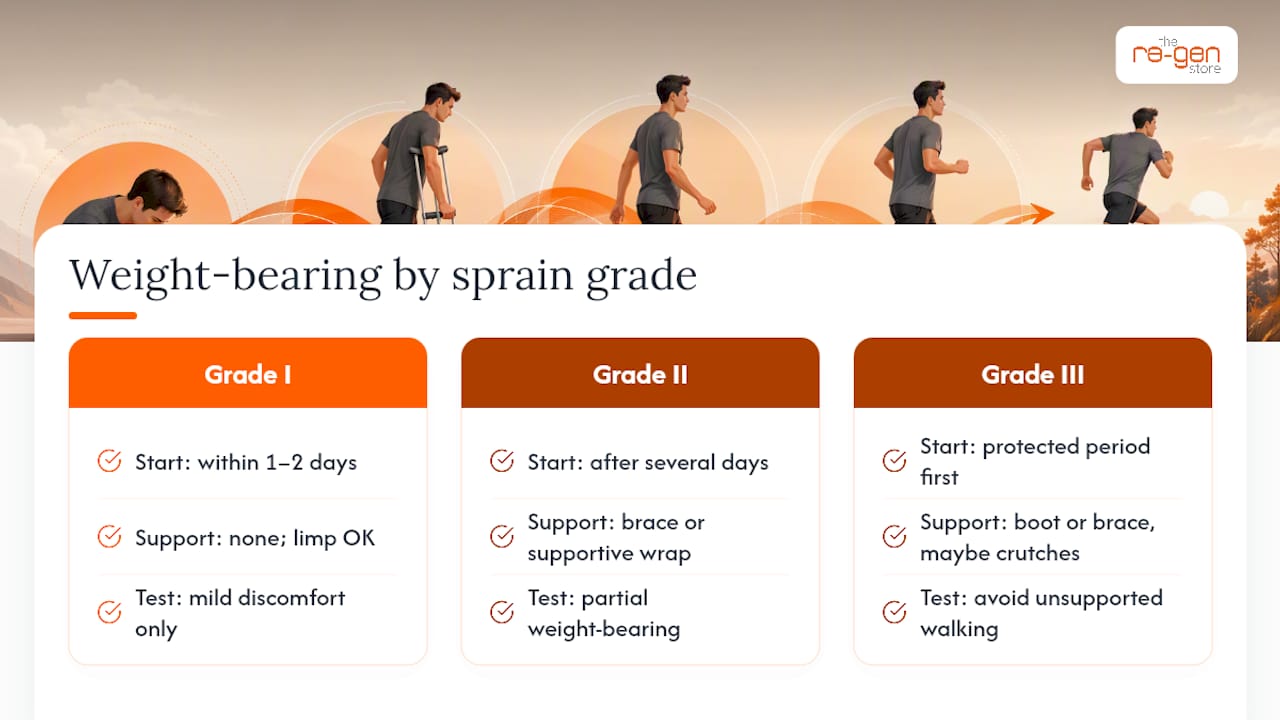
A practical test: stand on the injured ankle and shift your weight slowly. If you feel stability and only mild discomfort, try a few steps. If the ankle buckles, feels loose, or the pain sharpens, back off and give it another day or two. Pushing through instability, rather than pain alone, is what tends to cause repeat injuries.
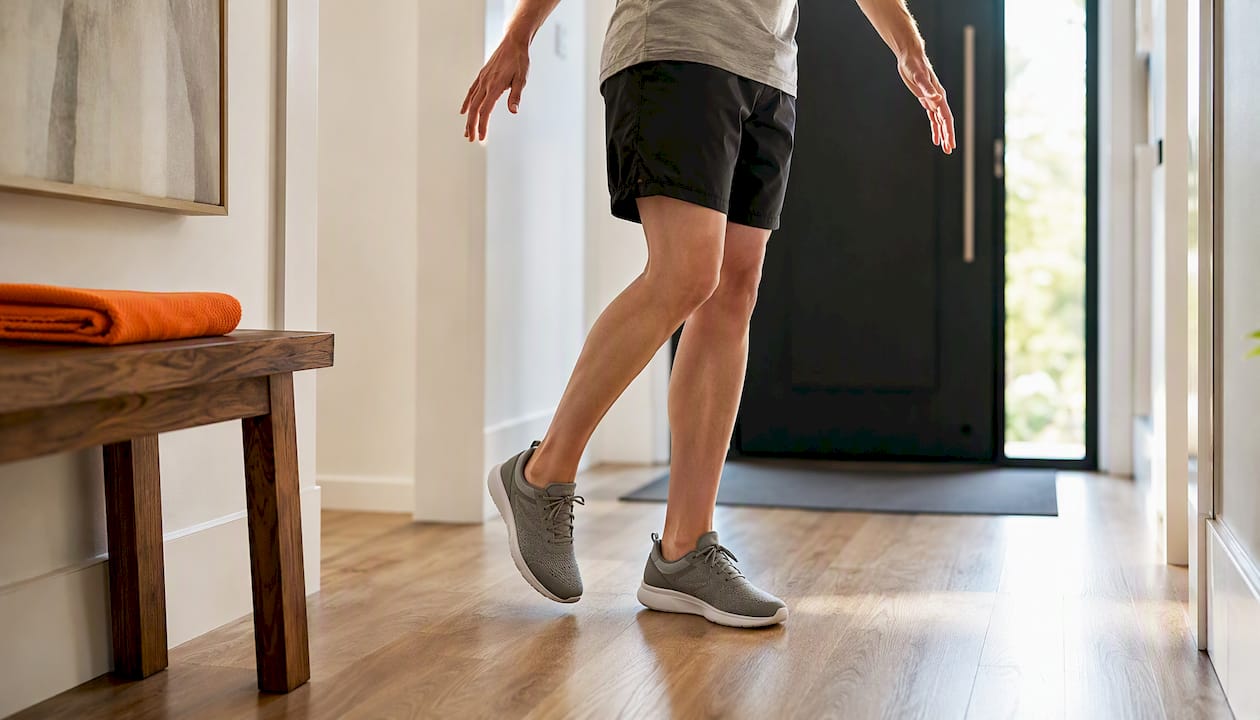
Footwear matters more than people think during this transition. A supportive, stable shoe rather than a flexible sneaker or sandal gives the healing ligaments extra support while proprioception, your ankle’s sense of where it is in space, is still recovering. Many people also benefit from an ankle brace for the first one to two weeks of return to full walking, even after pain has largely resolved, simply because the stabilizing muscles haven’t caught up yet.
If weight-bearing hasn’t improved noticeably by day four or five, that’s a reasonable point to check in with a healthcare provider rather than keep waiting it out.
Could It Be More Than a Sprain? Watch for These Complication Signs
Most sprains heal without incident, but a small number develop complications that need medical attention beyond standard home care. Knowing the difference protects you from a much bigger problem down the line.
Infection is rare with a sprain unless the skin was broken, but if you notice increasing redness that spreads rather than fades, warmth that intensifies rather than cools, or drainage from any break in the skin, along with fever, that combination needs prompt evaluation.
Deep vein thrombosis is the more serious concern, particularly with prolonged immobilization. Watch for swelling that’s asymmetric and dramatically worse than expected, calf pain or tenderness separate from the ankle itself, warmth in the calf, or skin that looks unusually red or discolored higher up the leg. These symptoms, especially when they appear days after the initial injury rather than immediately, warrant urgent medical review rather than a wait-and-see approach.
A third pattern worth flagging: pain and swelling that plateau, then suddenly worsen again after several days of steady improvement. That reversal often signals either a missed fracture, a developing infection, or overuse before the tissue was ready, and it’s a clear cue to stop self-treating and get evaluated.
None of this means you should treat every twinge as an emergency. It means the acute phase deserves attention, not just the injury itself. If something about your recovery doesn’t match the timeline described earlier in this article, that mismatch is the signal to act on.
Home Remedies That Can Slow Down Ankle Sprain Healing
A few well-meaning habits routinely undo the progress of otherwise solid home care.
Heat too early is the most common mistake. A heating pad feels good on a sore joint, but during the first 48 to 72 hours it increases blood flow to the area and worsens swelling rather than easing it. Save heat for the later stiffness phase, well after acute swelling has resolved.
Alcohol near the injury, whether as a topical rub or consumed to “take the edge off” pain, also increases inflammation and swelling. The NHS specifically advises against alcohol during the acute phase for this reason.
Vigorous massage on a fresh sprain is another common misstep. Deep tissue work on inflamed ligaments can aggravate swelling rather than resolve it. Gentle lymphatic-style stroking toward the heart, done lightly, is a different matter, but deep massage should wait until acute inflammation has passed.
Wrapping too tight overnight deserves its own caution. A compression wrap left on too snug for hours while you sleep, without periodic circulation checks, risks numbness and tissue damage. If you wrap for sleep, keep tension looser than daytime compression and check your toes before bed.
Skipping rest entirely because the pain feels tolerable is the last common trap. Walking normally on a sprain before swelling has settled tends to prolong the inflammatory phase and delays the point where real rehab can start.
Returning to Sports and High-Impact Activity Safely
Getting back to running, jumping, or cutting sports too early is the single biggest driver of repeat ankle sprains, and repeat sprains compound into chronic instability far more easily than a first injury does.
Before attempting any high-impact activity, confirm three things: full pain-free range of motion, the ability to walk normally without a limp, and balance on the injured leg that’s close to matching the uninjured side. If any of those three isn’t there yet, impact activity waits.
Once those benchmarks are met, ease back in with a graded approach. Start with straight-line jogging on a flat, predictable surface. Add cutting movements, direction changes, and jumping only after jogging feels completely stable. Sport-specific drills come last, ideally with a brace or supportive taping for the first several outings back.
A stiff, supportive shoe or a proprioceptive brace during this window isn’t a sign of weakness. It’s a practical way to reduce the odds of the same ligament giving out again while the surrounding muscles finish catching up. Many physical therapists recommend keeping a brace on for competitive sports for several months after a moderate or severe sprain, even once function feels fully normal.
If your ankle swells again after activity, feels unstable during quick direction changes, or aches for more than a day after a session that used to feel routine, that’s your body telling you the progression moved faster than the tissue could handle. Dial back a stage and give it another week before trying again.
Our Take on Plant-Based Support for Sprain Recovery
Theregenstore was built around a simple premise: recovery products should be honest about what they do. Topical plant-based options like comfrey have real, randomized evidence behind them, not just tradition, and that distinguishes them from most shelf remedies that lean on marketing rather than trial data. We treat that evidence seriously, which means we’re equally serious about the limits. A topical ointment supports the skin and soft tissue around a healing joint. It does not replace ice, compression, elevation, or a clinician’s evaluation when a sprain looks severe.
Our approach is adjunct-first: use standard PRICE care as the backbone of recovery, and let a plant-based topical support the surrounding tissue alongside it. For readers who want a deeper dive into recovery timelines, our guide on healing sprains faster covers more ground, and our piece on distinguishing tendonitis from a sprain helps if you’re not entirely sure what you’re dealing with.
— Kyle
Where Re-gen Fits Into Your Recovery Routine
Once you’ve got the ice, compression, and elevation steps handled, a topical option can support the skin and soft tissue around the joint while it heals. Re-gen is a plant-based, petroleum-free ointment built for exactly that role, applied to intact skin after your PRICE routine as an adjunct, not a substitute for medical care.

Such ointments are formulated without petroleum or synthetic fillers, which matters if you’re specifically trying to avoid conventional antibiotic ointments during recovery. For a sprain, that means applying topical products to the skin around the injured area once swelling has been addressed through ice and elevation, letting the topical do its part while the mechanical basics do theirs. If your sprain looks severe, meaning you can’t bear weight, the joint feels unstable, or pain keeps climbing, see a clinician before relying on any topical product alone. To see the full formulation and usage details, visit the Re-gen product page, or browse the Emerald Green option if you want to compare formulations. Every order ships at a flat rate of $3.
Sources
FAQ
What Is the Fastest Way to Cure a Sprained Ankle?
There’s no way to make a sprain heal overnight, but you can minimize swelling and pain fastest by starting PRICE (protection, rest, ice, compression, elevation) within the first hour. Consistent icing every few hours for the first 48 to 72 hours, paired with elevation and a snug compression wrap, gives you the best shot at a shorter, less painful recovery.
Is It Okay to Walk on a Sprained Ankle?
It depends on the grade. Mild (Grade I) sprains often allow gentle weight-bearing within a day or two if pain permits, while moderate or severe sprains typically need several days of limited weight-bearing, often with a brace, before walking normally. If you cannot bear any weight right after the injury, that’s a sign to seek medical evaluation rather than push through it.
How Long Does It Take for a Sprained Ankle to Heal on Its Own?
A mild Grade I sprain often improves within 48 hours and returns to near-normal function in one to two weeks. Grade II sprains typically need four to six weeks, and Grade III sprains, involving a complete ligament tear, can take well beyond six weeks and sometimes require specialist care.
Should You Wrap a Sprained Ankle Overnight?
You can, but keep overnight compression looser than daytime wrapping and check your toes for numbness, tingling, or color change before sleeping. A wrap that’s too tight for hours without monitoring risks cutting off circulation, so many people find elevating the ankle on a pillow overnight, with or without a light wrap, works just as well for controlling swelling.
Does Comfrey Actually Help With Sprained Ankle Swelling?
Yes, based on randomized trial data. An 8-day trial of topical comfrey found significant reductions in both pain and swelling compared with placebo, and a separate trial found it performed comparably to diclofenac gel. It works best as an adjunct to standard PRICE care, applied to intact skin, not as a stand-alone treatment for a severe sprain.
Recommended
Comments