
48–72 Hour Window: Clinically Backed Muscle Strain Recovery at Home

Protect the injured area, start P.R.I.C.E. within the first hour, and keep weight off it as needed for the first 48 to 72 hours. Manage pain with acetaminophen or short-term ibuprofen, and add gentle isometric holds once sharp pain fades. If you felt a pop at the moment of injury, can’t bear weight, or notice numbness, see a healthcare provider right away.
TL;DR:
Protect the area with gentle ice, compression, elevation, and avoid prolonged sleep under pressure to reduce swelling and prevent further injury.
Use acetaminophen for pain relief initially, but avoid aggressive NSAID use right after injury, as it may hinder early tissue repair.
Incorporate isometric contractions after sharp pain subsides, gradually progressing to gentle range-of-motion and resistance exercises based on pain levels.
Recovery timelines vary by injury severity, with mild strains healing in weeks and complete tears taking several months, emphasizing patience and gradual return to activity.
Seek medical evaluation if symptoms worsen after three to seven days or if signs like severe pain, loss of function, or visible deformity appear.
Table of Contents
Muscle Strain Recovery at Home: The First 48 to 72 Hours
Muscle strain recovery at home starts with protecting the tissue before it starts healing. The window right after injury matters most, and getting it right can shave real time off your recovery.
The classic framework is P.R.I.C.E., an update to the older R.I.C.E. method that adds “protect” to the front:
Protect the area from further strain. Avoid movements that reproduce the pain.
Rest the muscle, but don’t go fully sedentary. Total immobility can stiffen tissue and slow healing.
Ice for 15 to 20 minutes every 2 to 3 hours while you’re awake, for the first two to three days.
Compression with a snug (never tight) wrap to limit swelling and support lymphatic flow through proven compression therapy benefits.
Elevation, raising the limb above heart level when you can.
A few practical details make this work better:
Put a thin towel between ice and skin. Direct ice on skin for 20 minutes can cause frostbite.
If your fingers or toes go numb or tingly under a wrap, loosen it immediately.
For a leg strain, prop it on pillows while lying down. For an arm, a sling works during the day.
Remove ice packs and compression bandages before prolonged sleep periods. Sleeping under compression can cut off circulation without you noticing.
Braces, slings, or crutches have a place for more severe strains, particularly lower-limb injuries where weight-bearing is painful. Use them only as long as needed. Overusing a brace once you can move comfortably slows the muscle’s return to normal strength.
What’s Safe for Muscle Strain Pain Relief?
Over-the-counter pain relievers can make the first few days tolerable, but the timing matters more than most people realize.
Acetaminophen is generally the safer first choice for pain because it doesn’t interfere with inflammation. Ibuprofen and naproxen work too, but some research suggests that aggressive NSAID use immediately after an injury may blunt the early inflammatory response your body needs to start repairing tissue. If you’re unsure which is right for you, especially with kidney issues, stomach conditions, or other medications, check with a pharmacist or doctor before regular use.
Beyond pills, you have several non-drug options:
Icing on the schedule above
Menthol topical rubs, which can ease perceived pain enough to move more comfortably
Light massage once you’re past the acute swelling phase (usually after 48 to 72 hours)
Gentle pressure or wraps that shift your brain’s attention away from sharp pain signals
Pro Tip: Menthol products and light massage don’t heal the strain directly, but they can make the difference between avoiding movement out of fear and moving enough to keep tissue from stiffening.
How Do You Safely Move a Strained Muscle?
Total rest feels like the safe choice, but it’s often the wrong one. Muscle tissue heals with some mechanical stress, not none. Isometric contractions, where you contract the muscle without moving the joint, create that stress without the risk of a full-range movement re-tearing the fibers.
Here’s a simple progression to follow once sharp pain has eased to a dull ache:
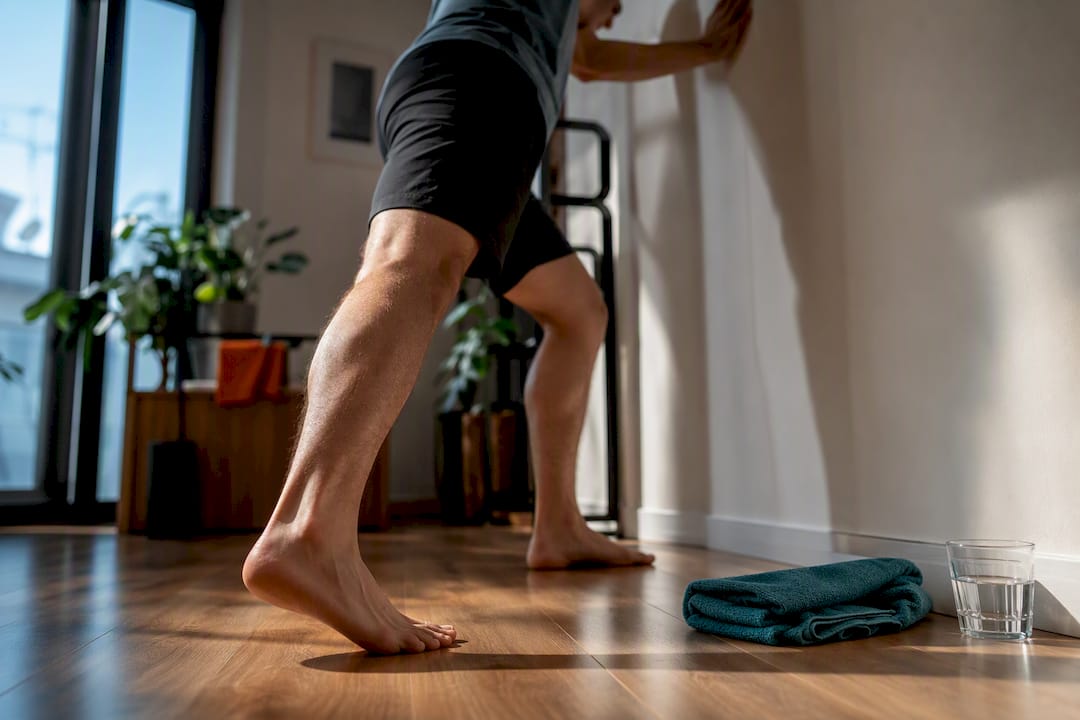
Start with isometric holds. For a hamstring, press your heel into the floor while lying down and hold for about 30 seconds. For a calf, press the ball of your foot against a wall. For a shoulder strain, gently squeeze your shoulder blades together.
Repeat 3 to 5 times, resting between holds, once or twice a day.
Add gentle range-of-motion once isometrics feel easy and pain-free, moving the joint slowly through its comfortable arc.
Introduce light resistance (a resistance band, light dumbbell) only once full range-of-motion feels normal.
Stop immediately if you feel sharp or stabbing pain, sudden swelling, or you can’t bear weight the way you could a moment before. Those are signs you’ve pushed too far, too fast.
Pro Tip: Judge progress by function, not the calendar. If you can do yesterday’s exercise with less discomfort today, you’re ready to add a little more. If not, hold steady another day or two.
Nutrition and Sleep for Muscle Strain Recovery
What you eat and how much you sleep directly shapes how fast repaired muscle fibers rebuild.
Aim for roughly your body weight in pounds multiplied by 0.36 grams of protein per day as a baseline, spread across meals rather than loaded into one sitting.
Get 7 to 9 hours of sleep a night. Deep sleep is when much of the tissue repair work actually happens.
Stay hydrated, and lean on easy, nutrient-dense foods like soups, smoothies, and fruit when eating feels like effort.
If you have kidney disease, a restricted diet, or signs of malnutrition, talk to a dietitian before increasing protein intake on your own.
When Should You See a Doctor for a Pulled Muscle?
Most mild to moderate strains heal fine with home care. Certain signs mean it’s time to stop self-treating and get evaluated.
Watch for these red flags:
Severe pain that doesn’t ease with rest or OTC medication
A pop or snap felt at the moment of injury
Complete loss of function, such as being unable to bear weight or lift your arm
Visible deformity, a lump, or a gap in the muscle
Numbness, tingling, or a cold, pale limb
Swelling or bruising that’s rapidly worsening rather than settling
Timeline matters too. If you see no improvement after three to seven days of consistent home care, or if symptoms are getting worse instead of better, schedule a visit. A clinician may run a physical exam and, if needed, order an ultrasound or MRI to check for a more severe tear. From there, you might get a referral to physical therapy or, in serious cases, orthopedics. Before your appointment, jot down how the injury happened, what activities aggravate it, and take a photo of any visible swelling or bruising to show changes over time.
How Long Does Muscle Strain Recovery Take by Grade?
Setting realistic expectations up front prevents the single biggest cause of re-injury: going back to activity too soon.
Grade 1 (mild): A few overstretched fibers. Usually heals within a few weeks.
Grade 2 (moderate): Partial tearing. Recovery often runs several weeks to a couple of months.
Grade 3 (severe): A complete tear. Healing can take four to six months, especially when surgery and up to six weeks of immobilization are involved.
Age, prior injuries to the same muscle, other health conditions, and how closely you follow your rehab plan all speed up or slow down that timeline. Rather than counting days, watch for real milestones: pain-free range of motion, strength that matches your uninjured side, and the ability to handle progressively heavier loads without symptoms flaring back up.
A Week-by-Week Home Rehab Plan for Muscle Strains
A rough map helps more than a rigid schedule, since every strain heals at its own pace.
Week 0 to 1: Protect the area, ice on schedule, keep movement pain-limited, and start isometric holds as soon as sharp pain allows.
Weeks 2 to 4: Build range of motion and add light strengthening. Begin reintroducing functional movements, like walking normally or lifting light objects.
Week 4 and beyond: Progress to heavier strengthening and movements specific to your sport or job. Return to full activity gradually, not all at once.
If progress stalls at any point, plateauing pain, strength that won’t improve, or swelling that keeps returning, bring in a physical therapist. They can identify compensations you can’t see or feel yourself and adjust loading before a plateau turns into a setback.
Pro Tip: Treat each week’s progress as a checkpoint, not a deadline. Muscle tissue doesn’t care what day of the calendar it is; it cares whether the load you’re asking it to handle matches what it can currently tolerate.

Balancing Clinical Steps With Natural Support
Recovery works best when you respect both sides: the clinical framework and thoughtful support for the tissue itself. I’ve spent enough time around this topic to trust the data on P.R.I.C.E., isometrics, and NSAID timing over shortcuts. What gets underrated is that comfort measures, done right, help you stick to the plan instead of avoiding movement out of fear. If a red flag shows up, function comes first. Get evaluated. You can read more about how I approach recovery topics on the author bio page.
— Kyle
Supporting Skin Comfort During Muscle Strain Recovery
Most muscle strains don’t happen in isolation. Scrapes, minor abrasions from a fall, or general skin irritation around a wrapped or braced area often come along for the ride, and that’s where Re-gen earns its place in a recovery kit. Re-gen is a plant-based, chemical-free topical ointment, built to support skin comfort and minor soft-tissue irritation without the synthetic ingredients found in conventional antibiotic ointments.

Re-gen isn’t a treatment for the strain itself, and it’s not a substitute for the P.R.I.C.E. protocol, isometric progressions, or a clinician’s exam when red flags appear. Think of it as support for the skin around the injury: minor abrasions from a fall, chafing under a compression wrap, or general skin comfort while you’re focused on the muscle underneath. It’s not intended for deep tears or open wounds beyond minor abrasions, and anything beyond that calls for medical attention. If your recovery involves broken skin alongside the strain, browse the plant-based wound treatment options or check out the Re-gen ointment product page to see if it fits your situation.
Where to Learn More About Muscle Strain Recovery
Mayo Clinic’s muscle strain guide covers diagnosis, treatment, and when imaging is warranted.
Harvard Health’s recovery timeline breakdown explains grading and realistic healing windows.
Harvard Health on pain management details non-drug pain-modulation techniques.
Theregenstore’s sprain recovery guide applies similar at-home principles to a related injury type.
Sources
FAQ
What is the fastest way to heal a muscle strain?
There’s no shortcut around tissue repair time, but you can avoid slowing it down by starting P.R.I.C.E. immediately, controlling pain without overusing NSAIDs early on, and adding isometric movement as soon as pain allows.
How can you tell if a muscle is strained or torn?
A strain (partial tear) usually causes pain, tightness, and some loss of strength, while a complete tear (grade 3) often comes with a pop felt at the moment of injury, a visible gap or deformity, and a near-total loss of function in that muscle.
What should you avoid doing with a pulled muscle?
Avoid aggressive stretching, heavy loading, or “working through” sharp pain in the first few days, and skip icing while asleep or leaving compression wraps on overnight, since both raise the risk of numbness or slowed healing.
Can you massage out a muscle strain?
Light massage can ease perceived pain and support movement once you’re past the initial swelling phase, typically after 48 to 72 hours, but deep or aggressive massage on a fresh, severe strain can aggravate the injury.
Recommended
Comments